





Loudly is an AI music platform that covers more of the production chain than most of its competitors: it generates tracks from a text prompt or a parameter panel, remixes material from its own catalogue or from an upload, splits finished songs into stems, and sells the same generation engine through a public API.
Our review of the Loudly AI music generator sets out what the platform is, how its main tools behave in practice, what the plans cost, where the output still trails the category leaders, and which creators should adopt it. The short answer: Loudly has the widest toolkit of any platform in the cleared-music category and is one of the few a developer can build on, but its licence is tied to an active plan, and its vocals remain behind Suno's.
What the Loudly AI Music Generator Is
Loudly runs in the browser at loudly.com. There is no dedicated Loudly mobile app; the company's separate Music Maker JAM product is a different tool, which is worth knowing because the two are occasionally confused in older listings.
The platform positions itself across four audiences: content creators who need music for video, independent musicians and producers, brands and agencies, and developers who want generation inside another product. That last group explains a design decision that shapes the whole product: the same engine that powers the web interface is exposed through a documented API, which is unusual in a category where most vendors keep generation closed.
Two boundaries are worth setting before the review proper. Loudly is a generator with an editing layer rather than a digital audio workstation, so the tools steer a generated track instead of assembling one from recorded parts. And the catalogue-based remixer works on material the platform has cleared, so it is a different proposition from uploading your own recording. Arriving with the wrong expectation is the fastest way to conclude, incorrectly, that the product is thin.
How Loudly Works in Practice
The workflow is short, and the official documentation describes four routes that cover almost everything the platform does. Understanding which route suits which task is most of the learning curve.
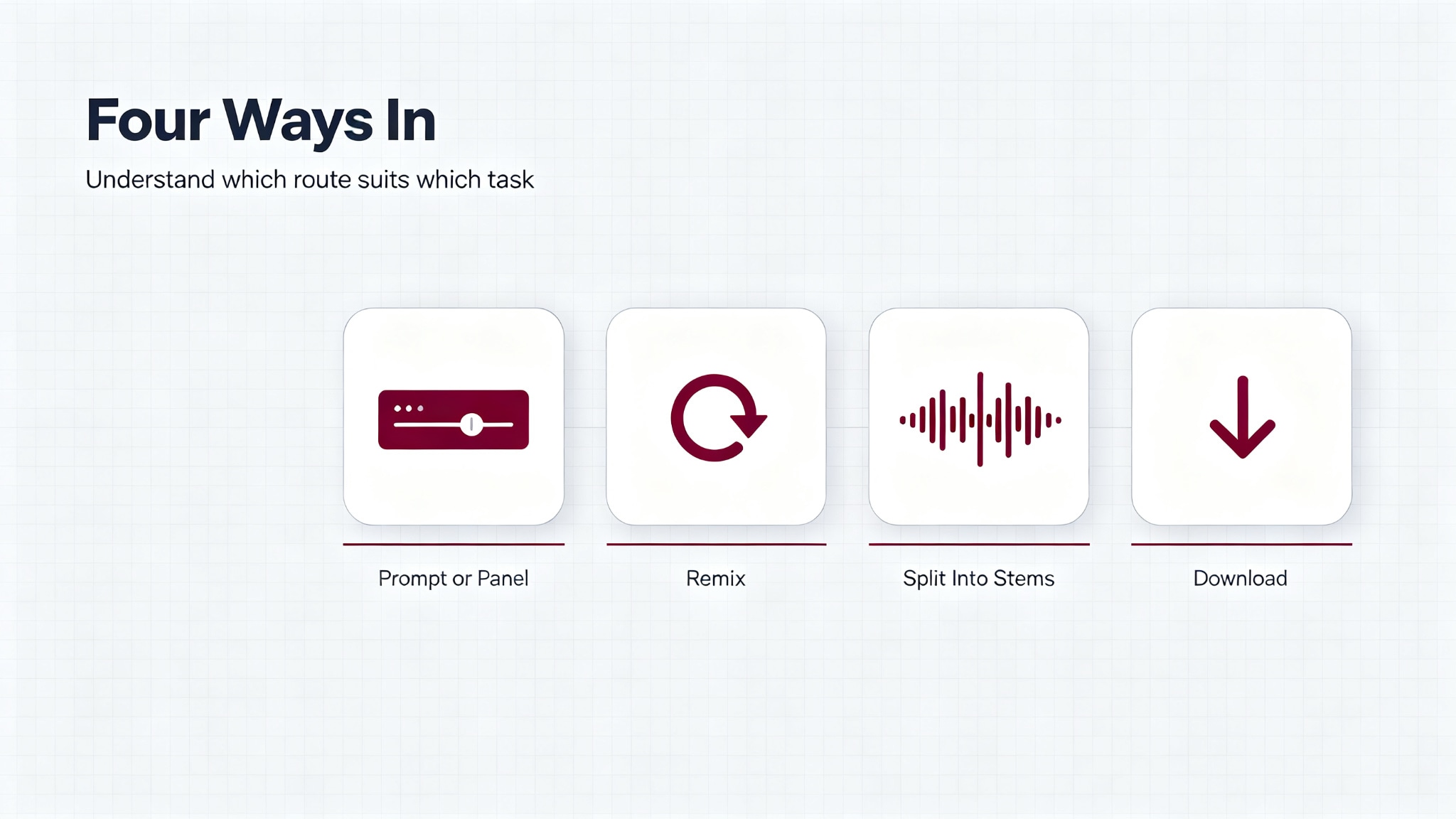
Start from a prompt or from the Song Formula panel
There are two entry points and they produce different kinds of control. A text prompt is the fastest route: describe a mood, a genre or a scene and let the model interpret it. The Song Formula panel is the opposite approach, exposing sliders for genre, energy, instrumentation, structure, tempo and key. In practice the panel is the better starting point for background music that has to sit under a voiceover, because you can fix the energy level before generating rather than auditioning generations until one happens to fit.
Remix from the catalogue or from your own upload
The remixer takes an existing piece of audio and reshapes it: a different arrangement, a different instrument set, a different treatment of the same underlying idea. It accepts the platform's own catalogue and uploaded audio, with the standard expectation that you bring material you have the rights to use. For teams that need a family of related cues from one source idea — a theme and four variations, for example — this is far faster than prompting five separate tracks.
Split a finished track into stems
The stem splitter separates a finished mix into vocals, drums, bass, guitar and synth as separate WAV and MP3 files. This is the feature that changes what the platform is for. Once a track can leave as parts, Loudly stops being a source of finished audio and becomes a source of material you can rework in a DAW, drop under a scene, or hand to an editor who needs only the drum bed.
Download, and check what your plan permits
Downloads run to MP3, WAV and stem packages, and availability is governed by the plan rather than by the platform as a whole. That distinction matters more here than on most competitors, because Loudly's usage terms are attached to the plan rather than to the file, and the terms are the part of this product that most needs a careful read.
What the Loudly AI Music Generator Gets Right
Three advantages held up when we read the platform's own documentation alongside independent testing published this year, and they shape who the product suits.
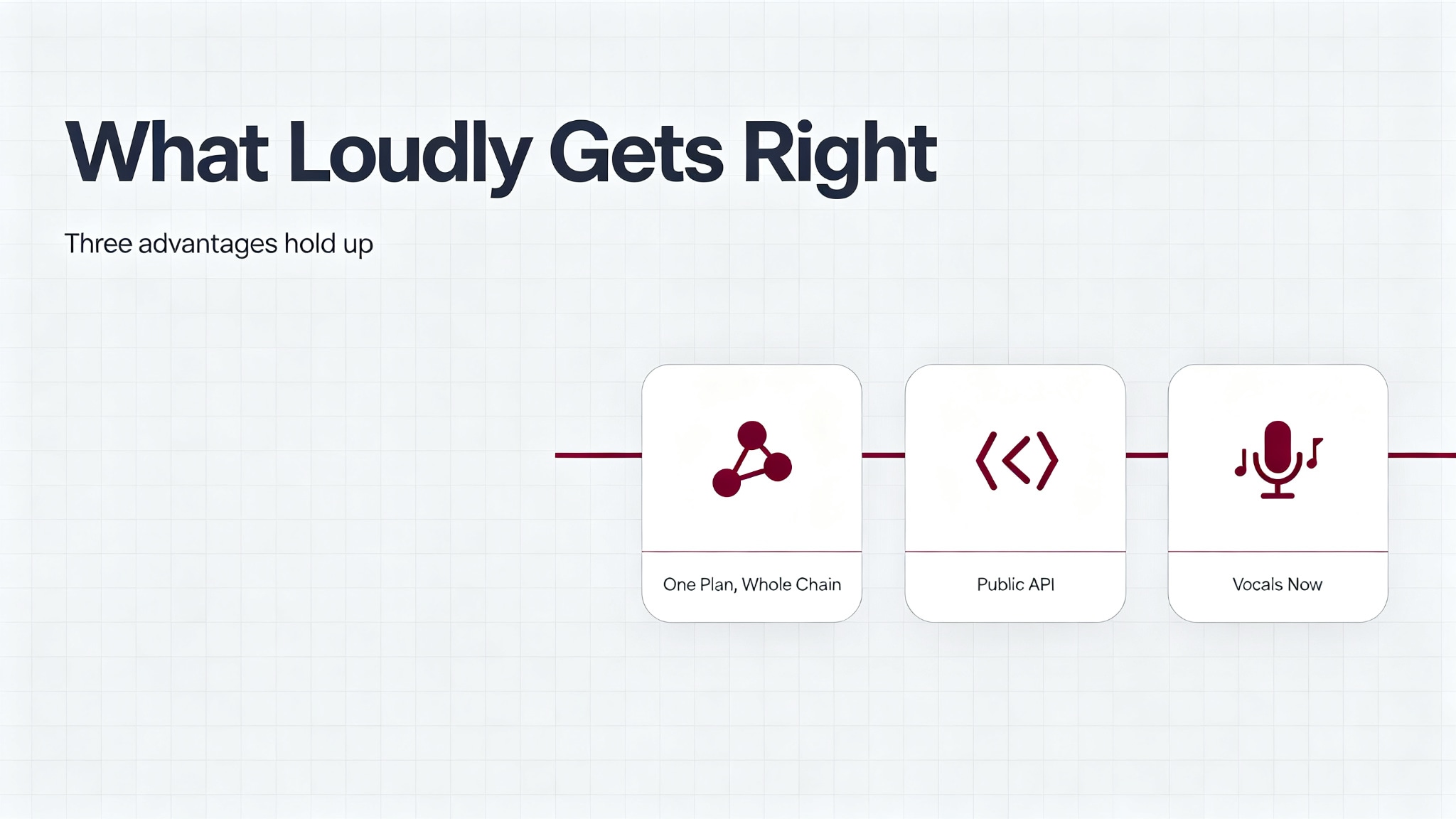
One plan covers the whole chain
Generation, remixing, sample generation and stem separation sit inside the same interface and the same credit pool. The alternative — using one tool for the song, another for stems, and a third for a variation — costs both money and time, and the friction is highest exactly where deadlines are shortest. Loudly's breadth is the clearest reason creators stay once they have learned the panel.
A public API that most competitors do not offer
The developer API exposes text-to-music, parameterised generation, stem extraction and playlist generation, with usage-based pricing and enterprise arrangements. For a product team that wants generated music inside an app or an internal tool, this removes the need to build a pipeline around a consumer interface. It is also the single feature that most obviously separates Loudly from the rest of the category.
Vocals, which arrived after most reviews were written
The company's current model generation supports full songs with vocals and lyrics, alongside the instrumental models that carried the platform through its earlier years. Much of the popular coverage still describes Loudly as an instrumental-only tool, which was accurate when it was written and is not accurate now. Buyers who skipped the platform on that basis should re-evaluate it.
Pricing and Credits
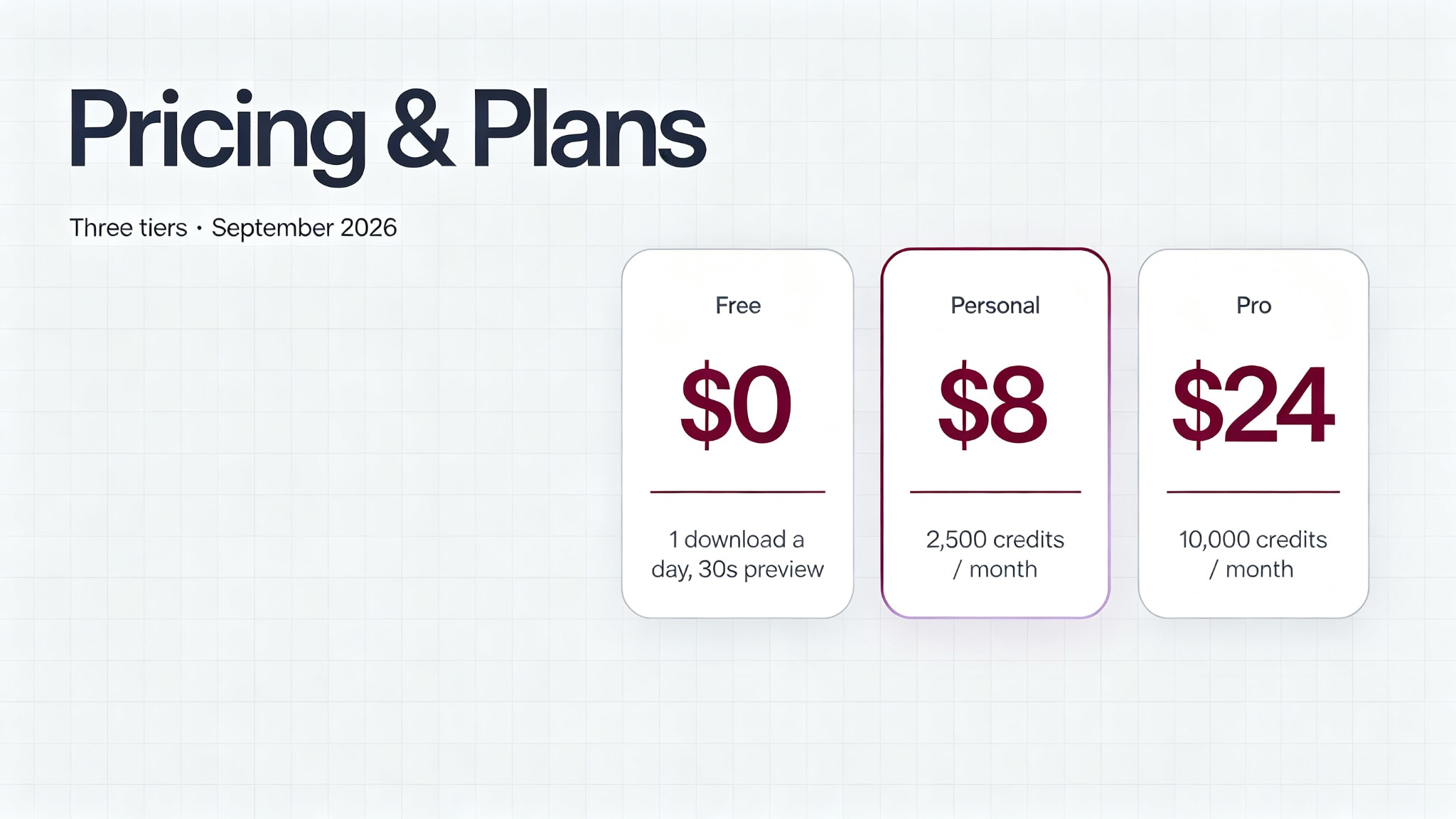
As of September 2026, Loudly lists three tiers on its official pricing page. The free tier allows one download a day with a preview limited to 30 seconds, and it excludes commercial use.
Personal is quoted at $8 per month billed annually, or $96 for the year, with 2,500 credits per month and a maximum track length of seven minutes. Pro is $24 per month billed annually, or $288 for the year, with 10,000 credits per month and a maximum length of 30 minutes. Both paid tiers export MP3 and WAV.
The detail that matters more than the headline price is what the money buys in practice. Credits are consumed by generation, remixing and stem work, so the plan number is a budget for the whole workflow rather than a count of finished tracks. Independent reviews put the effective cost of a usable track in the low cents on the entry tier, which makes Loudly one of the cheaper paid options in the category — provided the terms suit you, which brings us to the main commercial question below.
One caution about the numbers: several third-party listing sites quote Loudly's paid tiers at $14.99 and $39.99 per month, which does not match the vendor's own page. Prices and credit allowances sit with Loudly and have changed more than once, so check the official pricing page for the current plans rather than relying on any summary, including this one.
Compare what a plan includes.
Enkio plans include AI music video generation, templates, and watermark-free downloads depending on your plan.
Real Limitations
The limitations we found are mostly commercial and structural rather than technical, and they deserve the same attention as the strengths.
The licence is tied to an active plan
Loudly grants a licence to use its output; it does not transfer ownership, and the terms attach the licence to a paid plan. The practical consequence is that stopping your payment can affect what you may keep doing with tracks you already generated and published. For a one-off project that is a minor consideration.
For a channel, a podcast or a client library built on hundreds of Loudly tracks, it is the central risk, and it is worth deciding how much platform change you are willing to absorb before you build on it. Platforms do change hands and terms: for a worked example of how a licensing model can be rewritten by an acquisition, see our Riffusion AI music generator review.
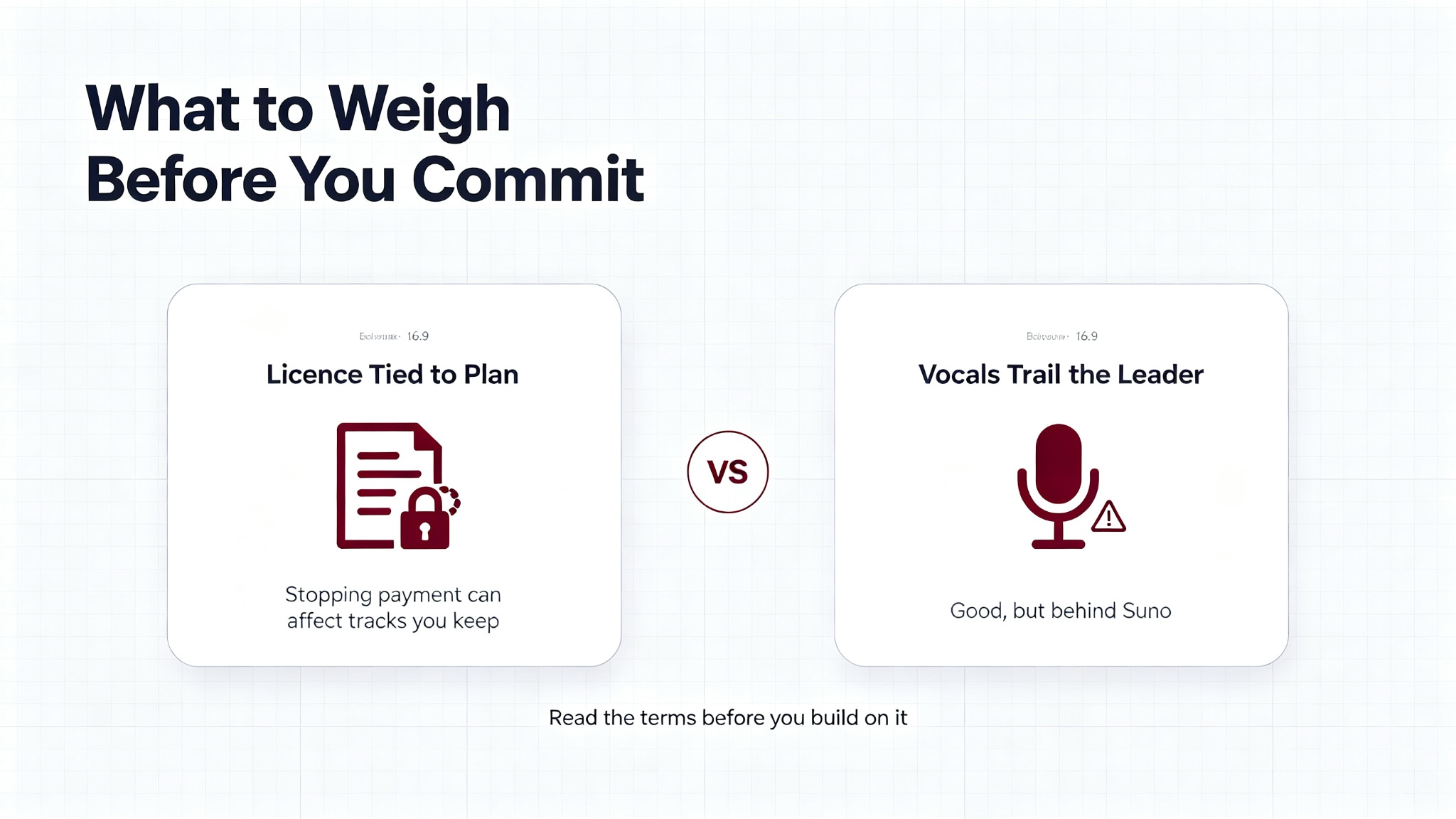
Vocals still trail the leaders
Independent testing continues to place Loudly's vocals behind Suno's on naturalness and emotional range. The gap is narrower than it was, and for a hook over a beat it is often not decisive. It becomes decisive when the vocal is the product rather than one element of it, which is the case for singer-songwriter material and for anything where listeners will compare the performance to human recordings.
Repeats, Content ID flags and the platform's own claims
User complaints collected on Trustpilot describe two related frustrations: generated beats that repeat more than expected, and tracks being matched by Loudly's own content identification system, which can leave creators defending work they generated on the platform. The reported resolution rate on those disputes is the part we would want a vendor to improve, because content identification friction is the fastest way to turn a music tool into an administrative problem.
Support and billing
The same complaint sources describe unanswered support requests, refunds refused, and difficulty cancelling auto-renewals, and the vendor's aggregate Trustpilot rating sits in the low band with a small number of reviews. A small review base amplifies each report in both directions, so we treat this as a signal rather than a verdict — but it is a signal worth weighing before committing a team to an annual plan.
How It Compares With Suno in 2026
The two platforms come up in the same purchase decision often enough that a short table is useful, even though they are aimed at somewhat different buyers.
| Dimension | Loudly | Suno |
|---|---|---|
| Primary approach | Prompt or parameter panel, plus catalogue remixing | Prompt-led song generation |
| Typical strength | Breadth of tools, stems, API access | Vocal naturalness and mix polish |
| Vocals | Supported, behind the leader on realism | The reference point in the category |
| Stem and WAV export | Available on paid tiers | Available on higher tiers |
| Public API | Yes, documented and usage-priced | Not a documented consumer API |
| Free tier | One download a day, no commercial use | Daily credit allowance, non-commercial |
| Entry paid price | $8 per month billed annually | Around $10 per month |
| Best fit | Content pipelines, developers, background music | Songwriting, vocals, release-ready tracks |
Both columns are a snapshot as of September 2026, and both platforms revise models and quotas frequently, so treat the table as a starting point rather than a settled ranking. If the vocal is what decides your purchase, weigh it against the platforms covered in our AI music video and music generator reviews, which apply the same four-question format to every tool in this series.
The 2026 Vocal Update and What It Changes
The arrival of a vocal-capable model generation changed the shape of the product, and it explains why so much published advice about Loudly is out of date. Reviews written before that release describe a purely instrumental tool that you would pair with a separate vocal generator; that arrangement is no longer necessary, though the instrumental models remain available and remain the better choice for background work where a vocal would only compete with dialogue.
What the update does not change is the ordering at the top of the category. Adding a capability and leading on that capability are different achievements, and the independent testing we reviewed is consistent that Loudly is now a complete platform rather than the best vocalist.
Common Misconceptions
Two assumptions about Loudly circulate widely, and each one leads people to a decision they later revise.
Misconception one: Loudly does not generate vocals
This was true for most of the platform's life and is repeated in a large share of current listings and comparison articles. Anyone who ruled the product out on that basis in an older evaluation is working from a description that no longer matches the tool. The instrumental models still exist, but they are now one option rather than the only one.
Misconception two: royalty-free means full ownership
Loudly's catalogue is built from material the company licenses, and the plan you buy determines what you may do with the output. That is a usage licence, which is a different thing from holding the underlying rights. Companies in this category vary in how they word this, and the wording is what governs your situation, so read Loudly's terms of use directly rather than relying on any summary, including this one.
Who the Loudly AI Music Generator Is For Right Now
The verdict splits by what you need after the track exists. Loudly suits content teams that want one workspace for generation, variation and stems; agencies that need a volume of cleared cues under a predictable monthly cost; and developers, for whom the public API settles the decision on its own. It also suits brands and studios that need instrumental beds they can edit, because the stem export is what makes that possible.
It is a weaker fit in four cases: anyone whose project depends on the most convincing vocal available, where Suno remains the reference point; creators who need a track library they can keep using indefinitely regardless of whether they keep paying; anyone who wants a pure instrumental tool at the lowest possible price, where a template-driven platform built for background music is usually the better fit; and anyone whose main concern is dispute handling, where the user reports above suggest caution.
From a Loudly Track to Something You Can Publish
The step after the music is the part Loudly does not cover. A finished audio file does not publish to TikTok, Shorts, Reels or YouTube on its own, because those platforms want video, and that is where a second tool becomes necessary.
Enkio's AI music video generator takes a finished track plus a visual direction and returns a music video, with 720p and 1080p output across five aspect ratios including 9:16 and 16:9, on a credit model rather than per-video purchases. The sequencing is straightforward, and a Loudly stem package makes it more flexible than most: you can send the full mix for a performance cut or send stems and let the edit follow the drums. Check the current plans and credit costs on Enkio's pricing page before you build a release around it.
One reminder applies whichever route you take: platform policies on AI-generated content differ, and several major platforms expect disclosure when a track or video is machine-generated. Check the destination platform's current guidelines before publishing, particularly if monetisation is the goal.
Make more from your MV.
Let Enkio create a complete AI music video from your song with cinematic templates.
Frequently asked questions
These are the questions we see most often about the Loudly AI music generator, answered for the platform as it stands.
Is the Loudly AI music generator free to use?
There is a free tier, and it is an evaluation allowance rather than a working one: one download a day, a short preview, and no commercial use. It is enough to hear whether the platform's sound suits your project and not enough to build one. Check the official pricing page for the current free limits.
Does Loudly generate vocals now?
Yes. The current model generation produces full songs with vocals and lyrics, which is the single biggest difference between the platform described in older reviews and the product on sale now. Vocal quality is good rather than best in class, so test a generation with your own material before committing.
How much does Loudly cost?
As of September 2026, Loudly quotes Personal at $8 per month billed annually, or $96 for the year, and Pro at $24 per month billed annually, or $288 for the year, with a limited free tier beneath them. Allowances are quoted in credits per month rather than in finished tracks. Prices sit with Loudly and have changed, so verify them on the official pricing page.
Can I use Loudly tracks commercially?
The paid tiers are licensed for commercial use and the free tier is not, which is the short version. The longer version is that the licence is attached to your plan, it does not transfer ownership of the underlying rights, and it can be affected by whether your plan stays active. Read Loudly's terms of use for the terms that apply to your situation.
Do I keep the rights to tracks after I cancel?
This is the question to resolve before you build anything substantial on the platform, and it is a contractual question rather than a technical one. Industry reporting and user reports point in different directions on how much survives cancellation, so treat the terms of use as the only reliable source and read them before you commit to an annual plan.
Does Loudly have an API?
Yes. The company documents a music API covering text-to-music, parameterised generation, stem extraction and playlist building, with usage-based pricing alongside its consumer plans. That puts it in a small group of generators that a product team can integrate directly, and it is the main reason technical buyers shortlist the platform.
Conclusion
Loudly earns its place on breadth. Very few platforms in this category let you generate a track, reshape it, split it into stems and drive the whole thing from an API under one plan, and that combination is worth real money to content teams and product teams alike.
The two things to weigh against it are specific rather than vague: the licence is bound to an active plan, which matters enormously for anyone building a library, and the vocals, while real, are not the reason to choose the tool. If your work is background music, high-volume content or integration, Loudly is one of the strongest options in the category right now. If the vocal performance is the product, test it against the leader before you commit — and either way, read the terms before you build on it.