





Mureka is an AI music generator that turns a description, a set of lyrics, or a reference clip into a complete song with vocals, and its distinguishing idea is simple to state: the platform plans a song's structure before it generates any audio. Our review covers what the Mureka AI music generator is, how that planning step changes the workflow, what the plans cost, where the output trails the category leader, and who should adopt it. The short answer, after working through the official documentation and the independent testing published this year: Mureka is the strongest option in 2026 for producers who want coherent structure and DAW-ready exports, and not yet the right choice for anyone who needs the most natural vocals available.
What the Mureka AI Music Generator Is
Mureka runs in the browser at mureka.ai and is developed by the team behind the Skywork AI assistant, backed by Kunlun Tech. The official product covers song generation with vocals and text-to-speech side by side, which is why the paid plans are quoted in songs and in minutes of speech rather than in songs alone.
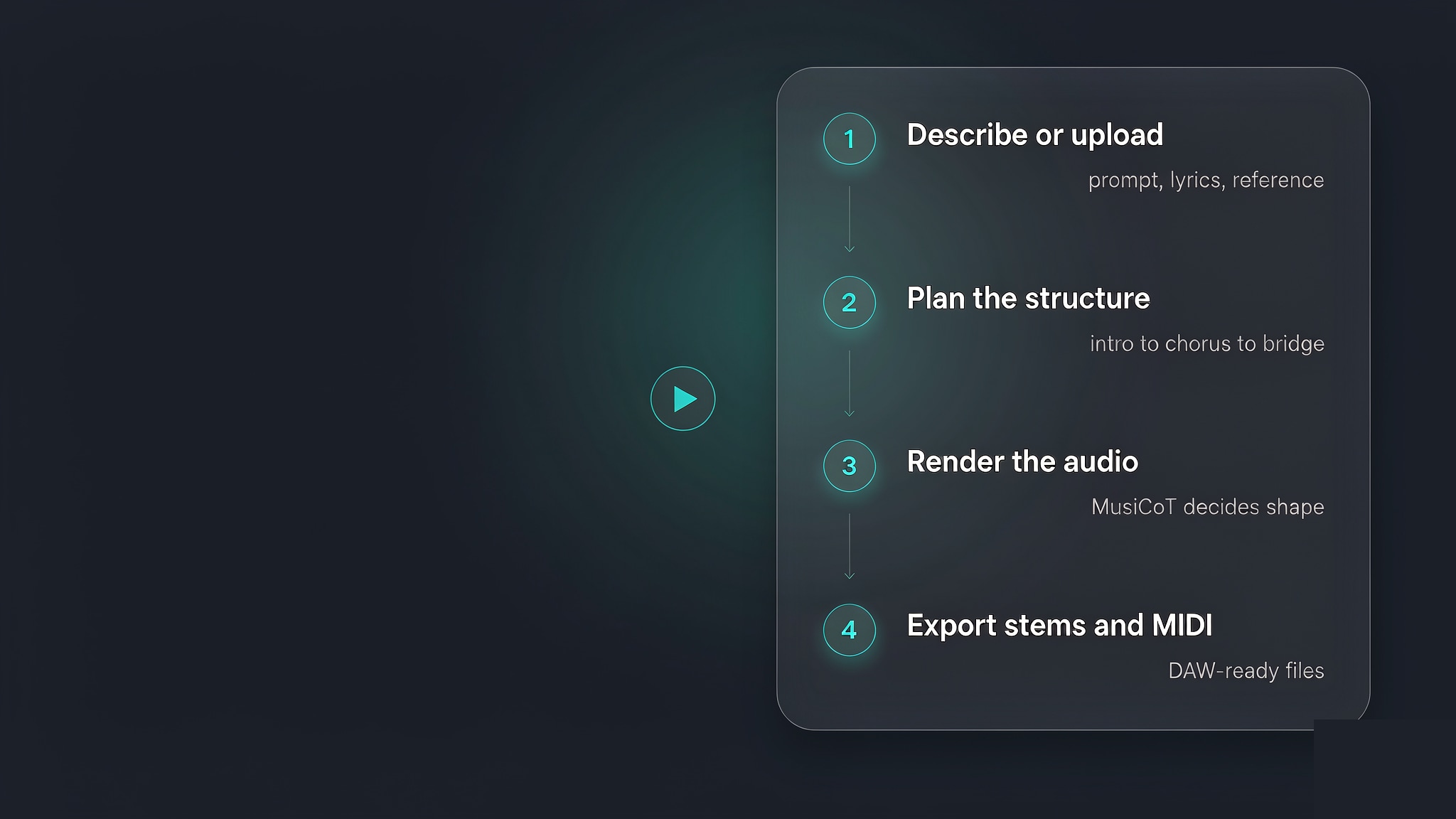
The premise matches the rest of the category: you describe what you want and receive a finished track rather than an instrumental loop. What differs is where the intelligence is applied. Most generators synthesise a whole piece in a single pass; Mureka plans first. Its MusiCoT method — music chain-of-thought, described in the company's own technical materials — works out the arrangement, the movement from intro to verse to chorus to bridge, before any audio exists. The company's argument is that deciding the shape of a song before rendering it produces more coherent results than generating everything at once.
Two boundaries are worth setting before the review proper. Mureka is a browser tool with an API behind it rather than a desktop application, and it is a generator with an editing layer rather than a digital audio workstation. The tools inside it steer a generated song; they do not assemble one from recorded parts. Arriving with the second expectation is the fastest way to conclude, wrongly, that the product is thin.
How MusiCoT Builds a Song
The workflow is short and the official documentation lays it out clearly. Understanding the four choices below is most of what you need, because everything else in the product is a variation on them.
Start with a prompt, your own lyrics, or a reference track
Mureka accepts three kinds of input, and they produce meaningfully different results. A plain description is the fastest route and the least controlled: you describe a mood, a genre, or a scene and let the model interpret it. Your own lyrics give you authority over the words while the platform handles the melody.
A reference track is the third option, and the one producers tend to prefer, because a reference communicates a sound rather than a genre label. Bring audio you have the rights to use, since the output follows what you feed it.
Choose between Basic and Advanced mode
Basic mode is a description box and an optional genre. Advanced mode exposes the inputs that matter for production work: a title, a lyrics field, a choice of vocal preset, a reference upload, and melody input. The documentation positions Basic for speed and Advanced for control, and the distinction holds up in practice. Basic tells you whether the platform's sound suits you; Advanced is where a project actually gets built.
Let the structure get decided before the audio
This is the step that separates Mureka from a one-pass generator. Instead of sampling continuous audio straight from your prompt, the system first decides what the song is: where the intro ends, how the chorus is approached, whether there is a bridge at all. You can take part in it too, since the editing tools regenerate or extend a chosen region rather than the whole track.
Pick a model, and accept the cost difference
Mureka exposes several generations of its own model at the same time, and they are not priced alike. The higher-quality model costs more credits per song than the faster ones, which makes the selector a budget control as much as a quality control. Most people settle into a pattern: cheaper renders while the prompt is still moving, the higher-quality model once the direction is settled.
If you are still deciding which platform to commit to, our roundup of Suno AI music generator alternatives puts Mureka beside the tools it usually competes with on price and output.
What the Mureka AI Music Generator Gets Right
Three advantages held up when we read the independent testing published in 2026 alongside the platform's own documentation, and they are consistent across reviewers.
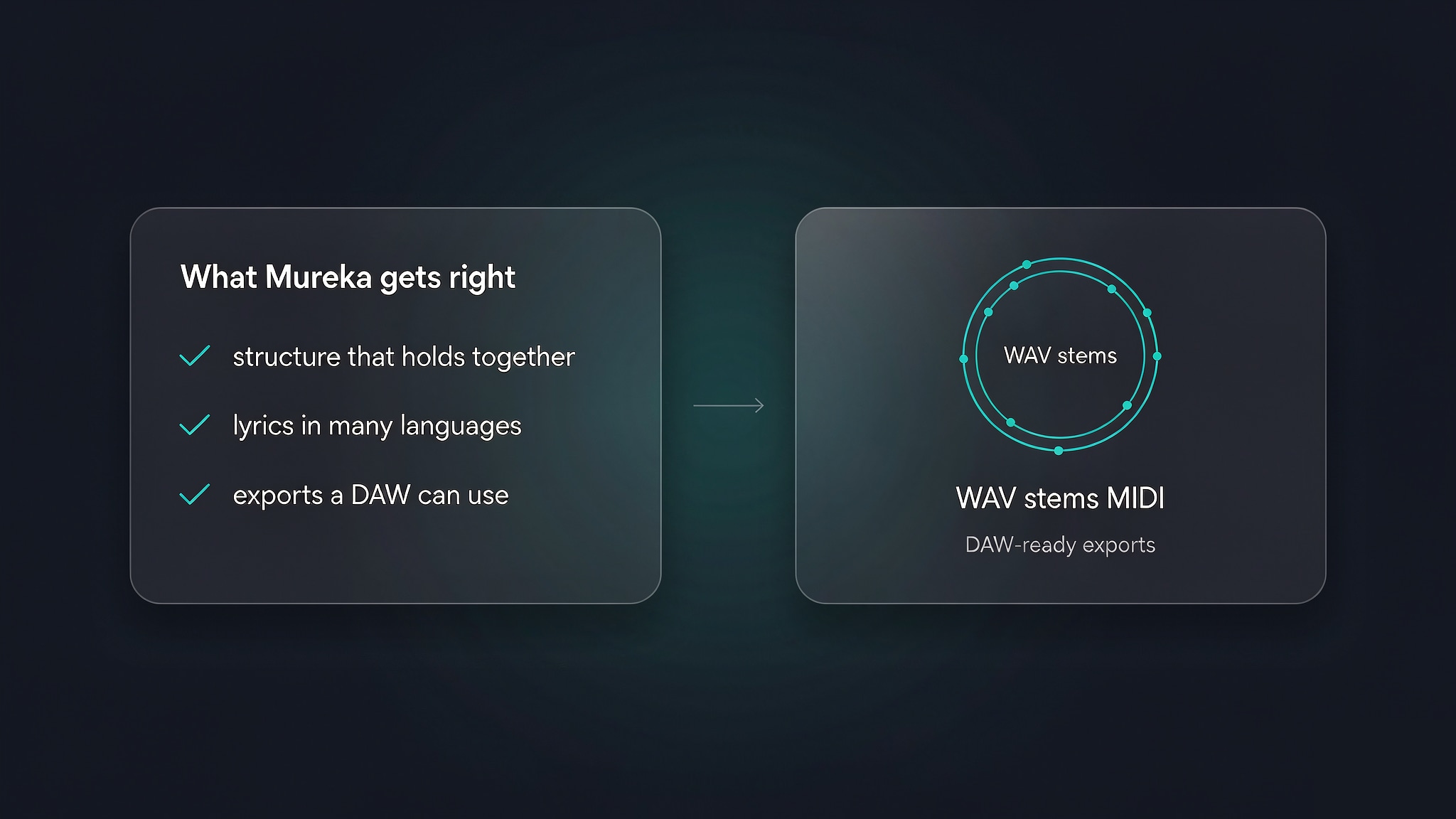
Song structure that holds together
The most consistently reported strength is arrangement. Where one-pass generators drift — a chorus that arrives without preparation, a section that repeats because the model lost the thread — Mureka's output tends to behave like a song made of parts. Reviewers testing it against the incumbent describe better rhythmic precision and a clearer sense of progression. That matters most where structure carries the listener: pop, rock, and anything with a hook that has to land in the right place.
Lyrics in more than English
Multilingual lyric generation is the second consistent advantage, and a larger deal than it sounds. Most of the category is tuned around English, and output in other languages often carries phrasing a native speaker notices immediately. Reviewers who test both English and non-English output place Mureka ahead of the incumbent here. If your audience is not primarily English-speaking, this capability can settle the comparison on its own.
Exports that survive contact with a DAW
The higher tiers offer WAV downloads, separated stems, MIDI, and in some cases a project file. That is unusual for a consumer text-to-song tool, and it changes the role the platform plays: rather than a finished track you either accept or discard, Mureka becomes an idea source that feeds a production workflow. It is also why the platform shows up in producer communities more than in casual creator discussions.
Pricing and Credits
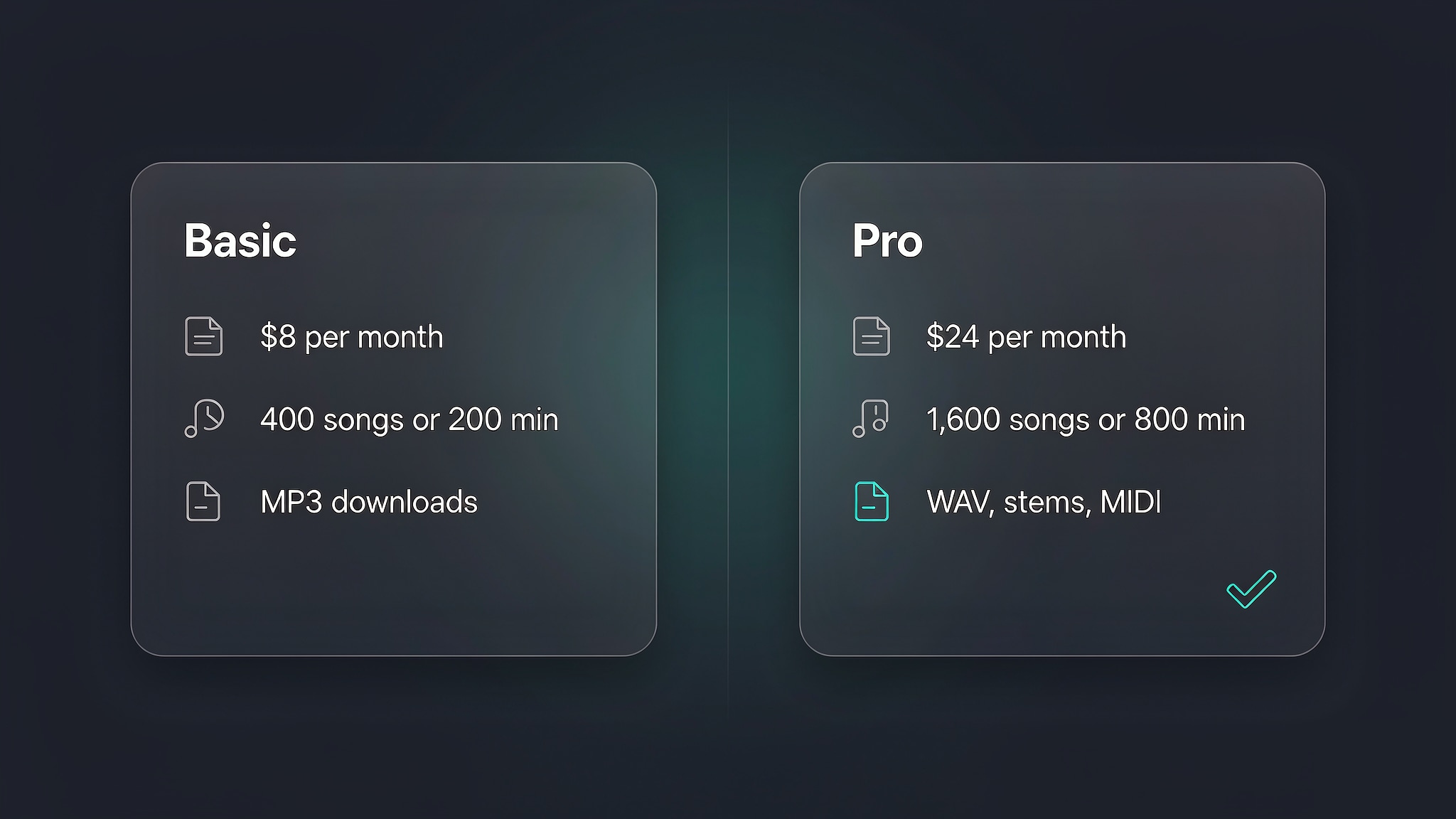
As of September 2026, Mureka lists a free tier and two consumer plans, with the API priced separately. Basic is quoted at $8 per month billed annually, or $96 for the year, covering up to 400 songs or 200 minutes of speech per month, with MP3 downloads, a priority queue, and up to 10 concurrent jobs.
Pro is $24 per month billed annually, or $288 for the year, raising the ceiling to roughly 1,600 songs or 800 minutes of speech and adding WAV and instrumental downloads, stem and MIDI export, reference audio uploads, voice cloning, and video export. Commercial licensing is included on the paid plans; the free tier is not licensed for it.
Two details we kept coming back to matter more than the headline price. Songs and speech are not separate budgets: the allowance is quoted together, so a team using both draws from one pool. And credits are not denominated in songs but in an internal currency whose cost per song depends on the model you select, which makes an exact cost per finished track harder to calculate than the plan table implies. Third-party comparisons put the realistic figure at a few cents per song on the entry tier, and note that monthly credits do not carry over while top-up packs are sold separately.
Prices, allowances, and export options are set by Mureka and have moved before, so verify the current plans on Mureka's pricing page rather than relying on any summary, including this one.
Compare what a plan includes.
Enkio plans include AI music video generation, templates, and watermark-free downloads depending on your plan.
Real Limitations
The limitations we found in 2026 are mostly about polish and predictability rather than capability, and an honest review needs that side of the story.
The vocals and the mix still trail the category leader
Independent hands-on reviews published in 2026 describe Mureka's vocals as very good rather than the best available, with less naturalness and less emotional range in English than Suno's, and mixing that is slightly less polished. The most quoted critique comes from the producer Rick Beato, whose A/B comparison of the two platforms found Suno markedly stronger and singled out Mureka's guitar tones. If a track has to stand on its vocal performance rather than its arrangement, this comparison decides the purchase.
The credit system is harder to forecast than the plan table
Because different models burn credits at different rates, and because songs, speech, and editing operations all draw on the same pool, the number on the plan page does not tell you how many usable tracks you will finish. Monthly credits do not roll over, and top-ups are sold separately rather than charged automatically. Budget for failed attempts, because the platform rewards iteration and iteration costs credits.
The free tier is an evaluation tool, not a workspace
The free allowance is small — a few generations a day in practice — and it excludes commercial licensing, with downloads limited to MP3. Treat it as a way to hear the platform's output before paying, not as somewhere to build a project. That is a normal arrangement in this category, but it is worth being explicit about, because a demo-grade free tier is the most common source of disappointment with any of these tools.
Documentation, support, and ecosystem gaps
Mureka is the smaller platform, and it shows in the places that are hard to measure. The API's pricing is less transparent than the consumer plans, independent reviewers report that lyric edits can come back slightly altered or truncated, and the community around the tool is thinner than the incumbent's, which matters when you are searching for a fix at midnight. Reviewers also flag billing and support as recurring complaints.
How It Compares With Suno in 2026
In our comparison, these two are usually the only realistic options in the decision, so a short table helps.
| Dimension | Mureka | Suno |
|---|---|---|
| Generation approach | Plans song structure before rendering audio | Generates a song in a single pass |
| Typical strength | Arrangement coherence, multilingual lyrics, exports | Vocal naturalness, mixing polish, easy hits |
| Vocals in English | Very good, slightly behind | The reference point in the category |
| Languages | Strong across non-English lyrics | Weaker outside English |
| Export options | WAV, stems, MIDI, project files on higher tiers | WAV and stems on higher tiers |
| Programmatic access | Public API with usage-based pricing | Not a documented consumer API |
| Entry price | $8 per month billed annually | $10 per month |
| Free tier | A few generations a day, no commercial licence | Daily credit allowance, non-commercial |
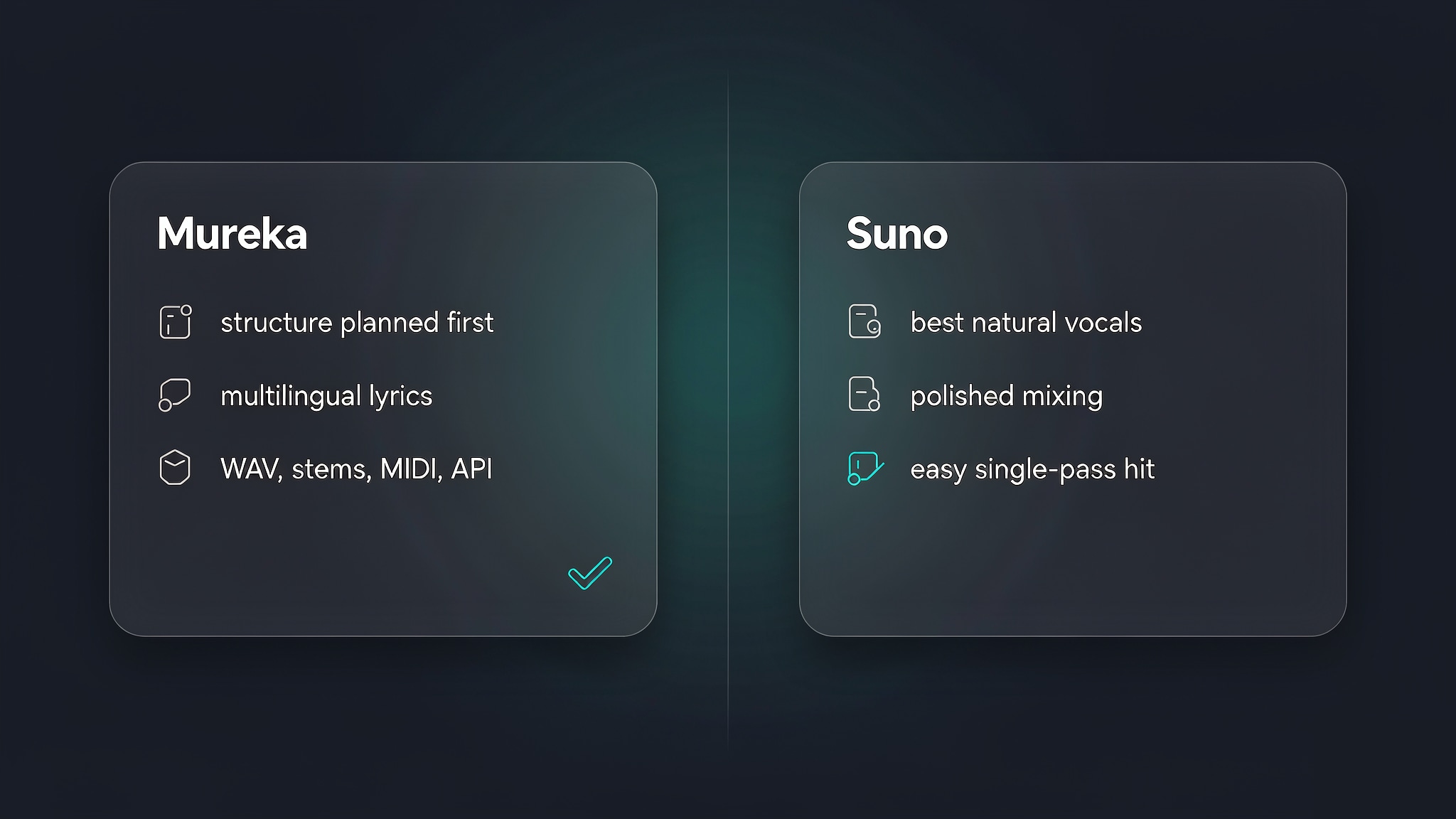
Both columns are a snapshot as of September 2026, and both platforms update their models and quotas frequently, so treat the table as a starting point rather than a settled ranking. For a deeper read on the incumbent, see our Suno AI music generator review.
Reading the Benchmarks and the Backlash
Mureka's marketing leans on blind-test leaderboards, and the claims deserve a fair reading rather than dismissal. On the Artificial Analysis comparison, as of mid-2026, Mureka's current model sits second in both the instrumental and vocal categories, behind the latest Suno release and ahead of other well-known models. Being the closest competitor to the category leader is a real position to hold.
The caveat is where the numbers travel. Much of the leaderboard coverage circulates through material connected to the company's own investor communications, and the samples behind Mureka's rating are a fraction of the leader's, which makes a single rating less stable than it looks. Independent hands-on testing points the same way on structure and multilingual output, and the opposite way on vocals.
Common Misconceptions
Two assumptions about Mureka circulate widely, and each one leads people to a decision they later revise.
Misconception one: the newest model is the best choice
Mureka exposes several model generations at once, and the newest costs more credits per song than the older ones. That makes it tempting to treat the newest as the default. In practice the older models are worth using deliberately: for prompt iteration, for instrumental beds, and for anything you will regenerate repeatedly, the cheaper model gets you to a decision faster and at lower cost.
Misconception two: a paid plan settles the licensing question
A paid plan unlocks commercial licensing, which is not the same as settling every question about how a track can be used. Terms cover what you may do with the output, how attribution works, and what happens if a release is distributed. Read Mureka's terms of use directly for the current terms instead of relying on a summary, including this one.
Who the Mureka AI Music Generator Is For Right Now
The verdict splits by what happens after the song is generated. Mureka suits songwriters and producers who want a structured starting point they can take apart — the stem and MIDI exports make that possible — and anyone producing in languages other than English, where its advantage is clearest. It is also a sensible pick for teams that need programmatic access, since a public API is unusual in this category.
It is a weaker fit for three groups: anyone whose project depends on the most convincing vocal performance available, which currently points elsewhere; creators who want a complete, catchy song from a single prompt with no iteration; and anyone who needs a predictable flat monthly cost rather than a metered one.
From a Mureka Track to Something You Can Publish
The step after the song is the one Mureka does not cover. A finished audio file does not publish to TikTok, Shorts, Reels, or YouTube on its own, because those platforms want video — and that is where a second tool becomes necessary.
Enkio's AI music video generator takes a finished track plus a visual direction and returns a music video, with 720p and 1080p output across five aspect ratios including 9:16 and 16:9, on a credit model rather than per-video purchases. The sequencing here is straightforward, because Mureka's exports make it easier than most: once a track leaves the platform as a WAV, the video step is minutes of work. Check the current plans and credit costs on Enkio's pricing page before you build a release around it.
One reminder applies whichever route you take: platform policies on AI-generated content differ, and several major platforms expect disclosure when a track or video is machine-generated. Check the destination platform's current guidelines before publishing, particularly if monetisation is the goal.
Make more from your MV.
Let Enkio create a complete AI music video from your song with cinematic templates.
Frequently asked questions
These are the questions we see most often about the Mureka AI music generator, answered for the platform as it stands.
Is the Mureka AI music generator free to use?
There is a free tier, and it is an evaluation allowance rather than a working one: a few generations a day, MP3 downloads, and no commercial licensing. Most people who continue with the platform move to a paid plan within a week or two, because the free allowance is not large enough to finish a project. Check Mureka's official site for the current free limits.
Can I download songs and stems from Mureka?
MP3 downloads are available on every paid tier, and the higher tier adds WAV, instrumental, stem, and MIDI exports, which is unusual for a consumer generator. Availability is tied to your plan rather than to the platform as a whole. Confirm the current export options on Mureka's pricing page, since the tiers have changed before.
Is Mureka better than Suno?
It depends which weakness you can live with. Independent testing puts Suno ahead on vocal naturalness, emotional range in English, and mixing polish, and puts Mureka ahead on structure, multilingual output, export options, API access, and songs per dollar. If the vocal is the product, that points one way; if the arrangement and the exports are, it points the other.
How much does Mureka cost?
As of September 2026, Mureka quotes Basic at $8 per month billed annually, or $96 for the year, and Pro at $24 per month billed annually, or $288 for the year, with the API priced separately on usage. Allowances are quoted in songs and speech minutes together rather than as separate budgets. Prices sit with Mureka and have changed, so verify them on the official pricing page.
Can I use Mureka songs commercially?
Paid plans include commercial licensing and the free tier does not, which is the short version. The longer version is that the licence terms govern how a track may be used, how attribution works, and what obligations apply if you distribute it. Read Mureka's terms of use for the current terms rather than relying on any summary.
Do I need musical experience to use Mureka?
No, and Basic mode assumes none: a description and a genre are enough to get a first song. Experience helps in the later stages rather than the first one, because recognising that a chorus will not improve with another generation is what keeps credit spending under control. The advanced inputs — lyrics, melody, reference tracks — reward an ear, but they are optional.
Conclusion
Mureka earns its position on arrangement and on what you can do with the output afterwards. Planning a song's structure before rendering it produces tracks that hold together, and the stem, MIDI, and DAW exports mean the result is a starting point rather than a dead end — which is why producers take it seriously despite the vocal gap.
That gap is real, and anyone whose project depends on the most convincing vocal available should weigh it carefully rather than treating the leaderboard position as the answer. If your work is about structure, exports, non-English lyrics, or programmatic access, Mureka is the strongest option in the category right now. Start on the free allowance, hear it for yourself, and read the terms before you build anything commercial on it.