





AIVA writes instrumental music to a brief — a style, a mood, a length — and then hands you something you can actually edit: a piano roll, a MIDI file, and on the paid tiers a licence that turns into ownership. Our review of the AIVA AI music generator covers what the 250-plus styles produce, how the editor and the influence upload behave, what each plan costs, where the copyright actually sits, and who should pay the Pro price.
The short answer: AIVA is the most writerly tool in this category, the only one we cover that delivers an editable composition rather than a finished audio file, and the plan you buy is really a purchase order for rights.
What the AIVA AI Music Generator Is
AIVA stands for Artificial Intelligence Virtual Artist, and it runs in the browser as a composition assistant. You choose a style from a library of more than 250 presets, set a mood, a length and basic musical parameters, and the service returns a finished instrumental piece with an intro, a development and an ending rather than a loop.
Three capabilities separate it from prompt-to-MP3 generators. The first is the editor: generated tracks open in a piano roll where individual notes, instruments, tempo and key can be changed after generation. The second is the influence upload, which analyses an audio or MIDI file you supply and uses it as a stylistic reference; the same mechanism lets you build custom style models from your own material. The third is the export set, which includes MIDI alongside audio, so a composition can leave the platform and continue in a DAW.
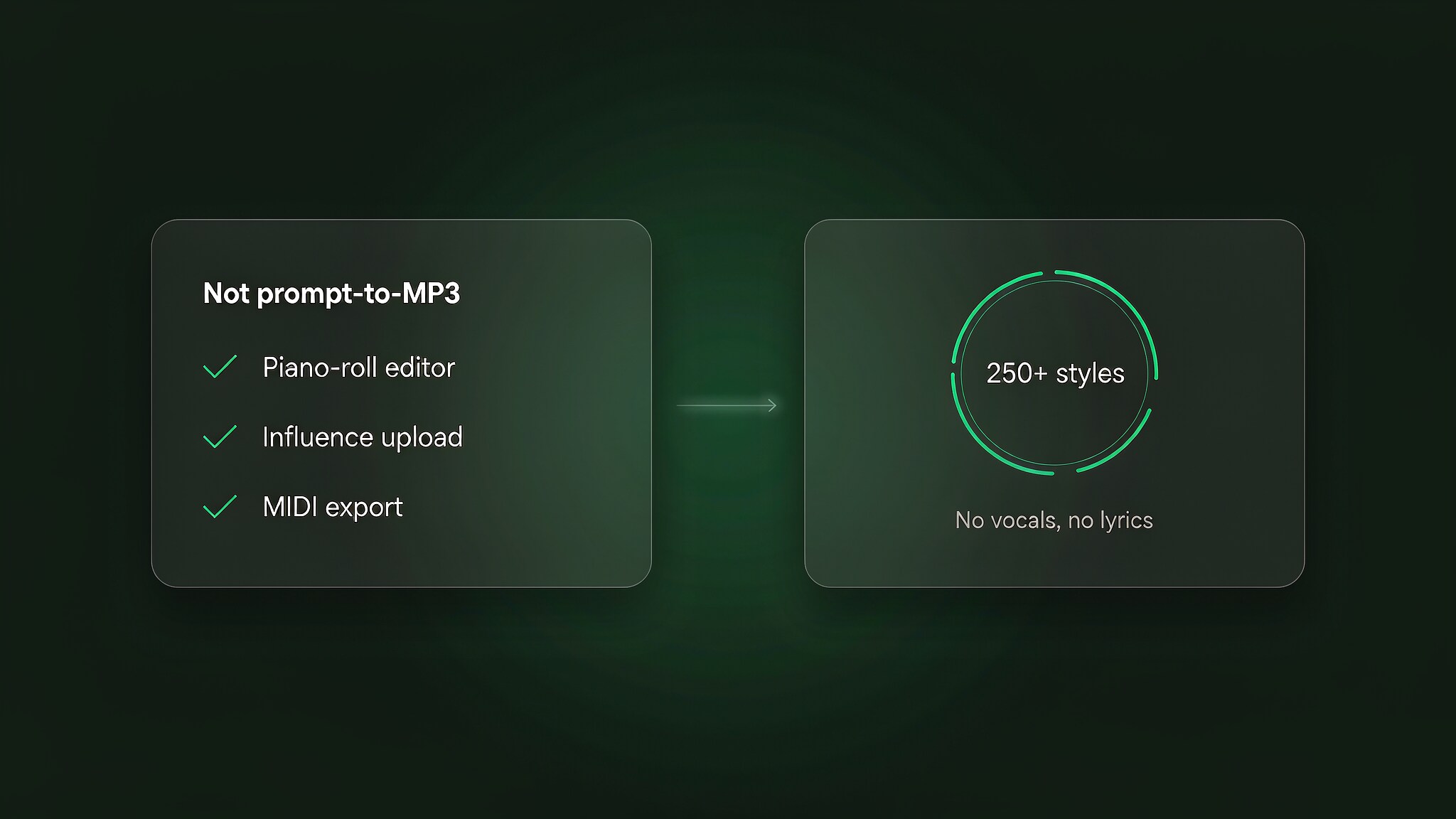
Two more facts shape how the product should be judged. AIVA is instrumental only — there is no vocal model and no lyric input. And the company has an unusual credential for a generative music service: it was registered with SACEM, the French society of composers and music publishers, which places it in a different conversation from tools that present themselves as content utilities.
How AIVA Works in Practice
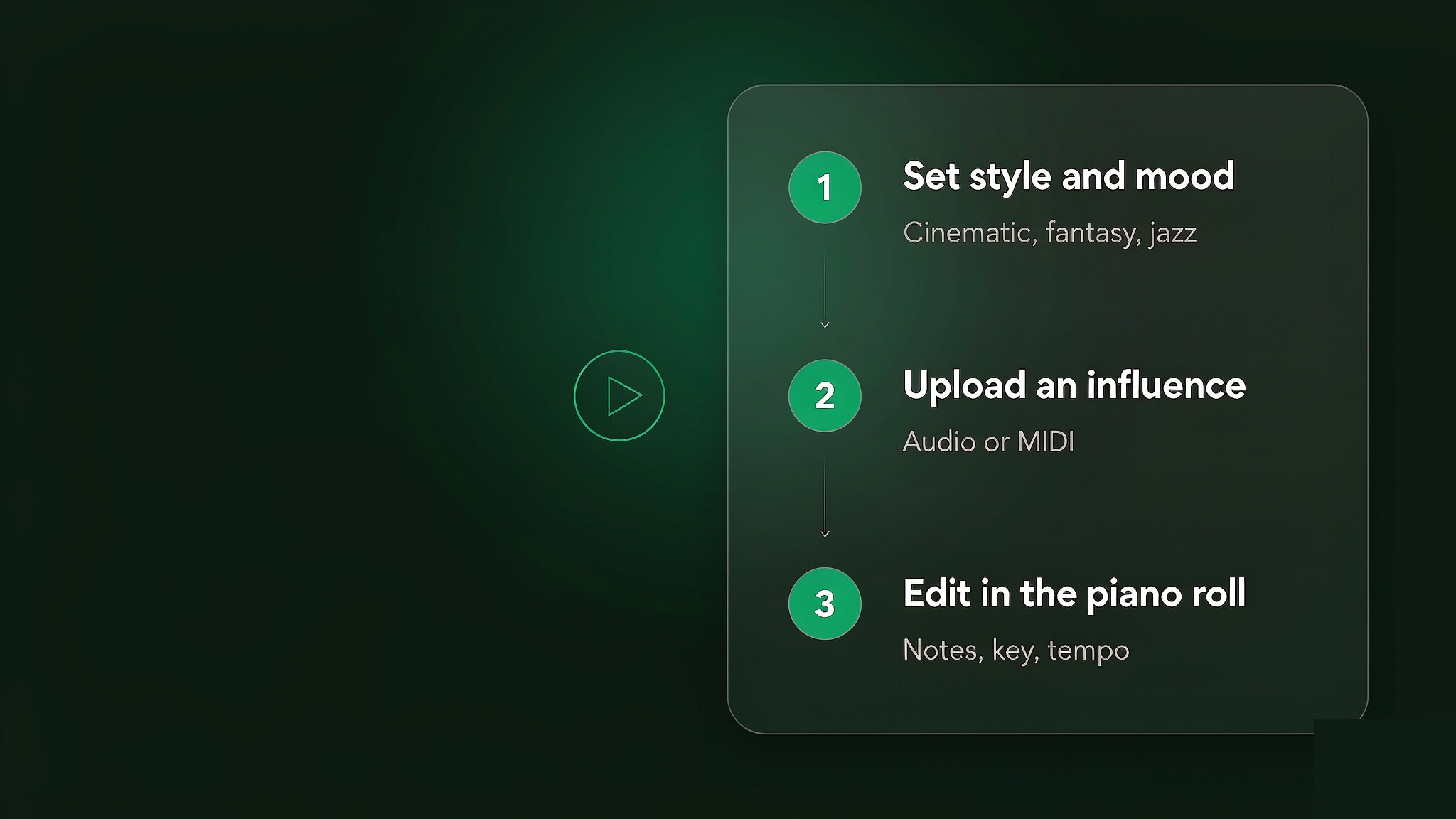
The workflow is short, and most of the craft sits in the two steps after generation.
Set a style, a mood and a length
Generation starts from parameters rather than from a paragraph of prose. Choose a preset such as cinematic, fantasy, jazz or electronic, set the mood, then set the duration the project needs. This is a weaker entry point than a written prompt for people who think in descriptions, and a stronger one for people who think in musical terms, because the preset already carries the arrangement conventions of its genre.
Upload an influence when you have a reference
If you have a piece of music in mind, the influence upload is the most direct way to communicate it. Supplying a MIDI file tells the model about harmony, rhythm and structure; supplying audio adds timbre and texture. The same feature is the basis for custom style models, which is what makes AIVA interesting to creators with a house sound — a theme or a channel signature can be taught, not just described.
Edit the arrangement in the piano roll
Every generation can be opened in the editor and rebuilt: delete an instrument you do not want, move notes, change the key, restructure sections. This is the feature that decides the review. Where most tools offer regeneration as the only lever, AIVA offers surgery, and the difference shows up on projects where eight bars are right and the rest is wrong.
Export MIDI into a DAW, or export audio and stop
On the paid tiers the export set includes MIDI, which is the instruction set rather than a recording, so the composition can be re-voiced with your own instruments, mixed against live players and finished in the environment you already use. Below the Pro tier, exports are limited to MP3 and MIDI; high-quality WAV is a Pro feature.
What the AIVA AI Music Generator Gets Right
Three advantages held up when we read the official documentation alongside the independent tests published this year.
The output is editable, not sealed
A MIDI-first architecture is the single most useful design decision in this tool. Because the generated material arrives as structured musical data, its value does not depend on the model's synthesis quality — a weak horn patch is a patch problem, not a composition problem. Creators who treat AI output as a starting point rather than a deliverable get far more from AIVA than from tools that only return audio, and producers can keep their own libraries doing the sounding.
Copyright transfer on Pro is the real product
The free and Standard plans keep the copyright with AIVA and restrict where the music can be monetised. Pro transfers ownership of the compositions to the buyer and removes the stated monetisation limits, which changes the tool from a rental into a source of assets. We read that as the plan's actual selling point; the download count is secondary.
Structure rather than atmosphere
The compositions behave like pieces of music: they have sections, development and endings, which is why the platform has been adopted for film cues, game loops and trailer beds. One independent comparison notes that the model was trained on a corpus of tens of thousands of scores, and the harmonic structure is where that shows. For work that has to sit under a scene and carry it, structure is worth more than novelty.
Pricing and Plans
AIVA sells three tiers, and the difference between them is a combination of download volume, track length, export formats and rights. As of September 2026, prices are listed in euros and exclude VAT, which matters for buyers outside the euro zone because the card is charged at the prevailing exchange rate.
Free gives three downloads a month with tracks up to three minutes, MP3 and MIDI exports, no monetisation rights and a required credit line; the copyright stays with AIVA. Standard is €15 per month, or €11 per month when billed annually — a 26% discount — and raises the allowance to 15 downloads a month with tracks up to five minutes, still in MP3 and MIDI. Standard permits monetisation only on YouTube, Twitch, TikTok and Instagram, and the copyright still stays with AIVA.
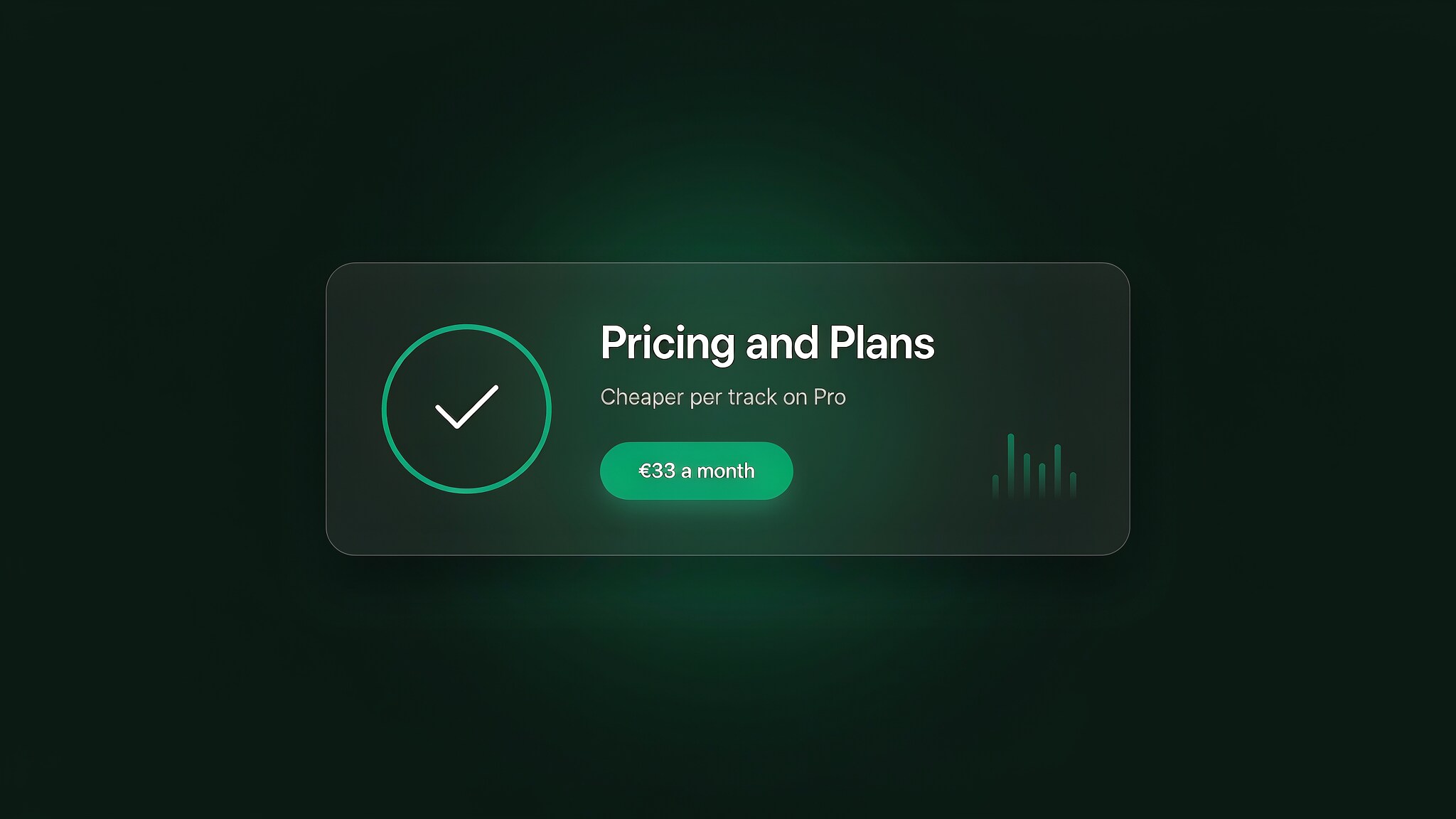
Pro is €49 per month, or €33 per month billed annually at a 33% discount, and it is the tier that changes the legal position: 300 downloads a month, tracks up to five minutes thirty seconds, all export formats including high-quality WAV, and ownership of the compositions. Student and school discounts exist but have to be requested through the company rather than selected at checkout.
The conversion worth doing is cost per usable download, because that is where the tier structure stops being intuitive. At the annual Standard price, 15 downloads for €11 works out at roughly €0.73 each. At the annual Pro price, 300 downloads for €33 works out at roughly €0.11 each, so the expensive-looking plan is the cheaper one per track by a factor of about six — and it is the only one that comes with the copyright. Unused downloads do not roll over, so the allowance should be sized to a month you would actually have; check AIVA's pricing page for the current rates before you commit to one.
Compare what a plan includes.
Enkio plans include AI music video generation, templates, and watermark-free downloads depending on your plan.
Real Limitations
The limits below are structural, and two of them are the direct cost of the design we found most useful.
It will not sing
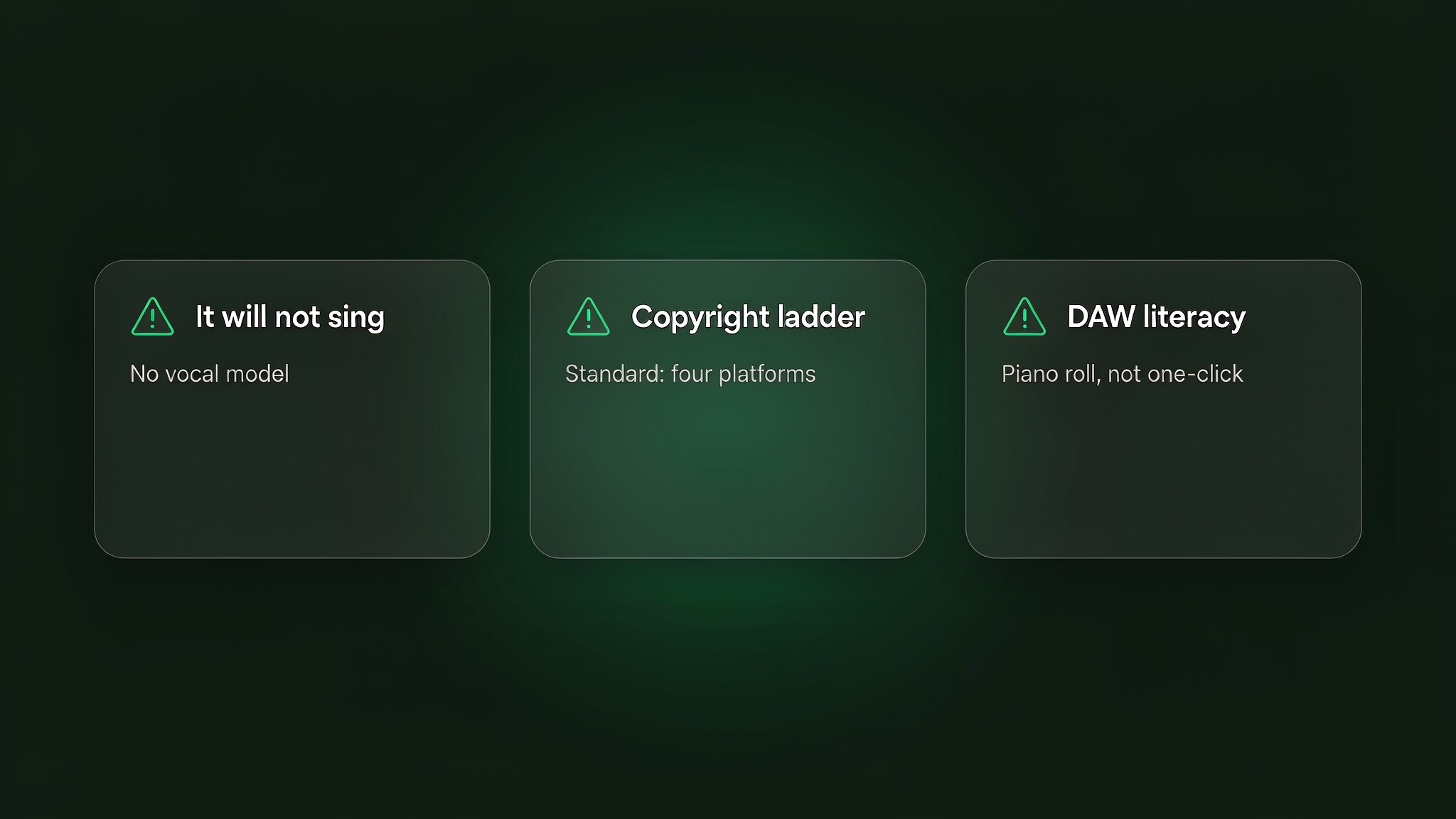
AIVA is an instrumental composer. There is no vocal model, no lyric input and no singing voice, and the platform does not pretend otherwise. If the deliverable is a song, this is the wrong tool and a vocal-first generator is the right one; if the deliverable is a cue, a bed or a theme, the absence of vocals is not a limitation at all.
The copyright ladder, not the download count, decides the plan
This is the most expensive misunderstanding in the pricing page. Standard covers monetisation on four named platforms only, which leaves podcasts, films, games, adverts and client work outside its scope — so a creator buying Standard for a podcast or a game will find the licence does not cover the use.
Reaching those uses means moving to Pro, which is roughly three times the annual-equivalent monthly price. The download allowance rarely justifies that jump; the rights business case almost always does. Our Soundraw AI music generator review covers a comparable instrumental platform with a different licensing model, and reading the two side by side makes the trade-off clearer.
The editor assumes some DAW literacy
The piano roll is the reason to choose AIVA, and it is also the reason beginners stall. Moving notes, muting instrument tracks and changing tempo are ordinary operations for anyone who has used a DAW, and unfamiliar vocabulary for everyone else. The interface does not abstract those decisions away, so a creator who wants one-click output will spend more time in this tool, not less.
Genre coverage is uneven, and long pieces need work
Independent tests are consistent on where the output is strong and where it is not: orchestral, cinematic and classical material lands well, while modern pop, hip-hop and electronic styles are weaker, and quality drifts on longer pieces where the arrangement can turn formulaic. The length caps compounds that: three, five and five and a half minutes depending on tier, with no way to generate longer material in one pass.
How It Compares With Soundraw
The nearest competitor is not a vocal song generator but another instrumental tool with an editing story, so that is the comparison our review drew. Both columns are a snapshot as of September 2026, and both vendors adjust promotions.
| Dimension | AIVA | Soundraw |
|---|---|---|
| Entry point | Style preset, mood, duration, then piano roll | Genre and mood selection, then bar-level mixer |
| Written prompts | Not the primary interface | Not supported |
| Vocals | Instrumental only | Instrumental only |
| Editing depth | Note-level piano roll plus instrument control | Bar-level instrument toggles and intensity |
| MIDI export | Yes, on paid tiers | Not offered |
| Copyright position | Transfers on Pro; stays with the vendor below it | Licensed per tier, with the master retained |
| Length caps | 3 minutes free, 5 minutes Standard, 5:30 Pro | 30 seconds to 5 minutes |
| Entry paid tier | €15 per month monthly, €11 annually | Around $11 per month billed annually |
| Case for it | Composition you can take into a DAW | Fast control over a finished bed |
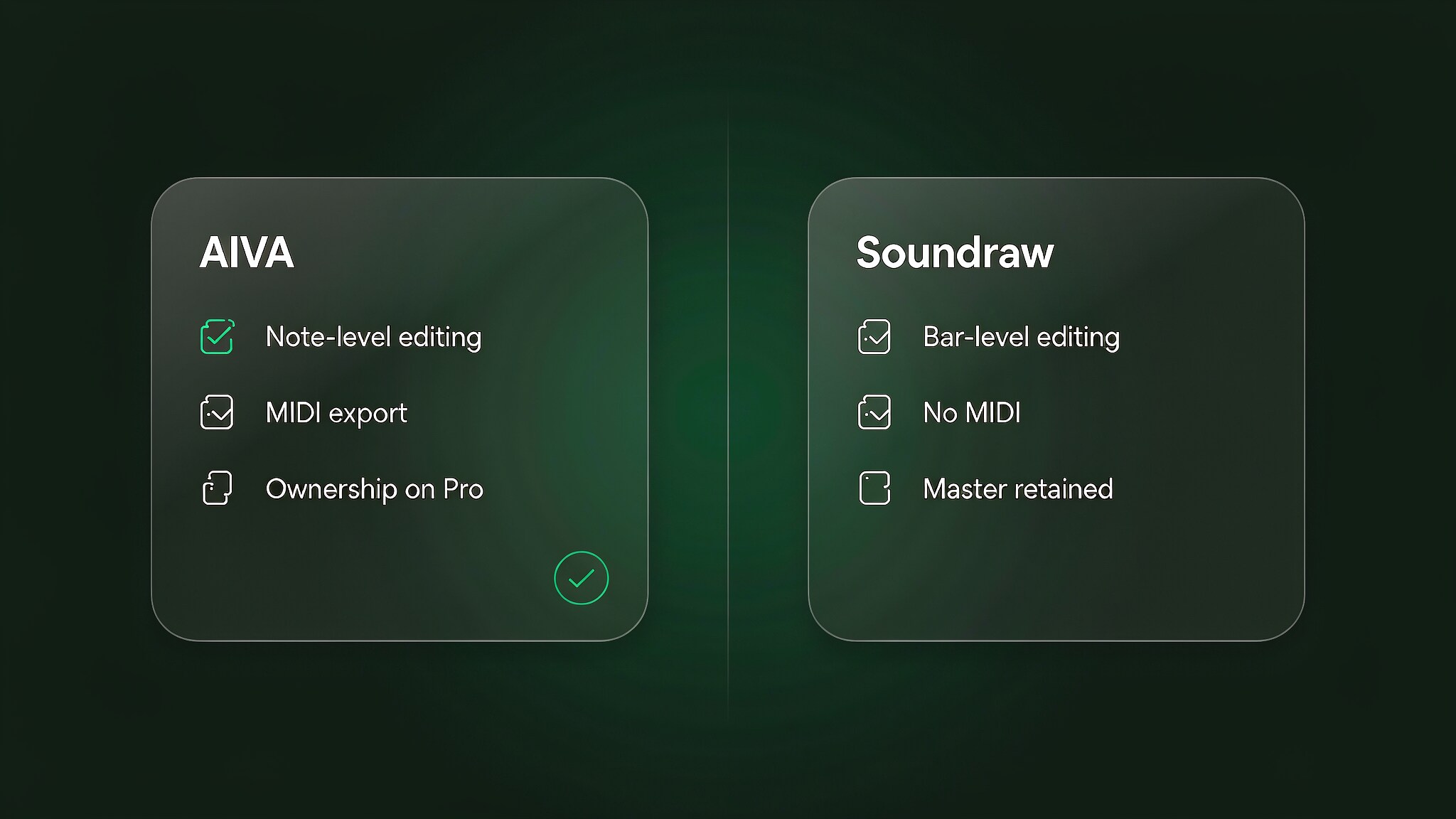
AIVA wins where the deliverable is a composition and where owning it matters. Soundraw wins where the job is to place a finished bed under a voiceover quickly and cheaply. For the wider field, the AI music video and music generator reviews hub collects every review in this cluster.
Who the AIVA AI Music Generator Is For Right Now
Our comparison splits by deliverable, because that is where the tiers separate.
AIVA suits filmmakers, game developers and ad agencies that need a cue built to a brief and owned outright; producers who want a starting arrangement, a MIDI file and their own instrument libraries; and creators who need a recurring theme rather than a one-off track, which is where the custom style models earn their place. Tier selection follows the use rather than the volume: podcasts, games, adverts and client work belong on Pro by licence, not by download count.
It is a weaker fit for songwriters who need a vocal, for absolute beginners who want a finished track from a sentence, and for high-volume short-form creators whose monthly output is measured in dozens of clips, where a metered bed generator is cheaper and faster.
How AIVA's Copyright Transfer Works
The ownership question is the one buyers most often get wrong here, so it is worth separating the two legal positions the platform sells.
On the free and Standard plans, the copyright in the compositions stays with AIVA and what you hold is a usage right shaped by your tier. Free excludes monetisation and asks for a credit line. Standard permits monetisation on four named platforms and drops the credit requirement, but the underlying copyright does not move. On Pro, ownership of the generated compositions transfers to the buyer, and that is a different asset position: the music can be registered, licensed onward or used in work where a client will ask who holds the rights.
We read the platform's own framing the same way — it presents the Pro plan as the route to owning compositions produced with the tool, and treats the licence question as the reason to upgrade rather than as a footnote. Two practical notes apply. The material is instrumental, so there is no lyric or vocal copyright arising from the service, and none of this is legal advice: read the terms for the tier you buy, and treat the definitions there, rather than a plan summary, as the version that governs your project.
Common Misconceptions
Two assumptions come up often enough to be worth correcting.
Misconception one: paying more buys better music
The generation engine does not change with the tier. What changes is download volume, track length limits, export formats and rights. Pro on the same style preset produces the same kind of material as Standard; it simply lets you keep more of it and own it. Buyers who upgrade expecting a quality jump will be disappointed, and buyers who upgrade for the copyright transfer will not be.
Misconception two: a MIDI export is a finished production
MIDI is a set of instructions — notes, timing, velocity, instrument assignments — rather than a recording. Exporting it means your DAW and its instrument libraries decide how the piece finally sounds, which is an advantage for anyone with good sample libraries and a surprise for anyone expecting the preview to survive untouched. Budget time for that step; it is the difference between a draft and a release-ready cue.
From an AIVA Cue to Something You Can Publish
A composition is usually the start of a piece of work rather than the end of one, and the next stage depends on what the cue is for. A cue written for a scene becomes a video; a theme written for a channel becomes a release asset.
Enkio's AI music video generator takes a track plus a visual direction and returns a music video, with 720p and 1080p output across five aspect ratios including 9:16 and 16:9, on a credit model rather than a per-video purchase. Instrumental cues suit this workflow particularly well, because there are no lyrics competing with the visuals, and a MIDI-first composition pairs cleanly with it: shape the arrangement in your own environment first, then give the finished audio a visual. Credit costs are listed on the pricing page, so check the current numbers before planning around them.
One reminder applies whichever route you take: platform policies on AI-generated content differ, and several major platforms expect disclosure when music or video is machine-generated. Check the destination platform's current guidelines before publishing, particularly if monetisation is the goal.
Make more from your MV.
Let Enkio create a complete AI music video from your song with cinematic templates.
Frequently asked questions
These are the questions we see most often about the AIVA AI music generator, answered for the platform as it stands.
Is the AIVA AI music generator free?
There is a free plan with no card required: three downloads a month, tracks up to three minutes, MP3 and MIDI exports, a required credit line and no monetisation rights. It is enough to judge the composition style and not enough to publish anything commercial. Check the official pricing page for the current free limits.
How much does AIVA cost?
As of September 2026, the paid tiers are Standard at €15 per month or €11 per month billed annually, and Pro at €49 per month or €33 per month billed annually, with prices excluding VAT. Standard covers monetisation on four named platforms; Pro transfers ownership of the compositions to the buyer. Check the vendor's current pricing page before subscribing, since promotions and allowances change.
Does AIVA generate vocals?
No. The platform composes instrumental music only, with no lyric or vocal model. A project that needs a sung part needs a different tool, and a common arrangement is to compose the instrumental here and add vocals elsewhere.
Who holds the copyright on music made with AIVA?
It depends on the tier. On the free and Standard plans the copyright stays with AIVA and you hold a usage right limited by your plan. On Pro, ownership of the generated compositions transfers to you. That transfer, rather than the higher download count, is the reason most professional buyers choose Pro. Read the current terms for your tier.
Can I release AIVA music on Spotify or Apple Music?
That depends on what you hold. Standard restricts monetisation to the platforms named on the plan, so broader distribution is a Pro question. Because Pro transfers ownership to the buyer, it is the tier to read carefully if distribution, licensing or selling work to clients is the goal. Confirm the current terms with the vendor rather than relying on a plan summary.
What file formats does AIVA export?
MP3 and MIDI are available from the free plan upward, and MIDI is the more useful of the two for anyone working in a DAW. High-quality WAV and the wider export set arrive with Pro. Export options are tied to the tier, so check the plan you are buying rather than assuming the full set.
Which is the official AIVA AI music generator site?
The official product is aiva.ai, and the generator runs in the browser from there. Directories and third-party pages reuse the name for listings and for unrelated tools, so confirm that a page links back to aiva.ai and shows the company's own pricing and terms before you create an account or upload material.
Conclusion
AIVA takes the least fashionable position in this category and makes it work. It composes instrumental music with real structure, hands the arrangement over as editable data, and sells the copyright rather than the novelty, which is why the price ladder is really a rights ladder.
The trade-offs are equally clear: no vocals, a genre range that thins out on modern pop and hip-hop, an editor that rewards DAW experience, and a Standard tier whose monetisation limits push most professional work up to Pro. If you need a cue you can own and finish in your own studio, this is one of the strongest options available. If you need a finished song, choose a tool built for that, and read the terms for whichever tier you buy before you build a project on it.