





Boomy is the platform that made the promise most of this category was built on: pick a style, get a finished song in seconds, publish it to streaming, and collect royalties. It was also the first to discover what happens when that promise scales. Our review of the Boomy AI music generator covers what the tool does now, what the plans and downloads cost, how the platform's distribution model changed, and where the original pitch no longer holds.
The short answer: Boomy remains the fastest way to get from nothing to a song, and the streaming-royalty story that made it famous has been dismantled — first by a catalogue-wide removal at Spotify, and then by the company itself stepping out of the distribution business.
What the Boomy AI Music Generator Is
Boomy runs in the browser at boomy.com and has been available since the end of the last decade, which makes it one of the oldest tools in the category. There is no official mobile app; the similarly named apps in the stores are not published by the company.
The product works from style presets rather than written prompts. You choose a direction — electronic, rap beats, lo-fi, global groove, relaxing meditation, and others — set parameters such as density and tempo, and the platform assembles a track. The formal claim in the marketing is that the catalogue now runs into the tens of millions of songs, and while that number is not verifiable from outside, the platform has been free to enter for most of its life, which makes a large figure plausible.
Two boundaries should be set before the review proper. First, this is not a songwriting tool in the sense the term is used now: there is no lyric input that produces a sung lead vocal, and vocal material is something you supply. Second, the platform's identity has shifted from a distribution service to a music generator, and much of the information circulating about it still describes the earlier version. That distinction runs through everything below.
How Boomy Works in Practice
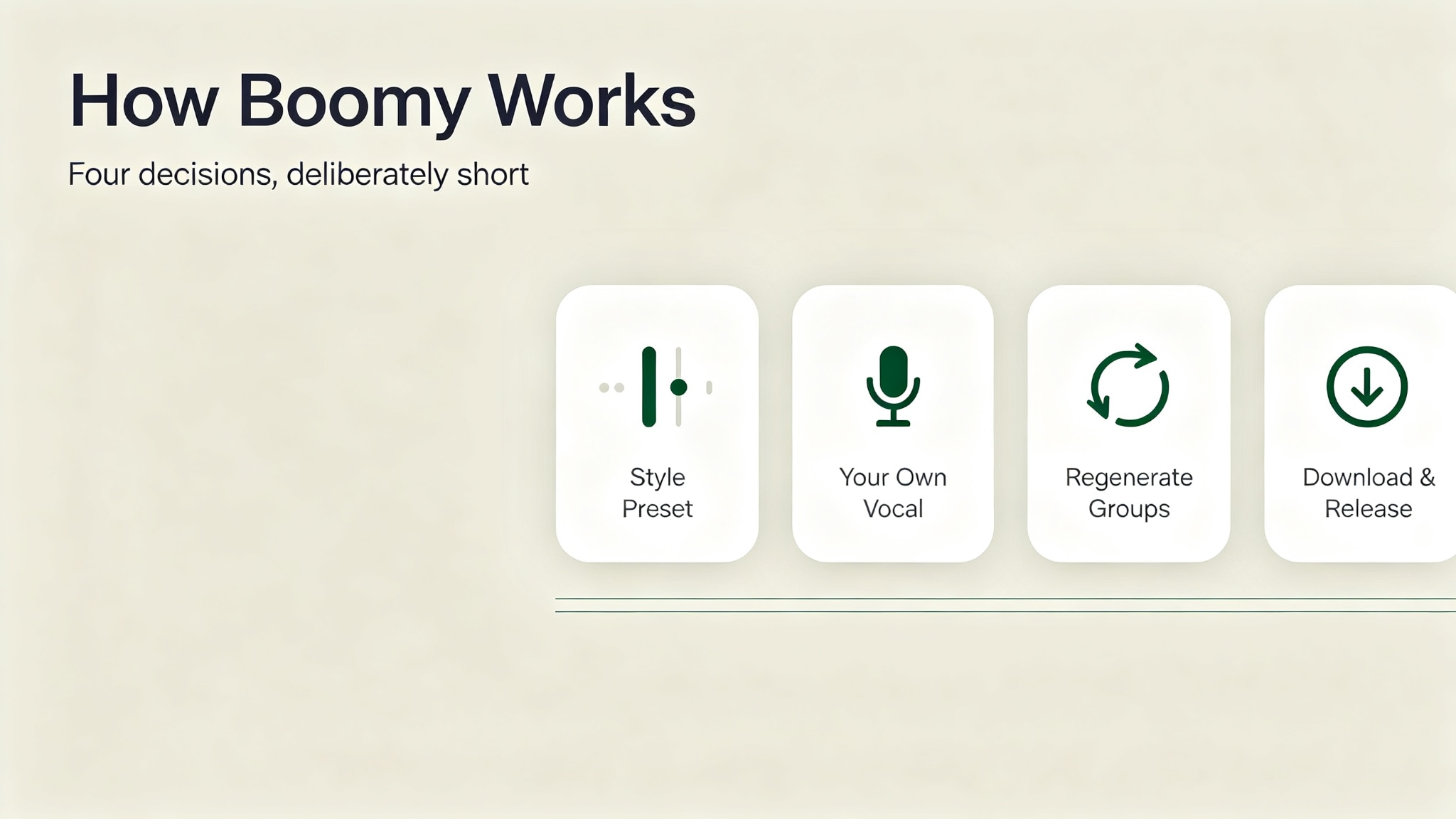
Four decisions cover the workflow, and from what we could verify the platform is deliberately short of options at each one.
Pick a style and set the texture
You start by choosing a style preset, then adjust how dense and how fast the result should be. There is no prompt box and no reference track, so the creative input is directional rather than specific. This is the fastest entry point in the category: a first song takes seconds rather than a minute, and no musical vocabulary is required to reach something listenable.
Bring your own vocal if you want one
Vocal handling is the part most summaries get wrong. Boomy does not turn lyrics into a sung performance, so a vocal has to come from somewhere else: the paid tiers accept a vocal recording you supply, and a beta feature generates a voice line from samples you provide. If a sung lead is the centre of your project, this is a constraint rather than a feature, and it is the point at which most songwriters look elsewhere.
Edit by regenerating parts of the arrangement
Editing works at the level of instrument groups rather than individual notes. You can regenerate the harmonic layer, the drums, the effects or the mix, and the paid tiers let you address individual instruments within those groups. What you cannot do is move a note or rewrite a chord as you would in a DAW. The design assumes you are steering a generator, not arranging a piece, and it is competent at that job.
Save, download, and now distribute it yourself
Saved songs live in your library, and downloads follow the plan. Distribution is the change that matters most: the platform no longer pushes your track to streaming services on your behalf, so the route to release is to download the release files and choose a distributor yourself, which adds both a step and a waiting period to the process. The details of that shift are worth reading in full below, because they invalidate a large amount of existing advice about this platform.
What the Boomy AI Music Generator Gets Right
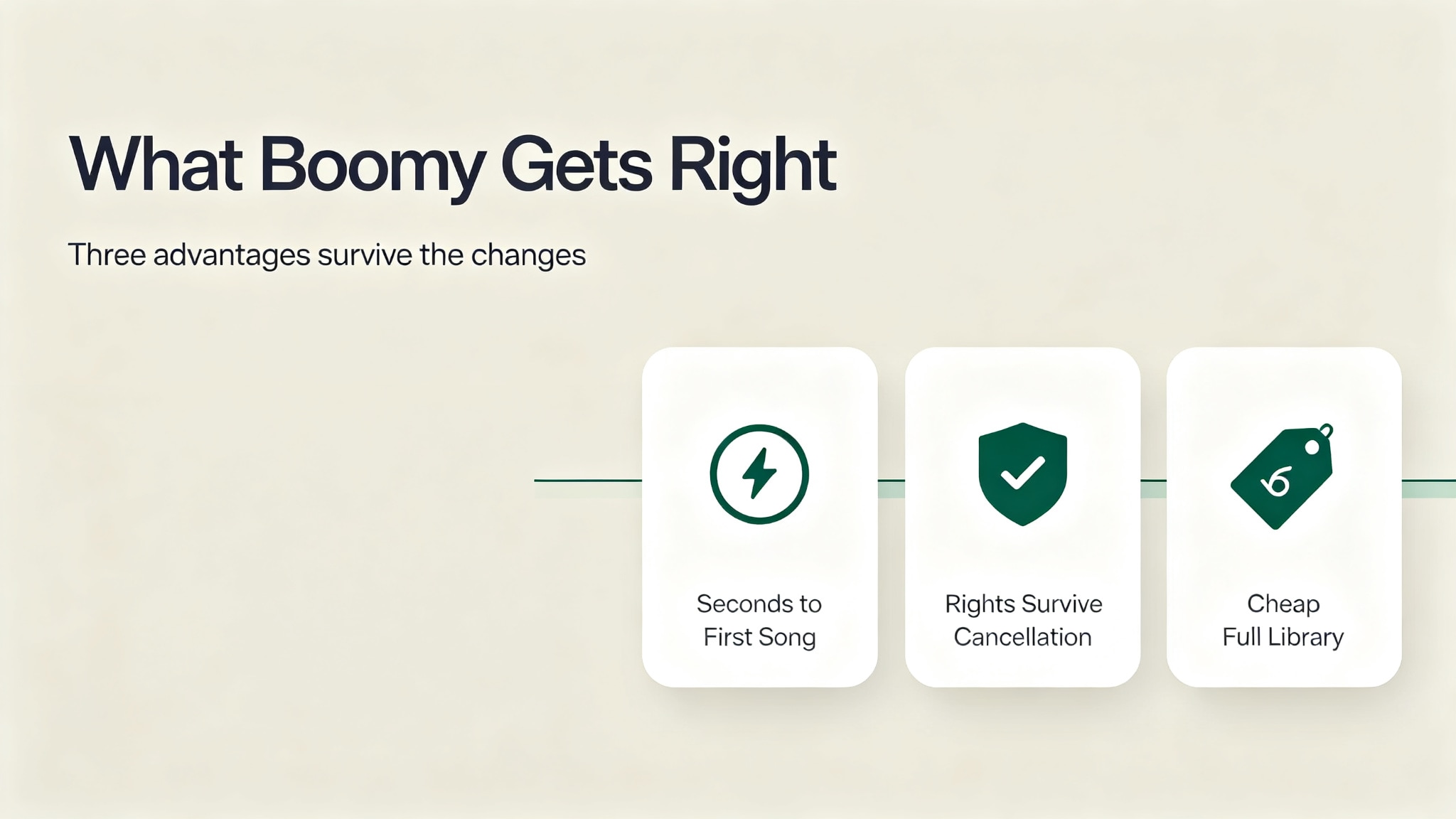
Three advantages survive the changes, and when we checked the company's own documentation against the published reviews they held up as real reasons to use the tool.
The lowest time-to-first-song in the category
Nothing here requires an account setup ritual, a prompting skill or a musical ear. Choosing a preset and hearing a finished track takes seconds, which makes Boomy unusually good for the uses that value speed above all: testing an idea, filling a background slot, teaching someone what generated music sounds like, or putting a placeholder under a rough cut.
Commercial rights that survive cancellation
Paid plans grant commercial rights to the tracks you download, and the company's own documentation states that those rights continue after a plan ends. That is a meaningfully better position than the licensing model on some competitors, where usage is tied to an active plan and stops when payment does. Anyone building a content library should weigh this alongside the price, because it changes what happens to the work if you leave.
A price that covers the whole library
The paid tiers are inexpensive relative to the download allowances they include, and as of September 2026 the entry tier is quoted under $10 per month with full commercial rights. For a creator who needs a stream of simple, finished tracks rather than a small number of crafted ones, the arithmetic works.
Pricing and Plans
As of September 2026, Boomy lists three tiers. Free allows a limited number of saved songs and releases, includes no downloads, and excludes commercial use. Creator is quoted at $9.99 per month, or $109.89 for the year, with a large save allowance, a monthly download allowance, and full commercial rights.
Pro is $29.99 per month, or $329.90 for the year, removing the save limit and raising the download allowance, with earlier access to new features. A separate remastering service is sold per track.
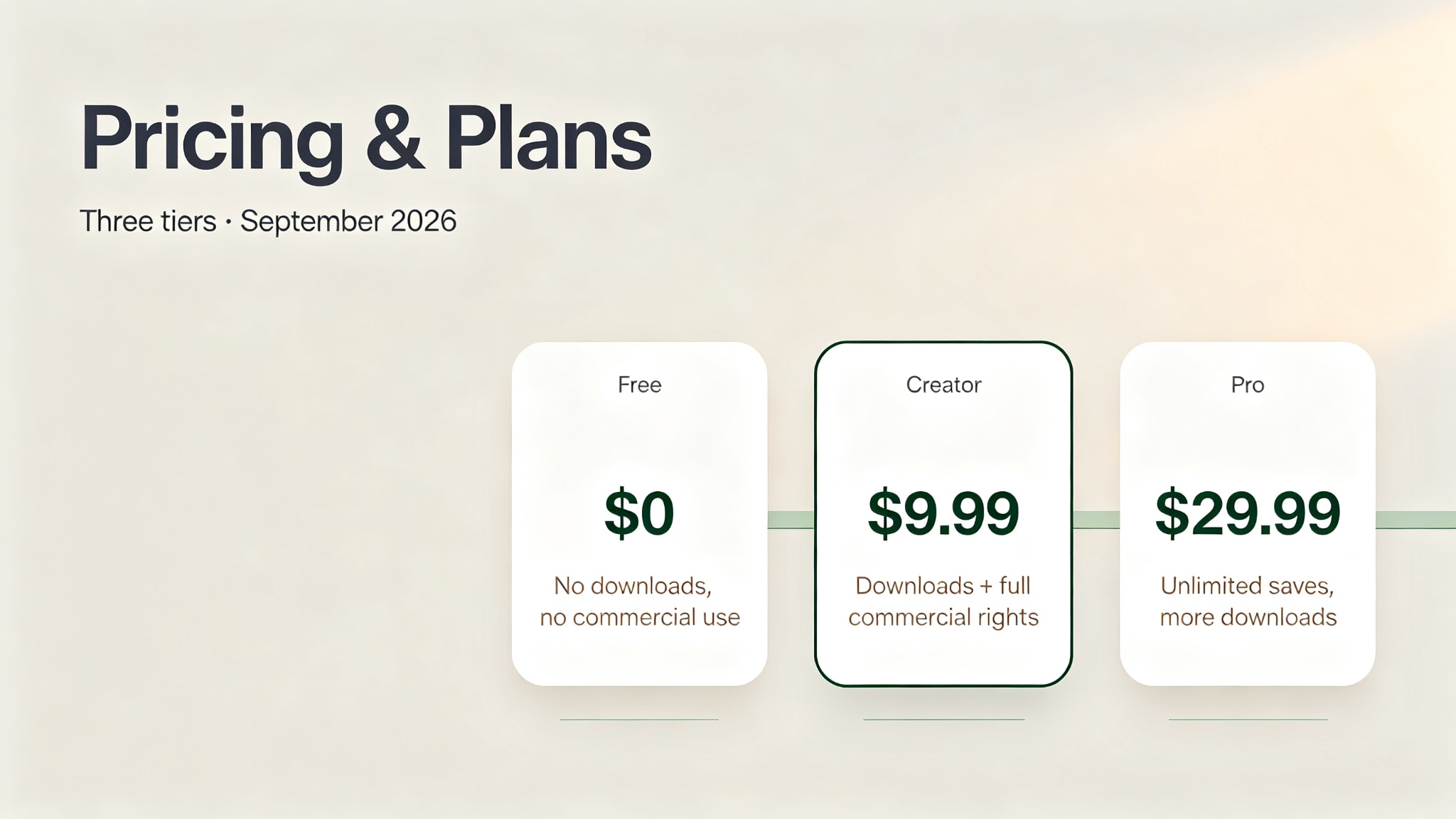
The detail that decides value is the download allowance rather than the price, because downloads are what turn generated audio into usable material. The entry tier's monthly allowance is enough for a regular posting schedule and not enough to build an archive quickly, and the free tier includes no downloads at all — which means the free tier cannot produce anything you are allowed to publish. Third-party listings quote the same tiers with slightly different allowances, and the company has revised the plans before, so check the official pricing page for the current numbers.
Compare what a plan includes.
Enkio plans include AI music video generation, templates, and watermark-free downloads depending on your plan.
Real Limitations
The limitations we found here are more consequential than on most tools in this category, because they include the value proposition the platform was built on.
The streaming-royalty promise no longer holds
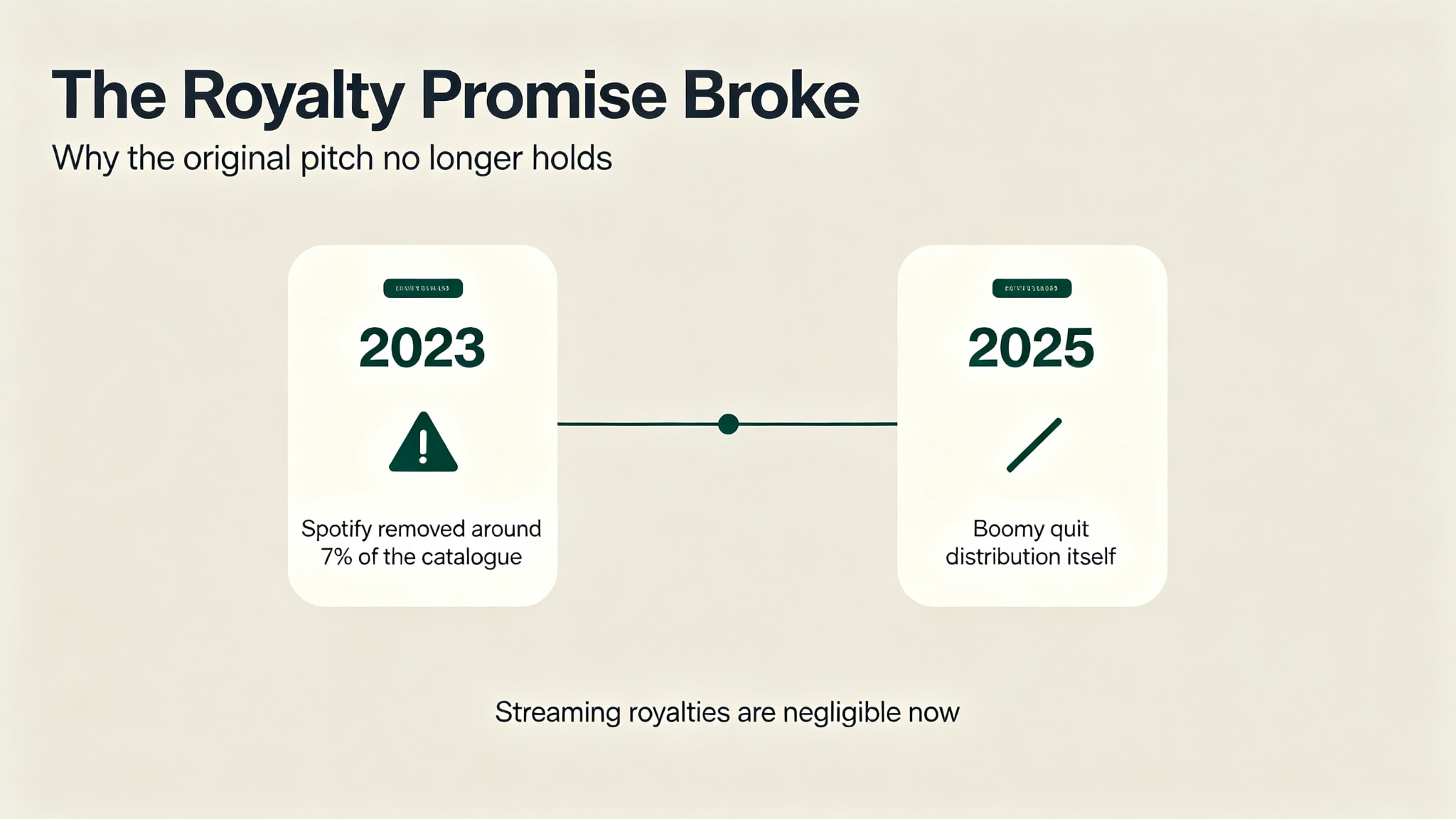
Boomy's original pitch was passive income: publish generated songs, collect royalties. Two events broke that story. In 2023, Spotify removed a substantial share of the platform's catalogue — reported at around seven percent, tens of thousands of tracks — in a sweep aimed at suspected artificial streaming activity, restoring the material later.
And in 2025, Boomy stopped acting as a distributor altogether, moving to a model where you download release files and choose your own distributor. The income story did not survive either event, and it remains the reason most people arrive at this platform.
Royalty economics were never going to carry a creator
Even while the platform distributed, per-stream payouts for this kind of material were reported at a fraction of a cent, and the volume required to earn meaningfully was far beyond what a casual user would publish. Independent complaints about payouts also describe long verification processes and accounts closed without resolution. The conclusion is not that the platform mistreats users, but that generating a track and uploading it is not a business, and treating it as one is the most expensive misconception in this category.
Editing stops short of the arrangement
The ability to regenerate instrument groups is a real editing capability, and it is well short of what a producer expects. There is no note-level editing, no structural rearrangement, no key or chord control, and no way to correct a single bar without regenerating around it. For casual use that is invisible; for anyone trying to finish a track to a standard, it is the wall.
Distribution now depends on you
Since the platform stepped out of distribution, releasing a track requires downloading the release files, choosing a distributor, and waiting through that distributor's own review, which independent reviewers describe as running into weeks. The company also took down existing streaming releases during the transition to avoid conflicts, which is a reminder that your distribution footprint is only as stable as the platform arrangement behind it.
How It Compares With Suno
The platforms are compared constantly even though they now aim at different users, so we keep a short table for that decision.
| Dimension | Boomy | Suno |
|---|---|---|
| Creative input | Style presets and texture parameters | Written prompts, lyrics and style tags |
| Time to first track | Seconds | Under a minute, with more iteration |
| Vocals | Supplied by you, or generated from your samples | Generated with lyrics |
| Editing depth | Regenerate instrument groups; individual instruments on paid tiers | Editing tools on higher tiers |
| Commercial rights | Included on paid plans and retained after cancellation | Tier-dependent |
| Distribution | Download and self-distribute | Download and self-distribute |
| Entry paid price | $9.99 per month | Around $10 per month |
| Best fit | Fast placeholders, simple background tracks, teaching | Songwriting, vocals, release-ready material |
Both columns are a snapshot as of September 2026 and both vendors revise their plans, so verify specifics with each platform. Independent testing published this year is the better source for where the other platform stands today.
The Distribution Shift and What It Means for Release Plans
The change from built-in distribution to self-distribution is the single most important fact about this platform now, and it reorders the workflow. In our reading of the release process, the timeline is part of the plan rather than an afterthought: releasing a track means downloading the release files, choosing a distributor, submitting, and waiting through a review period that independent reviewers place somewhere between one and three weeks.
It also raises the value of the download allowance: because the free tier includes none, and because you now need the files to release anything at all, the download quota is the real cost centre rather than the monthly price.
Common Misconceptions
Two assumptions we see brought up most often are worth correcting explicitly.
Misconception one: you can earn meaningful royalties this way
The platform's reputation was built on the idea that generated songs generate passive income. The payouts per stream are a fraction of a cent, the volume needed to make that add up is far beyond casual use, and the platform no longer distributes on your behalf. Anyone considering this route should treat streaming royalties as negligible and evaluate the tool on the cost of the music itself.
Misconception two: Boomy still publishes to major platforms for you
A large amount of the coverage still describes built-in distribution to dozens of services with a revenue split. That arrangement ended, and the current path runs through files you download and a distributor you choose. Advice that assumes the older model will lead you to plan a release that cannot be executed the way it describes.
Who the Boomy AI Music Generator Is For Right Now
Boomy suits users who want speed and simplicity and who are not trying to make a production-grade record: creators filling background slots, teachers demonstrating generated music, hobbyists who want to hear an idea immediately, and anyone who needs a placeholder track for a rough cut. Commercial rights that persist after cancellation also make it a reasonable choice for someone who wants a small library of licensed tracks without an ongoing commitment.
It is a weaker fit for songwriters who need vocals, for producers who need arrangement-level control, and for anyone whose goal is streaming revenue — for that last group, the model simply does not work. If your priority is a low-cost song with vocals and a light interface to iterate in, the budget options compared in our AI music video and music generator reviews cover a different set of trade-offs. If your need is background music rather than songs, our Soundful AI music generator review covers a template-driven platform built for exactly that job.
From a Boomy Track to Something You Can Publish
Since the platform no longer handles distribution, everything after generation is yours to arrange — and the first step is almost always visual, because the platforms where music reaches an audience are video platforms. A downloaded track still needs a video before it can be published anywhere that matters.
Enkio's AI music video generator takes a finished track plus a visual direction and returns a music video, with 720p and 1080p output across five aspect ratios including 9:16 and 16:9, on a credit model rather than per-video purchases. Boomy's short tracks fit that pipeline naturally, since a generated song sits comfortably inside the length of a short-form video. Check the current plans and credit costs on Enkio's pricing page before you build a release around it.
One reminder applies whichever route you take: platform policies on AI-generated content differ, and several major platforms expect disclosure when a track or video is machine-generated. That matters more here than on most platforms, given the catalogue-wide removal this one has already been through. Check the destination platform's current guidelines before publishing, particularly if monetisation is the goal.
Make more from your MV.
Let Enkio create a complete AI music video from your song with cinematic templates.
Frequently asked questions
These are the questions we see most often about the Boomy AI music generator, answered for the platform as it stands.
Is Boomy free to use?
There is a free tier, and it is limited in a way that matters: a small number of saved songs, no downloads, and no commercial rights, which means nothing generated there can be published. The paid tiers are inexpensive and unlock downloads and commercial use. Check the official pricing page for the current free limits.
Can I still publish Boomy songs to Spotify?
Yes, but not through the platform. Distribution now works by downloading the release files and submitting them through a distributor you choose, which adds a review period of up to a few weeks. The built-in distribution service that older guides describe is no longer available.
How much does Boomy cost?
As of September 2026, Boomy quotes Creator at $9.99 per month, or $109.89 for the year, and Pro at $29.99 per month, or $329.90 for the year, with a limited free tier beneath them. Download allowances differ by tier and matter more than the price. Verify current plans on the official pricing page.
Do I own the songs I create?
The company retains copyright by default and the paid tiers grant commercial usage rights to the tracks you download, with those rights continuing after a plan ends. Outright ownership is a separate arrangement handled on request. Read the current terms for the version that applies to you.
Does Boomy generate vocals?
Not from lyrics. A vocal has to be supplied as a recording you upload, or generated from samples you provide in a beta feature. Projects built around a sung lead are better served by a platform that writes vocals, and this is the clearest functional boundary of the tool.
Can I earn royalties from Boomy tracks?
Streaming payouts for this kind of material are a fraction of a cent per stream, and the volume required to earn anything meaningful is far beyond casual publishing. With the platform no longer distributing on your behalf, the practical answer is to treat royalties as negligible and the tool as a fast source of music rather than an income stream.
Conclusion
Boomy is the clearest case study in this category of a promise that outran the economics. It is still genuinely excellent at one thing — getting from nothing to a finished track faster than anything else — and the commercial rights attached to its paid tiers are better than most competitors offer. What it is not is a publishing business, a songwriting tool, or an arrangement environment. Use it for what it does well, plan the video step yourself, and decide how you will release anything worth releasing before you generate it rather than after.