





Soundful generates instrumental music from templates rather than from written prompts: you choose a genre, a mood and a tempo, and the platform returns a finished instrumental that you can license for video, podcasts and streams. Our review of the Soundful AI music generator covers what the platform is, how the template workflow behaves in practice, what each plan costs, what the licence actually gives you, and where the tool falls short of prompt-driven competitors.
The short answer: Soundful is one of the cheapest ways to get a steady supply of themed background music with clear usage terms, and a poor fit for anyone who needs vocals, written-prompt control, or ownership of the master recording.
What the Soundful AI Music Generator Is
Soundful runs in the browser at soundful.com and has done since 2022, when the company launched on a $3.8 million seed round. There is no mobile app, which is consistent with how the platform expects to be used: at a desk, against a production deadline, working through a queue of tracks rather than writing one.
The product occupies a specific corner of the category. Most AI music generators take a text prompt and try to interpret it. Soundful does the opposite, removing the prompt entirely and replacing it with a structured panel: genre template, mood, tempo, key, and a choice between major and minor. The output is instrumental only — there are no vocals and no lyric generation, and the company does not present itself as competing for songwriting work. Its users are creators who need music under something else: a video, a podcast, a stream, a client campaign.
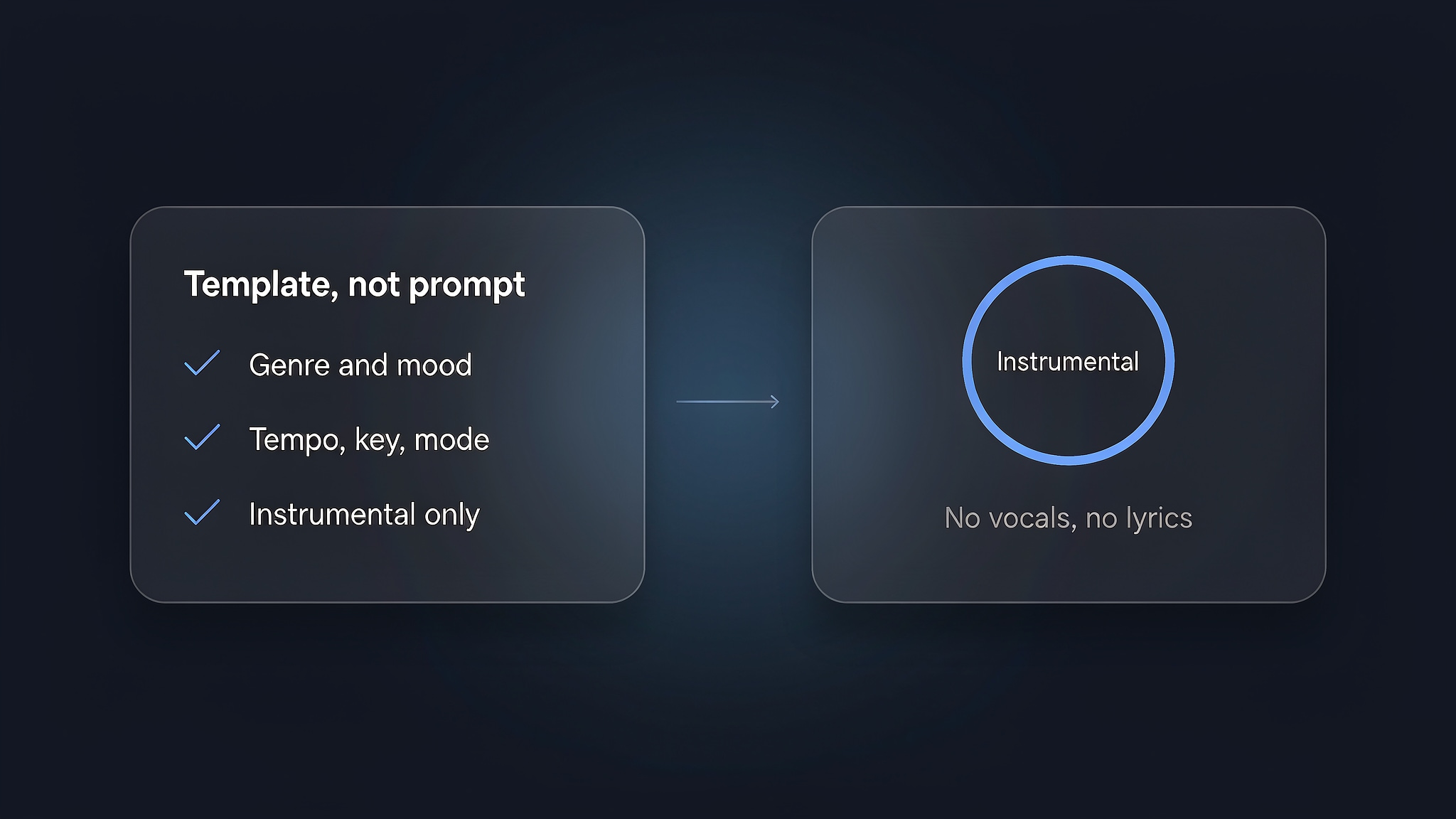
That positioning has two consequences worth stating before the review proper. First, judging Soundful on how well it writes a song misses the point, because writing songs is not the job it takes. Second, judging it purely on how quickly it produces background music is the right frame, and on that measure the templates are a feature rather than a limitation.
How Soundful Works in Practice
Six decisions produce a finished track, and the platform keeps them visible rather than hiding them behind a prompt box.
Choose a template, a mood and a genre
Everything starts from a template, with the paid tiers exposing a library that runs to roughly 150 styles against around 25 on the free tier. Templates are organised by use case as much as by genre, which is the practical part: a lofi bed for study content and a corporate bed for a product explainer are different jobs, and the library reflects that.
Dial in tempo, key and mode
The controls are musical rather than verbal. You set the tempo in BPM, choose a key, and pick major or minor, then generate. For editors working to a fixed cut, the tempo field is the difference between a track that fights the edit and one that sits inside it, and it is the reason a slider interface can beat a prompt for this kind of work.
Preview, then regenerate or adjust
The platform returns a preview, and from there you either accept it, regenerate for a variation, or adjust the parameters and go again. The important behaviour to understand is that regeneration is variation rather than transformation: the template's underlying structure tends to persist across attempts, so the parameters are your main lever.
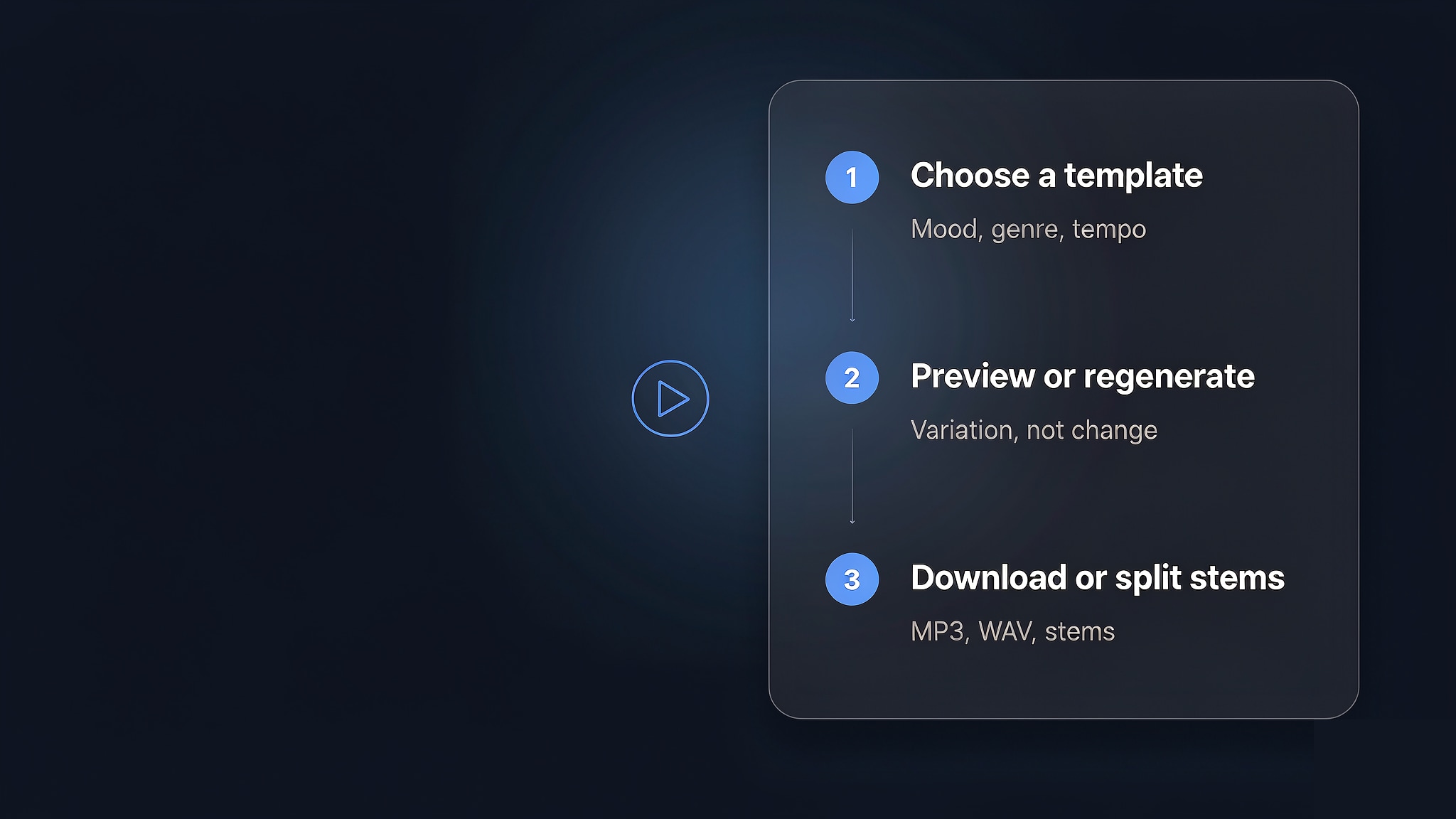
Download, split stems, or send it to SoundCloud
Export formats depend on the tier. The entry paid tier downloads MP3 and WAV, the higher tier adds stem packages and direct distribution to SoundCloud, and the business tier raises the download allowance substantially. Stem packages matter more than they look: being able to take the drums out from under a track is what lets you place music under dialogue without ducking the whole mix.
What the Soundful AI Music Generator Gets Right
Three advantages held up when we read the vendor's documentation alongside the independent reviews published this year, and they explain why the platform has stayed in the conversation even as prompt-driven tools grew louder.
The lowest realistic cost per track
The middle tiers sit under ten dollars a month, and the download allowances are generous relative to that price. For a creator publishing several videos a week, the effective cost of a licensed background track lands in the range of a few cents, which is difficult to beat anywhere in the category. This is the single strongest argument for the platform.
Usage terms written for the people who need them
Soundful's licensing is explicit about what each tier covers, which is more than can be said for several competitors. The Music Creator tier covers YouTube, social platforms, podcasts and streaming; the free tier excludes commercial use; and uses that fall outside the standard terms — broadcast, television, advertising — are handled as separate purchases. The company also holds a Fairly Trained certification for training data, has stated publicly that its models were not trained on copyrighted music, and built its catalogue from its own producers' recordings. That is a certification based on the company's own disclosure rather than an external audit of compensation, so treat it as documented intent rather than an independently verified claim — but it is a stronger position than most of the category can state.
Collaboration models from established producers
The Collabs programme builds style models with named producers, giving the library a set of textures that are recognisable and signed rather than generically labelled. For creators whose content has a distinct aesthetic, that is a shortcut to music that fits without sounding like a stock library.
Pricing and Plans
As of September 2026, Soundful lists a free tier and three paid tiers on its pricing page, with a custom tier above them. Free includes one MP3 download per month across roughly 25 styles, requires attribution and excludes commercial use. Plus is quoted at $4.99 per month for 100 MP3 and WAV downloads per month and roughly 150 styles.
Pro is $9.99 per month, raising the allowance to 400 downloads and adding stem packages and SoundCloud distribution. Business is $45.99 per month across several download tiers, adding a larger stem allowance and business licensing. Enterprise is quoted on request.

The conversion to keep in mind is not the subscription price but the cost per usable track. At the Pro tier, the allowance works out to well under ten cents per download, and the licence that comes with it covers the platforms most creators publish to. Where the cost structure becomes expensive is at the edges: uses the standard licence does not cover, such as television or paid advertising, are sold separately rather than included, and a single-track rights purchase is quoted on the order of $49.99. That is not unusual for stock-style licensing, but it is worth knowing before planning a campaign that needs broadcast clearance rather than social clearance.
Plan names and allowances have shifted more than once, and the vendor's site does not always present them identically across pages. Check the official pricing page for the current plans and limits rather than relying on a summary, including this one.
Compare what a plan includes.
Enkio plans include AI music video generation, templates, and watermark-free downloads depending on your plan.
Real Limitations
The limitations we found are structural rather than cosmetic, and two of them are the direct cost of the design that makes the platform cheap.
No vocals, and no way to ask for them
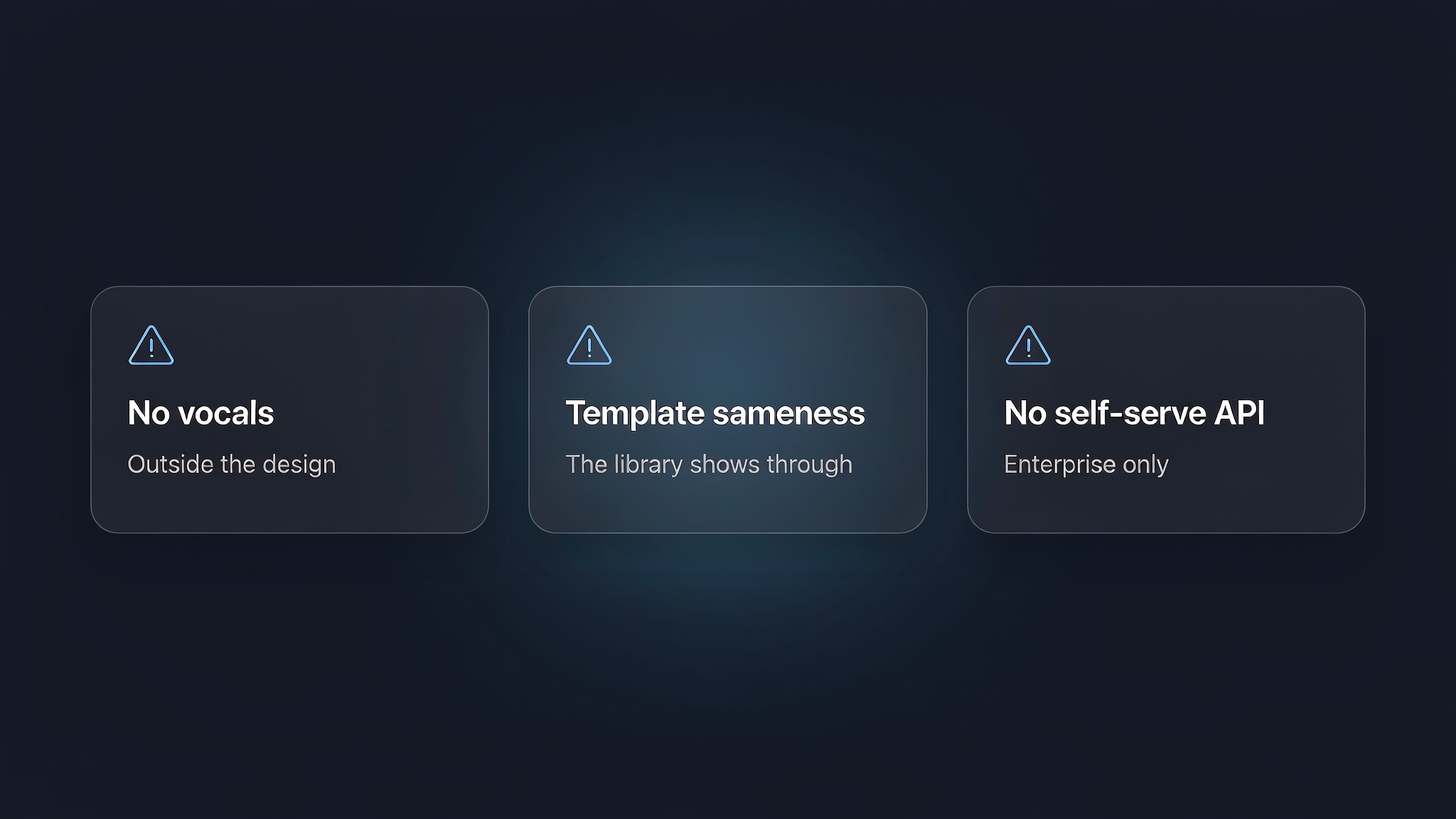
If your project needs a sung vocal, Soundful cannot produce one. Vocals are not a setting that is currently missing; they are outside the product's design, and the company does not position the tool against songwriting platforms. The practical implication is that a project needing both a song and a background bed requires two tools rather than one.
The interface removes expressiveness along with the prompt box
Templates are fast and they are also a ceiling. There is no written instruction, no reference track, no lyric input and no structural control beyond the parameters on screen, so you cannot ask for a specific arrangement idea and get it. On a copy that needs to hit a brief precisely rather than sit under a voiceover, the difference between parameter control and prompt control becomes the reason to choose something else — our Loudly AI music generator review covers a platform that keeps both entry points, and stems and an API with them.
Output within a template tends to sound related
The most consistent criticism in independent reviews is sameness: tracks generated from the same template share enough structure and instrumentation that a heavy user begins to hear the library behind the music. For a single video that is invisible. For a channel publishing daily, the repetition is the complaint viewers eventually notice and the one a creator is least able to fix from inside the tool, since the levers are the same parameters that produced the run.
No self-serve API, and a quiet roadmap
The company's public position is that an API is not offered under its standard terms, with integration handled at the enterprise level instead — a meaningful difference from competitors that document a usage-priced API for developers. Independent reviewers in 2026 also describe development as having slowed, with little visible change to the product and a community that has largely stopped discussing it. A stable tool with no surprises is not a problem for a creator, but it is a consideration for anyone planning a workflow that depends on integrations arriving later.
How It Compares With Soundraw
In our comparison, the closest rival is not a songwriting platform but another template-driven instrumental tool, so that is the one worth making.
| Dimension | Soundful | Soundraw |
|---|---|---|
| Interface | Genre template plus tempo, key and mood | Visual selection of genre, mood and length |
| Written prompts | Not supported | Not supported |
| Vocals | Instrumental only | Instrumental only |
| Editing depth | Parameters and regeneration | Bar-level editing with instrument toggles and intensity |
| Entry paid price | $4.99 per month | Around $11 per month billed annually |
| Download allowance | 100 downloads on the entry tier | Tier-dependent, with unlimited generation before download |
| Free tier | One download a month, no commercial use | Unlimited previews, no downloads |
| Distinctive feature | Producer collaboration style models | Advanced mixer for section-level control |
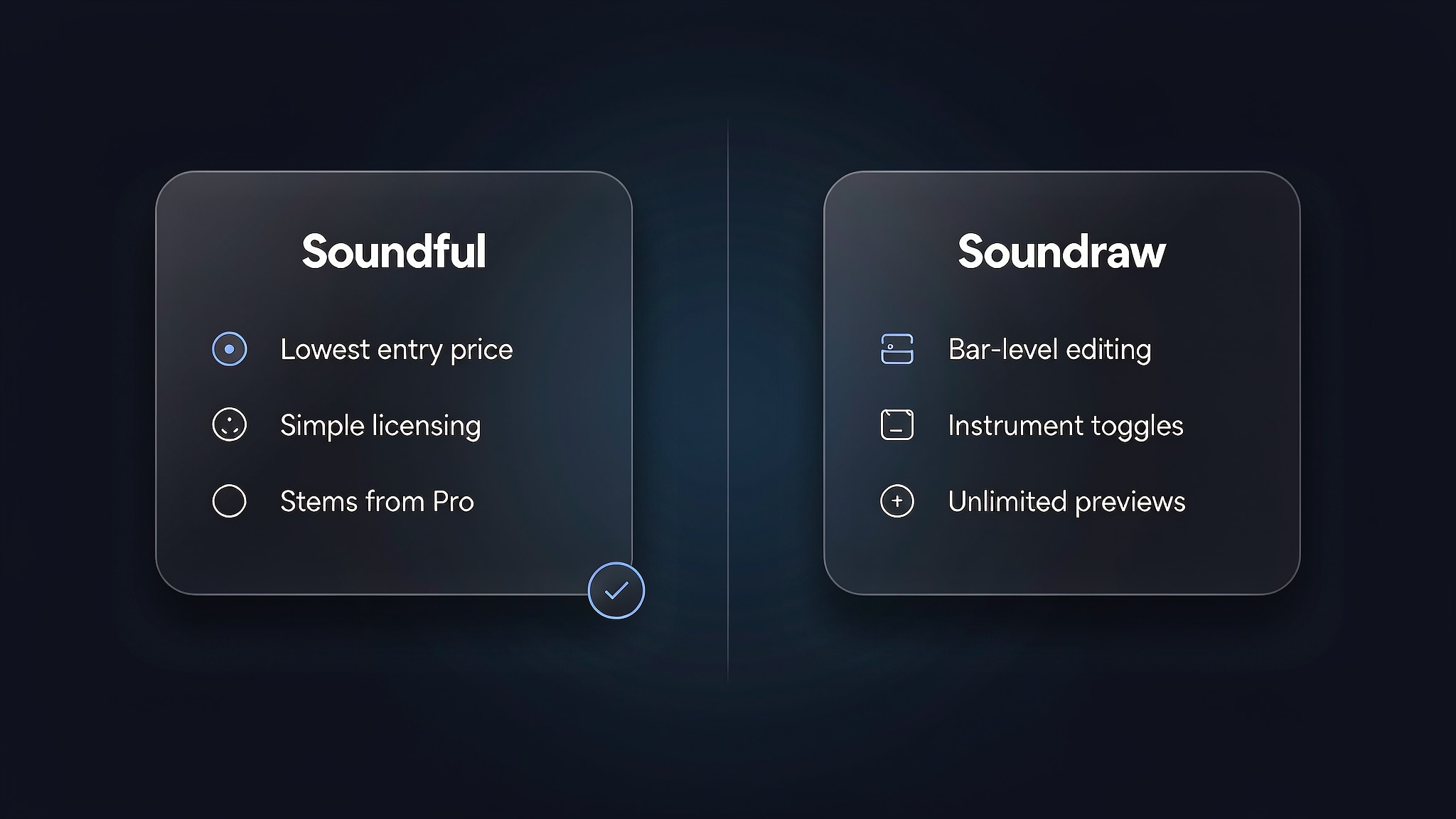
Both columns are a snapshot as of September 2026, and both platforms adjust pricing between promotions, so verify the current numbers with the vendors. Soundful wins on price and on the straightforwardness of its licensing tiers; Soundraw wins on how much control you have after the track exists. For the fuller picture of both options and the rest of the series, see our AI music video and music generator reviews.
How Soundful's Licensing Works for Creators
The licensing model is the part of this product most likely to surprise people, in both directions, so it is worth stating plainly. Soundful retains ownership of the master recording and grants you a licence to use it. The tier you buy determines what that licence covers: the free tier is non-commercial and requires attribution, the standard paid tier covers the platforms most creators care about, and broadcast, television and advertising uses sit outside it and are priced separately. A single track's rights can also be purchased outright if you need to own rather than license it.
The practical upshot is that this is a stock-licensing arrangement, not an authorship arrangement. What you buy is the right to use the music in defined ways, and it is durable in the way a licence is durable — which is genuinely useful for a channel that needs consistent clearance, and different from the copyright position you would hold over a track you wrote yourself. Read the vendor's terms for the version that applies to your purchase, since the definitions are what govern the outcome.
Common Misconceptions
Two assumptions circulate often enough to be worth correcting.
Misconception one: royalty-free means I own the music
Royalty-free describes the payment structure — no per-use royalties — rather than the ownership of the underlying rights. Under Soundful's terms the master stays with the company and you hold a licence, which is a perfectly workable arrangement and a different legal position from authorship. If you need to own the recording, buy the track out or generate on a platform whose terms transfer ownership.
Misconception two: the free tier is a small version of the paid product
The free allowance is one download a month, it excludes commercial use, and it requires attribution, which places it in the evaluation category rather than the production category. Nothing can be published commercially from the free tier. Treat it as a way to hear the templates, not as a way to work.
Who the Soundful AI Music Generator Is For Right Now
Our verdict splits by what you need after the track exists. The platform suits three groups clearly: creators who need a regular supply of background music under a predictable small monthly cost; podcasters and video editors whose music has to sit under a voice without competing; and agencies that need licensed beds with paperwork that survives a client review. For all three, the combination of price, stems and explicit tier terms is difficult to match.
It is a weaker fit for anyone who needs vocals, which rules out songwriting projects entirely; for producers who want to write toward a specific brief in words; for anyone who needs to own the master; and for product teams that need a documented API. If your requirement is closer to a full song than a backing track, the platforms built for songwriting are the better starting point.
From a Soundful Track to Something You Can Publish
Instrumental music is often the start of a video rather than the end of a project, and that step needs a different tool. A licensed background track still has to be paired with footage before it reaches an audience.
Enkio's AI music video generator takes a track plus a visual direction and returns a music video, with 720p and 1080p output across five aspect ratios including 9:16 and 16:9, on a credit model rather than per-video purchases. Instrumental beds are a natural fit for this workflow, particularly with the stem packages the higher Soundful tiers provide, since a mix without vocals leaves more room for the visuals to carry the piece. Check the current plans and credit costs on Enkio's pricing page before you plan a release around it.
One reminder applies whichever route you take: platform policies on AI-generated content differ, and several major platforms expect disclosure when a track or video is machine-generated. Check the destination platform's current guidelines before publishing, particularly if monetisation is the goal.
Make more from your MV.
Let Enkio create a complete AI music video from your song with cinematic templates.
Frequently asked questions
These are the questions we see most often about the Soundful AI music generator, answered for the platform as it stands.
Is the Soundful AI music generator free?
There is a free tier, and it is an evaluation tool rather than a working one: one MP3 download per month, a smaller style library, required attribution and no commercial use. Most users who continue move to the entry paid tier, where downloads become usable in real projects. Check the official pricing page for the current free limits.
Does Soundful generate vocals?
No. The platform is instrumental only and does not offer lyric or vocal generation. Projects that need a sung vocal require a different tool, and combining two platforms for one production is the usual arrangement.
How much does Soundful cost?
As of September 2026, Soundful quotes Plus at $4.99 per month, Pro at $9.99 per month with stem downloads and SoundCloud distribution, and Business at $45.99 per month with higher allowances, plus a limited free tier. Plan names and allowances have changed before, so verify them on the official pricing page.
Can I release Soundful tracks on Spotify and YouTube?
The standard paid licence covers social platforms, streaming and podcast use, and the free tier does not cover commercial use at all. Broadcast, television and paid advertising fall outside the standard terms and are purchased separately. Soundful retains the master, so what you are releasing is used under licence rather than owned outright. Read the current terms for your tier.
Do I get stems for editing?
Stem packages are included from the Pro tier upward, alongside MP3 and WAV downloads. Stems are the difference between placing a track under dialogue and having to duck the whole mix, so if editing flexibility matters, the tier decision follows from that rather than from the download count.
Does Soundful have an API?
Not on a self-serve basis. The company's terms state that API use is not available under the standard agreement, with integration handled at enterprise level. Teams that need programmatic generation should look at platforms that document a usage-priced API instead.
Conclusion
Soundful does one job precisely: it produces instrumental beds quickly, cheaply and with usage terms most creators can read in a minute. The template interface is why the tracks are consistent and also why they are limited, and the instrumental-only design is why the platform is good at background music and irrelevant to songwriting. If you need a reliable supply of licensed music under a small fixed cost, this is one of the best-value options in the category right now. If you need vocals, prompt-level control, an API or ownership of the recording, choose accordingly — and read the licensing terms for your tier before you build a library on top of them.