





Riffusion has been three different products in four years: an open-source experiment that generated audio from spectrogram images, a free unlimited generator that went viral, and now a Google-owned studio built on DeepMind's Lyria models. Our review of the Riffusion AI music generator covers all three stages, because the reason most people search for this name today is that they remember the second one and have not caught up with the third.
The short answer: Riffusion's engine and its team now live inside Google Flow Music, where the low entry price survived the acquisition, the unlimited free tier did not, and the product carries Google's watermarking, language coverage and generation limits.
What the Riffusion AI Music Generator Is
The name comes from a research project published at the end of 2022. Its authors, Seth Forsgren and Hayk Martiros, applied image diffusion to spectrograms — pictures of sound — and converted the results back into audio. It was a clever demonstration rather than a product, and it circulated widely among people who follow generative models rather than among musicians.
The project became a company in 2023 on a $4 million seed round, and the first commercial version followed the free-tier playbook that defined the category: a new model released early in 2025 generated complete songs with vocals at no cost, at a quality that had been a paid feature months earlier. That release is why the phrase "free AI music generator" still leads people to this name.
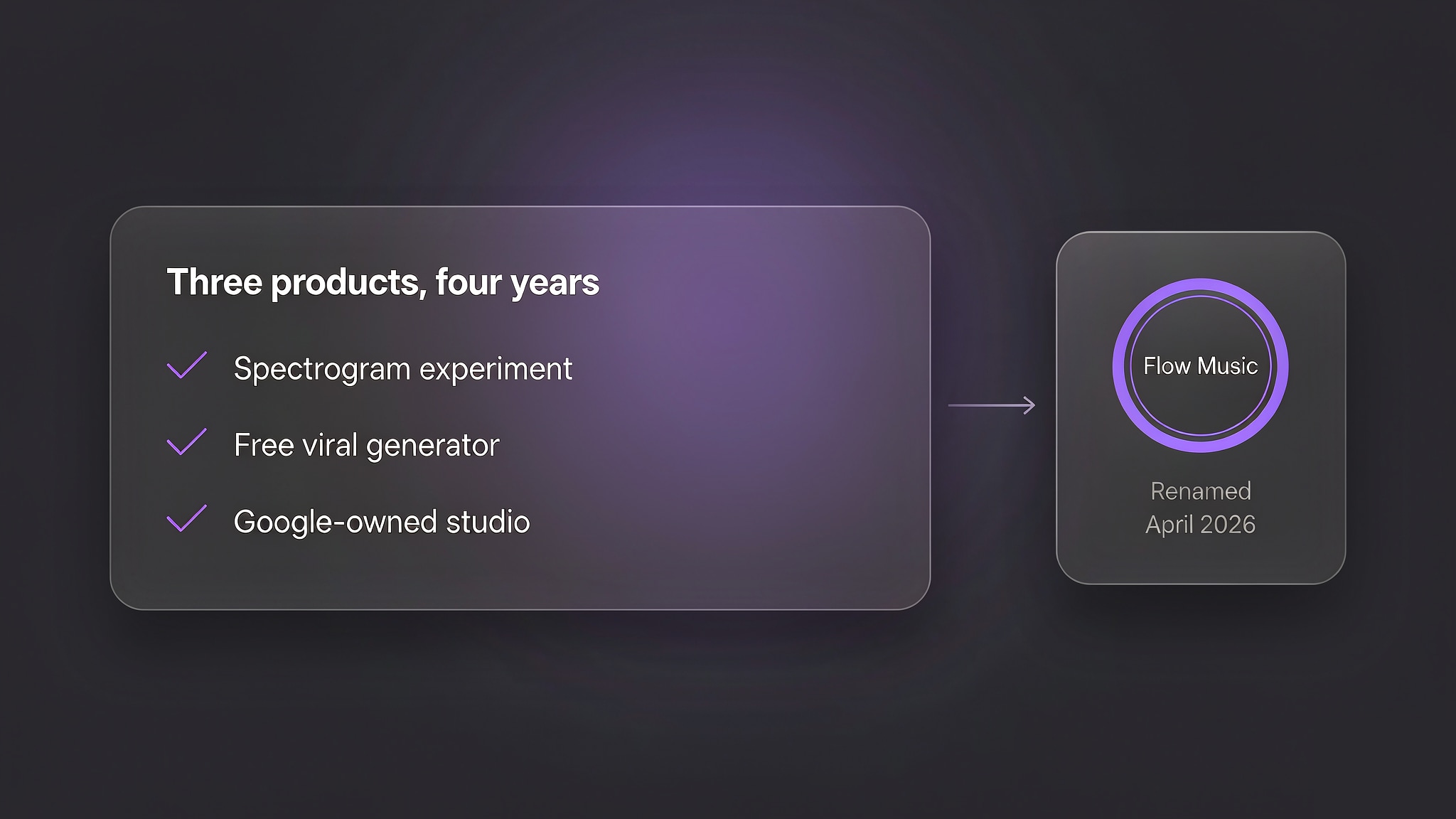
The second transition was quieter and more consequential. The company relaunched as ProducerAI, a conversational system for generating and revising complete songs, and in February 2026 Google acquired it and moved the team into Google Labs and Google DeepMind. The service was renamed Google Flow Music in April 2026, and the old domain now redirects to the current product. Song generation on the platform today runs on DeepMind's Lyria models, which reached their current version in July 2026, and the platform has been folded into the same product family as Google's video and image tools.
That history explains why answers to straightforward questions about Riffusion disagree with each other. Review sites that describe an anonymous, unlimited, spectrogram-based tool are describing a product that stopped existing; sites that list a $6 entry tier are describing what replaced it.
How It Works in Practice
The current workflow is built around conversation rather than one-shot prompting, and the difference shows up as soon as you try to fix something.
Draft a song by describing it, then keep talking
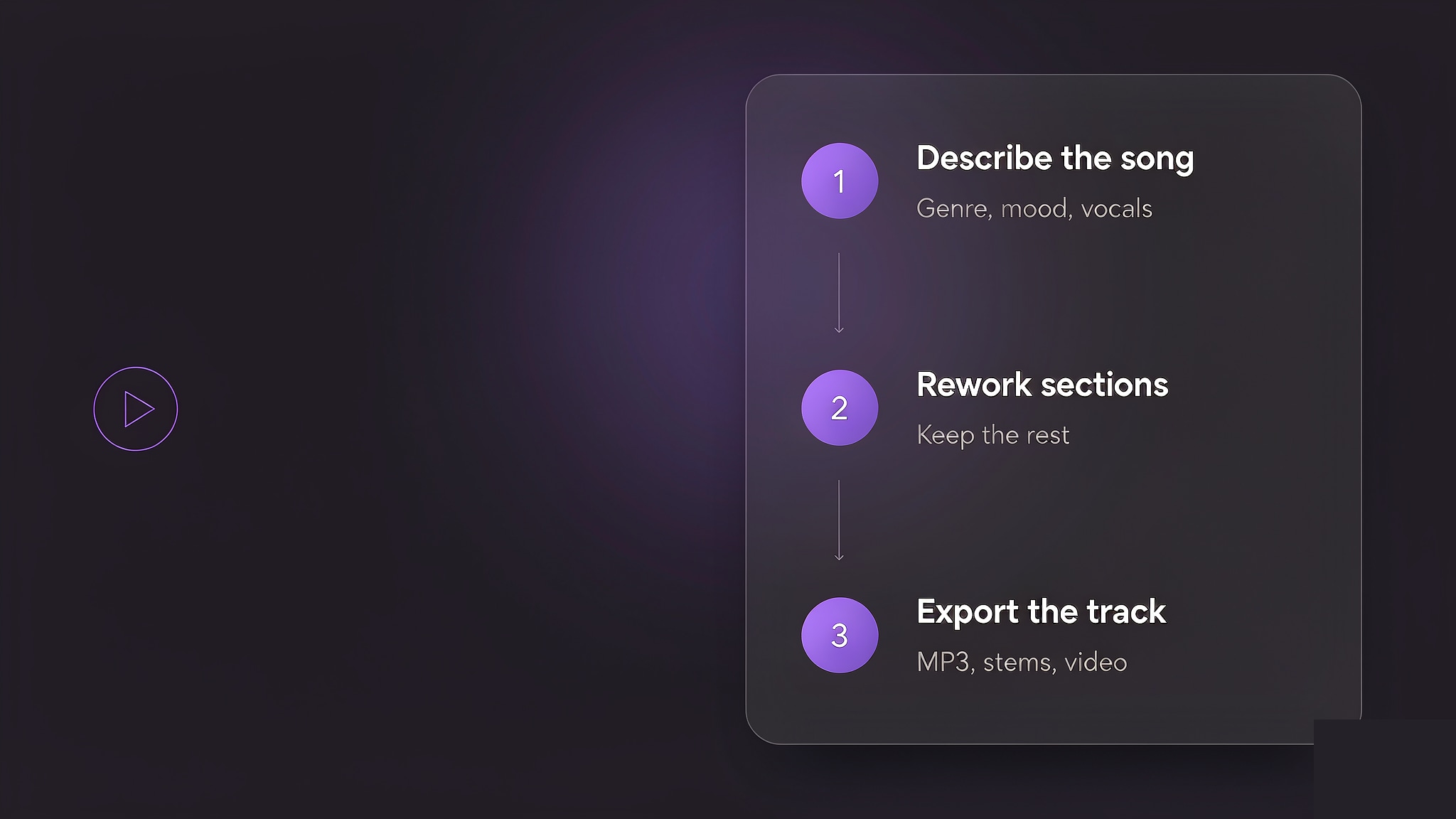
You describe what you want — a genre, a mood, an arrangement idea, a vocal character — and receive a draft. The difference from most competitors is what happens next: instead of starting over, you respond in plain language, asking for a shorter intro, a bridge, a more prominent kick drum or a different instrument, and the system revises the track while keeping the rest.
For anyone who has spent an afternoon regenerating prompts to change one section, this is the feature that justifies the product.
Rework sections, extend ideas and make covers
The editing layer goes beyond instructions. A specific part of an existing track can be reworked without discarding the whole piece, a short melodic idea can be extended into a full song, and cover treatments can be produced from an existing track. Track length extends up to roughly three minutes, and tempo and duration are now directly controllable rather than something you steer by trial and error.
Build your own instruments in Spaces
Spaces is the part of the product with no close equivalent elsewhere. It is a workspace for describing instruments, effects and small musical tools into existence instead of choosing them from a preset list, and it has picked up song generation, editing, stem splitting and image and lyric generation over successive updates. Reviewers consistently single it out as the genuinely distinctive control surface on the platform.
Export the track, the stems, or the video
Finished songs export as MP3, with stem separation available, and the video-generation features in the Flow family can turn a track into a music video. Everything the platform produces carries SynthID, Google's inaudible watermark for machine-generated content, which is a disclosure mechanism rather than a defect — but it is worth knowing about before you plan a release.
What the Riffusion AI Music Generator Gets Right
Three strengths survived the transition intact when we read the platform's documentation alongside the independent testing published this year, and they are the reason it stays in comparisons despite the ownership change.
A free tier you can actually evaluate on
The current free tier grants a starting credit allowance, and holders of Google's own AI plans get the corresponding tier folded in. Free evaluation allowances are common in this category; what is less common is a free tier attached to a model that reviewers describe as understanding song structure, so the evaluation is of the real product rather than a degraded version of it.
Conversational revision instead of prompt roulette
Independent commentary credits the current model with following structural instructions — an intro that builds into a chorus, a bridge that changes the texture — rather than treating a prompt as a single roll of the dice. Combined with section-level replacement, that turns generation into an editing process, which is how working producers actually operate.
Rapid model improvement under a large owner
The platform has moved through several model generations within a single year, with each release claiming better melodic structure, lyrics and vocal pronunciation. Whether or not every claim holds, the release cadence is faster than most independent vendors can sustain, and improvements arrive inside the same free tier rather than behind a new product.
Pricing and Plans
As of September 2026, the platform runs a free tier plus three paid tiers, with higher tiers adding credits and simultaneous generations rather than changing the fundamental capability.
The free tier grants a starting credit allowance on signup. Starter is quoted at $6 per month, Plus at $18 per month, and Member at $48 per month, with the top tier including early access to new features and Google's own AI subscription holders receiving the corresponding tier.
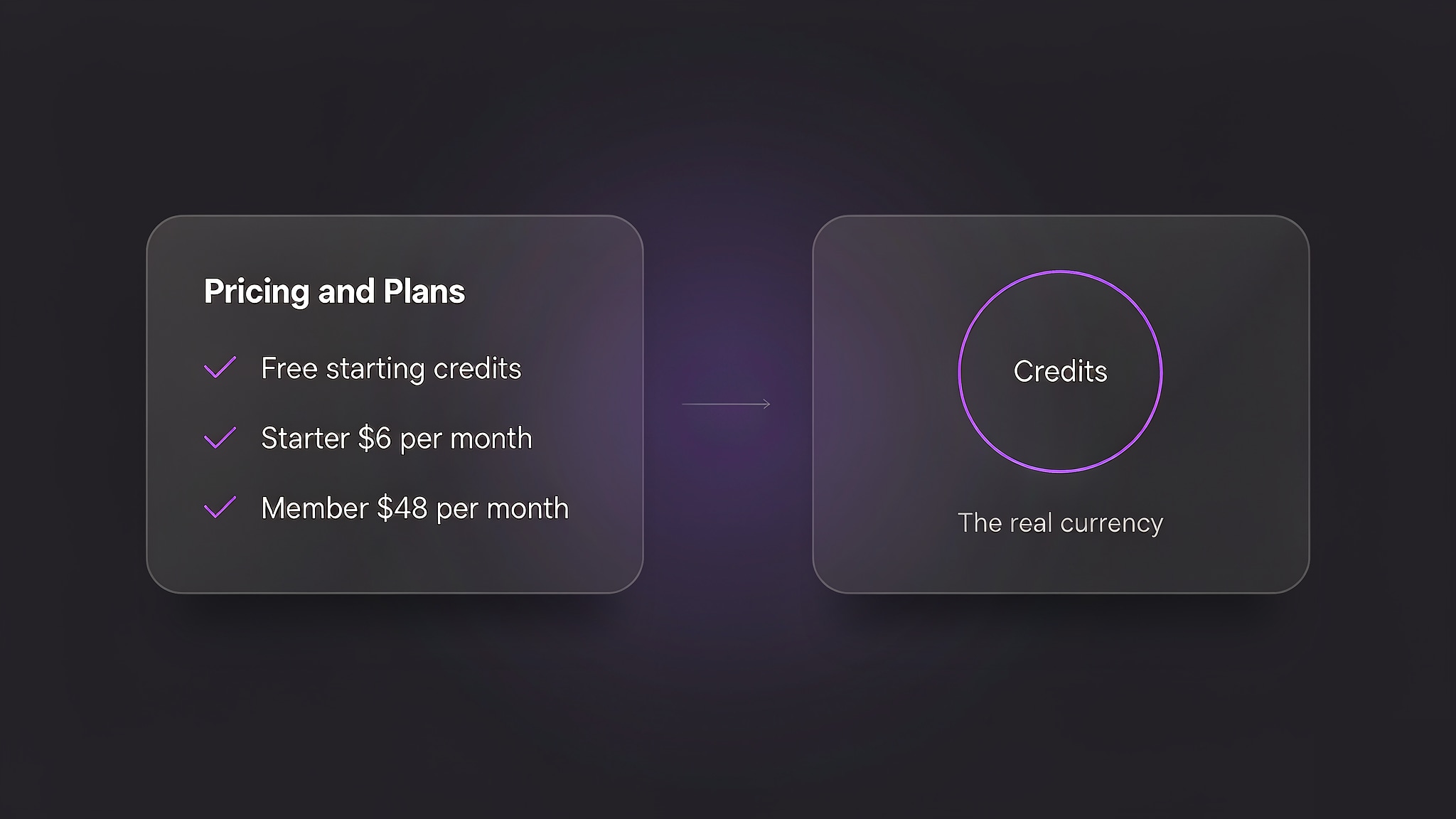
Two details matter more than the headline numbers. First, the entry price is lower than most of the category — it sits roughly half of what the best-known competitor charges at the equivalent tier — and unlike the original product's giveaway phase, the paid tiers now include commercial use.
Second, credits are the real currency: a three-minute song and a short experiment draw on the same pool, so the plan number describes a budget rather than a track count. Third-party listings that quote a $5 or $10 tier are describing the pre-acquisition product; prices sit with the vendor and have changed repeatedly, so check the official pricing page for the current plans.
Compare what a plan includes.
Enkio plans include AI music video generation, templates, and watermark-free downloads depending on your plan.
Real Limitations
The limitations we found fall into two groups: what the model still does not do well, and what changed when the product moved inside a larger company.
Vocals remain the weak point
Independent testing published in the middle of 2026 scored the platform's vocal-led output well below both leading competitors, with vocal artifacts, inconsistent loudness and occasional lyrical incoherence showing up more often. Instrumental and ambient material fares better, and electronic and experimental output sits in the usable range. If a track has to stand on its vocal performance, this is the comparison that decides the purchase.
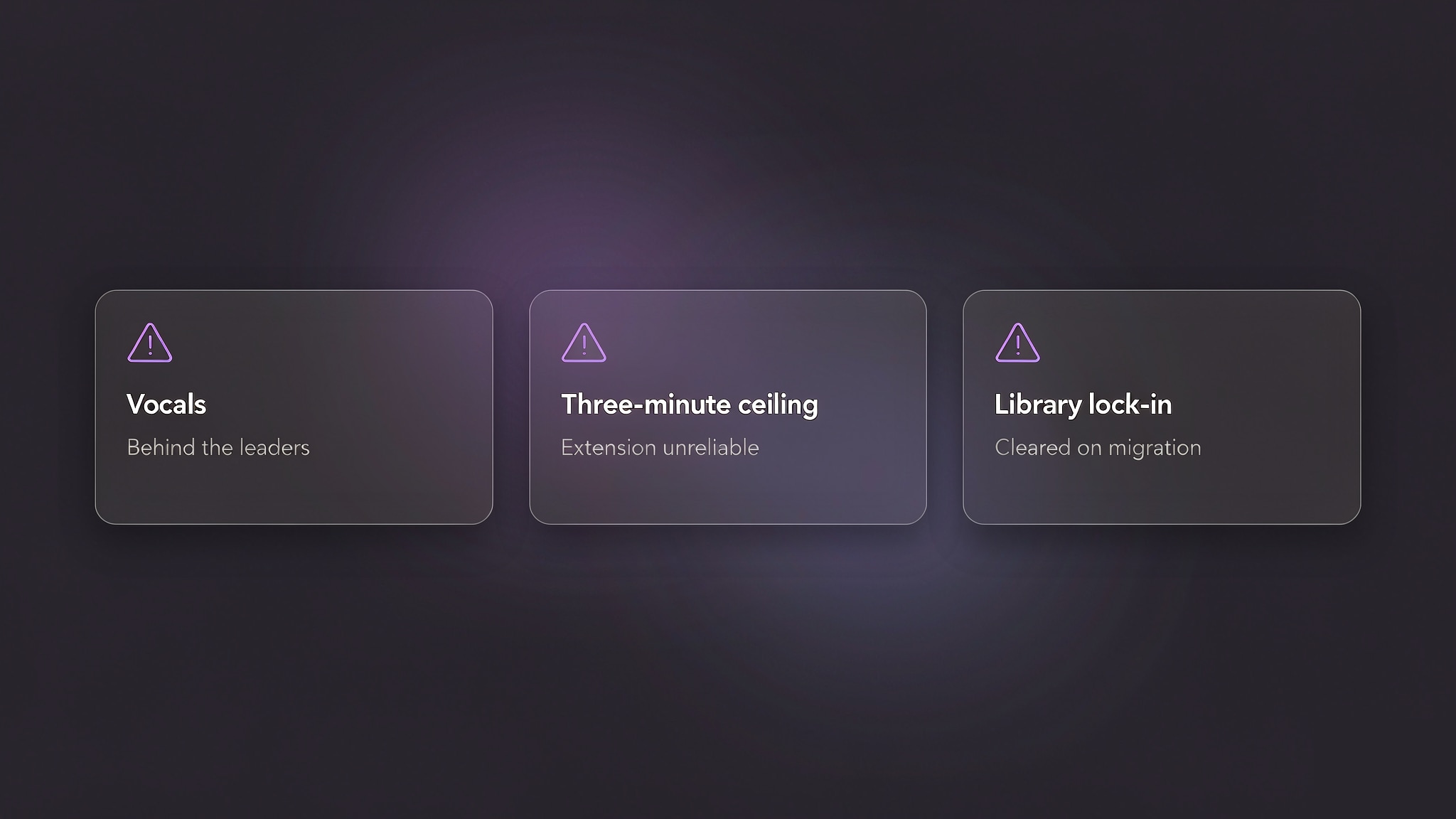
A three-minute ceiling and unreliable long-form continuation
Output is capped at roughly three minutes, which covers a single or a sync cue and not a full arrangement. Attempts to extend beyond the comfortable range are the least reliable part of the workflow, so material that needs to run longer than a radio edit should be planned as several sections rather than one continuous generation.
Your library belongs to the platform
The transition between products came with a step that deserves more attention than it received: the historical track library was cleared when the platform changed, and users who had built up material lost access to it. Nothing about that was unusual for a product migration, and the lesson generalises well beyond this vendor. If your work depends on being able to keep using a track years from now, understand the export rights and the ownership terms before you build a library on any generator, because the company's roadmap is not something you control.
Watermarking and distribution screening
Every output carries Google's SynthID watermark, which is detectable by verification tools. Separately, the major distributors have been tightening automated screening of machine-generated submissions, and third-party testing found that platform output can be flagged or held during that screening. Neither fact makes the music unusable; both mean that a release plan should account for disclosure and for a possible manual review rather than assuming a clean upload.
How It Compares With Suno in 2026
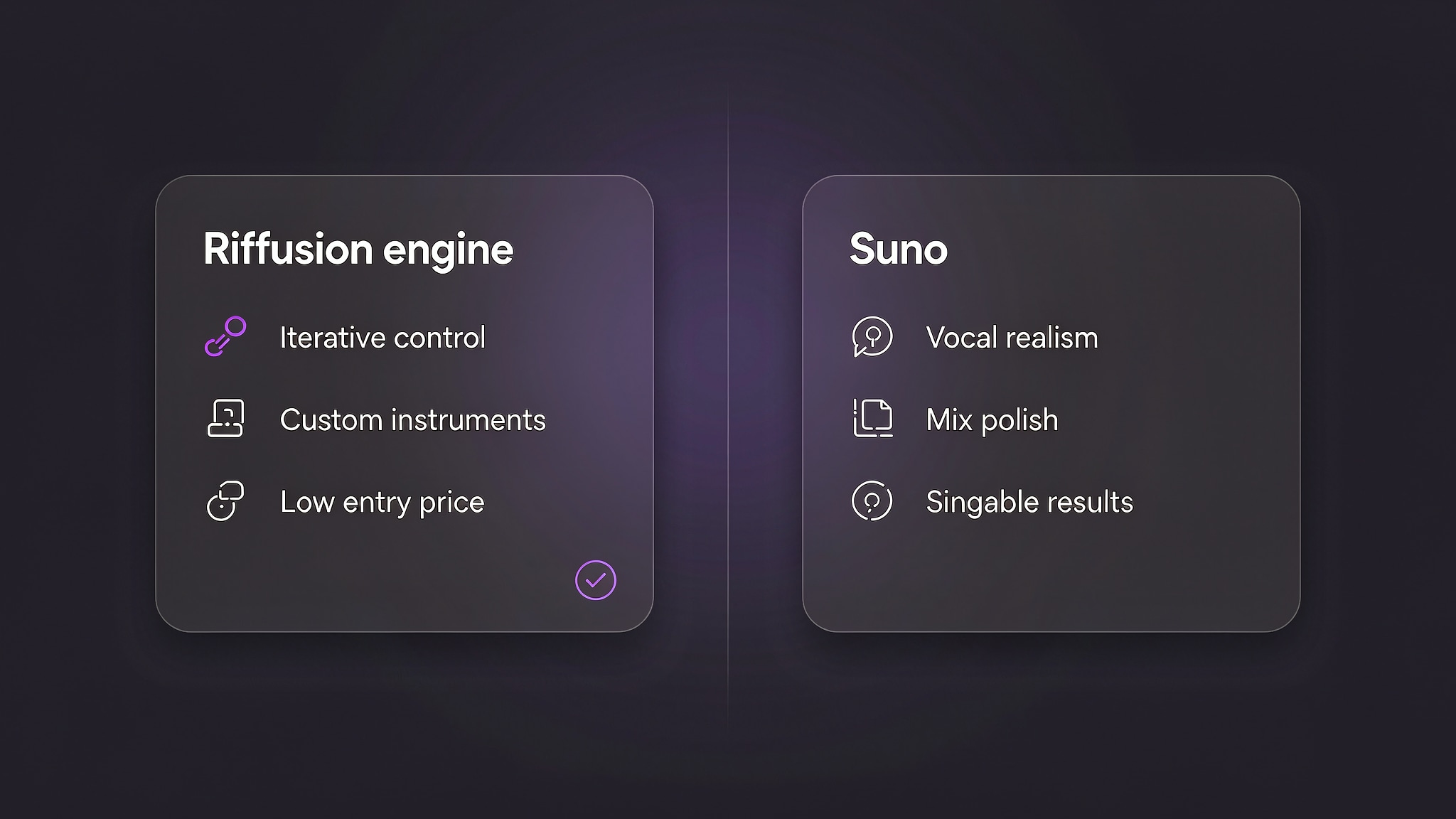
The comparison most readers are making is between this platform and the category leader, so a short table helps. What we found across the current testing is a genuine split rather than a winner: this platform leads on iterative control, and the other leads on vocals.
| Dimension | Riffusion engine (Flow Music) | Suno |
|---|---|---|
| Generation approach | Conversational drafting with section-level rework | Prompt-led generation with editing tools |
| Typical strength | Iterative control, custom instruments, low entry price | Vocal realism, mix polish, singable results |
| Vocals | Usable, behind the leaders on vocal-led material | The reference point in the category |
| Track length | Roughly three minutes | Longer arrangements supported |
| Watermarking | Inaudible watermark on all output | Depends on tier and platform policy |
| Entry price | $6 per month, plus a free starting allowance | Around $10 per month |
| Ownership | Vendor-controlled platform, Google-operated | Vendor-controlled platform |
Both columns are a snapshot as of September 2026 and both platforms revise models frequently, so treat the table as a starting point rather than a settled ranking. The independent testing published this year remains the better source for where either platform currently stands.
The Google Acquisition and What It Means
For anyone choosing a tool, the acquisition matters for three reasons, and only one of them is about quality. The first is stability: the model now improves on a large company's release cycle, and the platform is clearly Google's surviving music product rather than a side experiment, which is reassuring if you were worried about the vendor disappearing.
The second is lock-in: your material lives in a walled product, the watermark is Google's, and the terms are Google's, which changes nothing today and everything in the event of a policy change.
The third is industry trajectory — independent leaders in this category have been consolidating, partnering or litigating, and the platform you pick is increasingly a bet on the company behind it. Our AI music video and music generator reviews cover several platforms whose distribution rules were rewritten by deals or settlements, which is the same lesson from different directions.
One related development is worth stating carefully. Google's music generation faces a proposed copyright class action filed in 2026, in which plaintiffs allege that a large volume of their recordings was used in training without permission. Those are allegations that a court has not established, and Google's position is that its models use material it has the right to use. Anyone considering the platform for commercial release should follow the case rather than treat either side's framing as settled.
Common Misconceptions
Two assumptions we see repeated about this product are widespread enough to mislead people in opposite directions.
Misconception one: it is still the free unlimited generator
The viral phase of 2025 genuinely offered unlimited generation for a period, and that period is over. The current product runs on credits across a free tier and three paid tiers, and the free allowance is a starting balance rather than an open tap. Guides that still describe unlimited free use are describing a product that has changed twice since.
Misconception two: Riffusion is one of the platforms being sued by the major labels
The 2024 filing that shaped this category's legal landscape named two other platforms, not this one. The more recent case concerns the model the current product runs on rather than the original Riffusion project, and it is a proposed class action rather than a judgment. Treat the distinction carefully: the legal exposure belongs to whichever entity operates the product you use.
Who the Riffusion AI Music Generator Is For Right Now
In our reading, the product suits three groups well. It is a sensible first stop for anyone who wants to evaluate AI music generation without paying, because the free allowance sits on the current model rather than a stripped one. It suits producers who think in revisions rather than prompts, since conversational editing and section replacement are the strongest parts of the workflow. And it suits anyone who wants to build unusual instruments or effects through description, which no competitor matches directly.
It is a weaker fit for anyone whose work depends on vocal performance, where the leader remains the safer choice; for anyone who needs tracks longer than a few minutes without stitching sections together; and for product teams that need a documented, self-serve API, where a platform like the one in our Loudly AI music generator review is the more practical route.
From a Riffusion Track to Something You Can Publish
A finished audio file does not travel on its own. TikTok, Shorts, Reels and YouTube all want video, and the export formats that a music platform provides are the input to that step rather than the output of it.
Enkio's AI music video generator takes a track plus a visual direction and returns a music video, with 720p and 1080p output across five aspect ratios including 9:16 and 16:9, on a credit model rather than per-video purchases. A three-minute song fits that workflow comfortably, since the length ceiling on the music side is roughly the length of a short-form video's worth of material. Check the current plans and credit costs on Enkio's pricing page before you plan a release around it.
One reminder applies whichever route you take: platform policies on AI-generated content differ, and several major platforms expect disclosure when a track or video is machine-generated. Watermarked output from this platform makes that disclosure straightforward but does not remove the requirement. Check the destination platform's current guidelines before publishing, particularly if monetisation is the goal.
Make more from your MV.
Let Enkio create a complete AI music video from your song with cinematic templates.
Frequently asked questions
These are the questions readers ask most about the Riffusion AI music generator, answered for the product as it exists now.
Is the Riffusion AI music generator still free?
There is a free tier that grants a starting credit allowance, and it is a genuine allowance rather than a trial, but it is not the unlimited access the platform offered during its viral period. Beyond the free credits you move to one of three paid tiers. Check the official pricing page for the current free limits.
Is riffusion.com still the right address?
The original domain now redirects to the current product, which was renamed in April 2026. Anyone following an older link arrives at the right place automatically, but any guide that describes the product by its former names is describing an earlier version of it.
How much does the Riffusion AI music generator cost now?
As of September 2026, the platform quotes a free tier plus Starter at $6 per month, Plus at $18 per month, and Member at $48 per month, with credits and concurrent generations scaling across the tiers. Prices sit with the vendor and have changed several times, so verify them on the official pricing page.
Does it generate vocals?
Yes, with limits. The model generates vocals with lyrics in a number of languages, and pronunciation and expression have improved with each release. Independent testing still places vocal-led output below the category leaders, so material that depends on the vocal should be tested early.
Can I use the output commercially?
The paid tiers include commercial use, and output carries an inaudible watermark that identifies it as machine-generated. The terms that govern redistribution, watermarking and platform disclosure are set by the vendor, so read them directly rather than relying on a summary. Distribution platforms have also tightened automated screening of generated submissions, so allow time for that step.
Was Riffusion one of the platforms sued by the major record labels?
No. The prominent filing that reshaped this category named two other platforms. The later case involving the model this product now uses is a proposed class action against the parent company, not a claim against the original Riffusion project, and no court has resolved it.
Conclusion
Riffusion's story is the category's story compressed into four years: a research curiosity, a free viral hit, a commercial product, and finally an asset inside a company large enough to fold it into a wider platform.
Judged as the product it is today, it is worth using for the reasons it stood out in the first place — conversational revision, section-level control, custom instruments and the lowest entry price among the serious options — and worth avoiding if the vocal has to carry the track or if you need to know that your library is yours regardless of what the vendor does next. Start on the free allowance, hear the current model, and read the terms before you build anything commercial on it.