





The Kaiber AI music video generator is a stylized, audio-reactive video tool built around its Superstudio canvas. Our review covers what the product actually produces, how its modes and credits work, where the plan tiers place limits, and how it stands next to general-purpose video models.
The short answer: the Kaiber AI music video generator delivers a distinctive audio-reactive look and a flexible node-based workspace, but its core beat-sync feature sits behind the $29-per-month Creator tier and its credit system uses clips up faster than the headline numbers suggest.
What the Kaiber AI Music Video Generator Is
Kaiber is an AI video tool served from kaiber.ai and positioned for musicians and visual artists who want stylized, audio-reactive video rather than photorealistic footage. The product entered the market in 2022 and has stayed close to that music-first brief, which is the first thing to confirm before comparing it with general video generators.
The workspace is called Superstudio, an infinite canvas with a node-based layout that usagepricing.com places at its October 2024 launch. Clips, prompts, and audio sit on one surface, so the tool reads like a moodboard that renders rather than a linear editor, which suits creators who think in scenes and references.
Kaiber sits in the AI Music Generator family, but it renders video from audio rather than the track itself. For creators deciding between a song engine and a video engine, the Alternatives to Suno AI Music Generator guide maps the wider field of music tools that feed video work.
Kaiber is not a photoreal renderer. Its positioning is built on art-directed looks, style transfer, and track-following motion, and third-party reviews note that Linkin Park used Kaiber for the "Lost" music video. That lineage shows the aim: a clip that feels like a record sleeve in motion, not a filmed scene.
How It Works in Practice
The workflow is short; most effort sits in picking a mode and a source rather than in editing afterward.
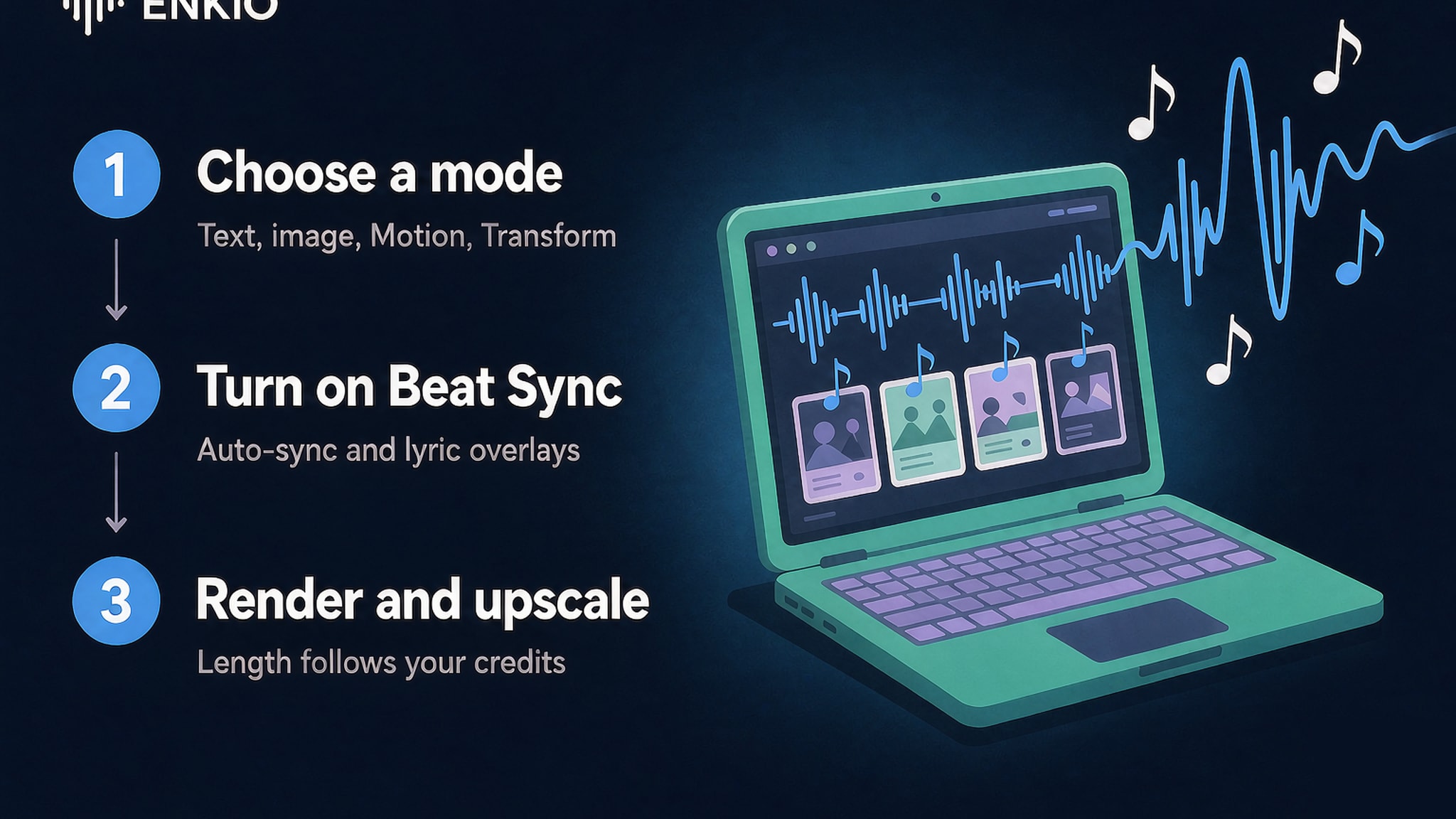
Choose a mode and upload your source
Generation starts from one of several modes: text-to-video, image-to-video, Motion for movement and camera moves, Flipbook for frame-by-frame animation, and Transform for style transfer. You bring a song, image, or clip, and the mode decides what the engine does.
Set style and camera motion
Each mode takes a style direction and, in Motion, a camera path. The controls favor look over exact composition, so the first pass is a styling choice more than a shot list.
Turn on Beat Sync to lock to the audio
Beat Sync is the audio-reactive layer: it auto-syncs to music, detects lyrics for text overlays, offers no-prompt image-to-video, and includes Auto-Clip on higher tiers. This is the feature most tied to the music-video use case, and it is the step that separates Kaiber from a generic text-to-video tool.
Render, upscale, and export
The engine renders the clip, and 4K upscaling is listed by third-party reviews as available on Creator and Pro tiers. Export resolution depends on your plan, and the upscale step is where a meaningful share of credits is spent, which matters for the cost math later.
What the Kaiber AI Music Video Generator Gets Right
Four strengths held up against the official listings and the third-party reviews we read.
The audio-reactive look is its clear signature
Beat Sync's auto-sync, lyric detection, and text overlays are the features multiple independent reviews single out as Kaiber's standout. For a music video, locking visuals to a track's structure is the core job, and Kaiber treats it as a first-class control. The Revid AI Music Video Generator Review and the Neural Frames AI Music Video Generator Review cover two other music-first tools if you want to compare how each handles the audio lock.
Superstudio gives a flexible, non-linear workspace
The node-based infinite canvas, launched in October 2024 per usagepricing.com, is a genuine differentiator against timeline-only editors. Creators who build from references get a surface that matches how moodboards form, which is why some visual artists prefer Kaiber over a strict cut-and-edit app.
Stylized, art-directed output is the point
Transform turns existing footage into an art style, and Flipbook supports frame-by-frame control, so output leans expressive rather than literal. For an artist who wants a video that reads like their cover art, that direction is a feature, not a limitation.
It has a real track record
Kaiber has shipped since 2022 and appeared in notable music videos, with third-party reviews citing the Linkin Park "Lost" clip as a reference use. A multi-year history gives it more real-world evidence than many newer entrants.
Pricing and Credits
As of September 2026, the official pricing page lists the plans below in US dollars, and the vendor may adjust them, so check the official pricing page for current rates before you subscribe. Subscriptions renew automatically until cancelled, and the trial converts to a paid plan unless you cancel.
| Plan | Price per month | What it covers |
|---|---|---|
| Trial | $5 for 5 days | Converts to Creator after 5 days; one per account; cancel anytime |
| Starter | $10 | 500 credits, Premium AI models, commercial use, 1 Canvas, 3 concurrent generations, no Beat Sync, 1 Timeline Edit |
| Creator | $29 | 1,500 credits, 5 Canvases, 15 concurrent generations, Beat Sync (2 videos per batch), unlimited Timeline Edits |
| Pro | $99 | 5,000 credits, unlimited Canvases, Beat Sync (10 videos per batch) plus Auto-Clip |
| Visionary | Custom quote | Unlimited credits; contact support@kaiber.ai |
Credit packs are sold separately at 300 credits for $5, 1,000 for $15, 3,500 for $50, and 20,000 for $250, and annual billing is advertised at 20 percent off. Check the official pricing page for current rates. The detail that decides real value is the per-clip credit cost, not the headline price, so the next paragraph converts the units.
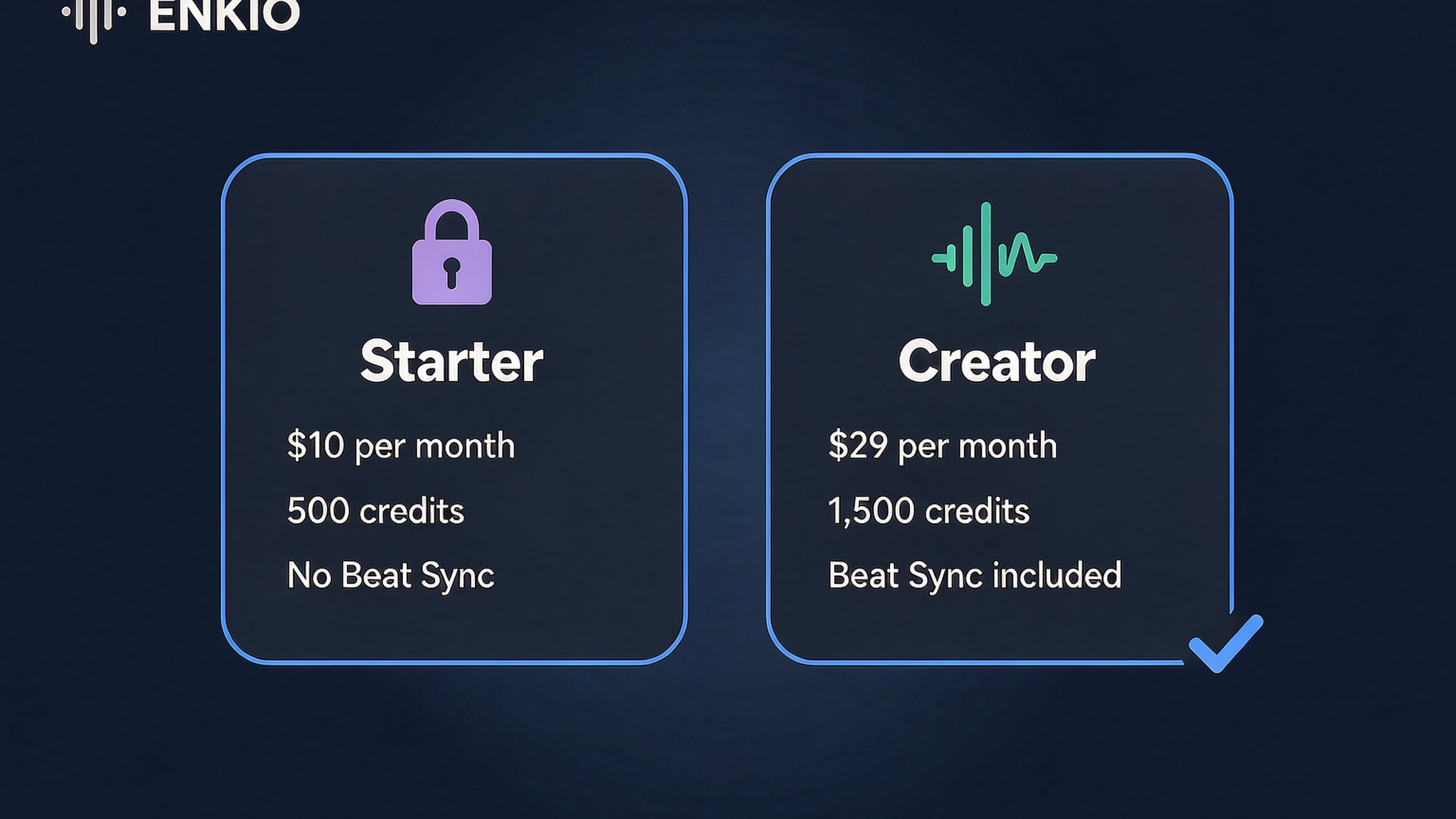
As of September 2026, independent reviewers estimate a standard 1080p generation at about one credit per second. A four-second Motion clip runs around 32 credits, and upscaling it to 1080p or 4K adds roughly 33 credits per five seconds, so a finished four-second clip lands near 65 credits per usagepricing.com and aibrainjet.com.
On that basis the Starter plan's 500 monthly credits cover about eight finished four-second clips. usagepricing.com also reports that a July 2026 help-center change lets subscription credits roll over and not expire. Kaiber sets no hard length cap; output length follows your credit balance, and independent estimates put a Creator plan's 1,400 to 1,500 credits at roughly 23 minutes of standard 1080p video. Check the official pricing page for current rates.
See what a plan includes.
Enkio plans include AI music video generation on credit-based pricing, with current credit costs listed on its pricing page.
Real Limitations of Kaiber AI Music Generator
The limits below are structural, and the first one is the reason most plan decisions turn on this tool rather than its visual style.
Beat Sync is locked to the Creator tier
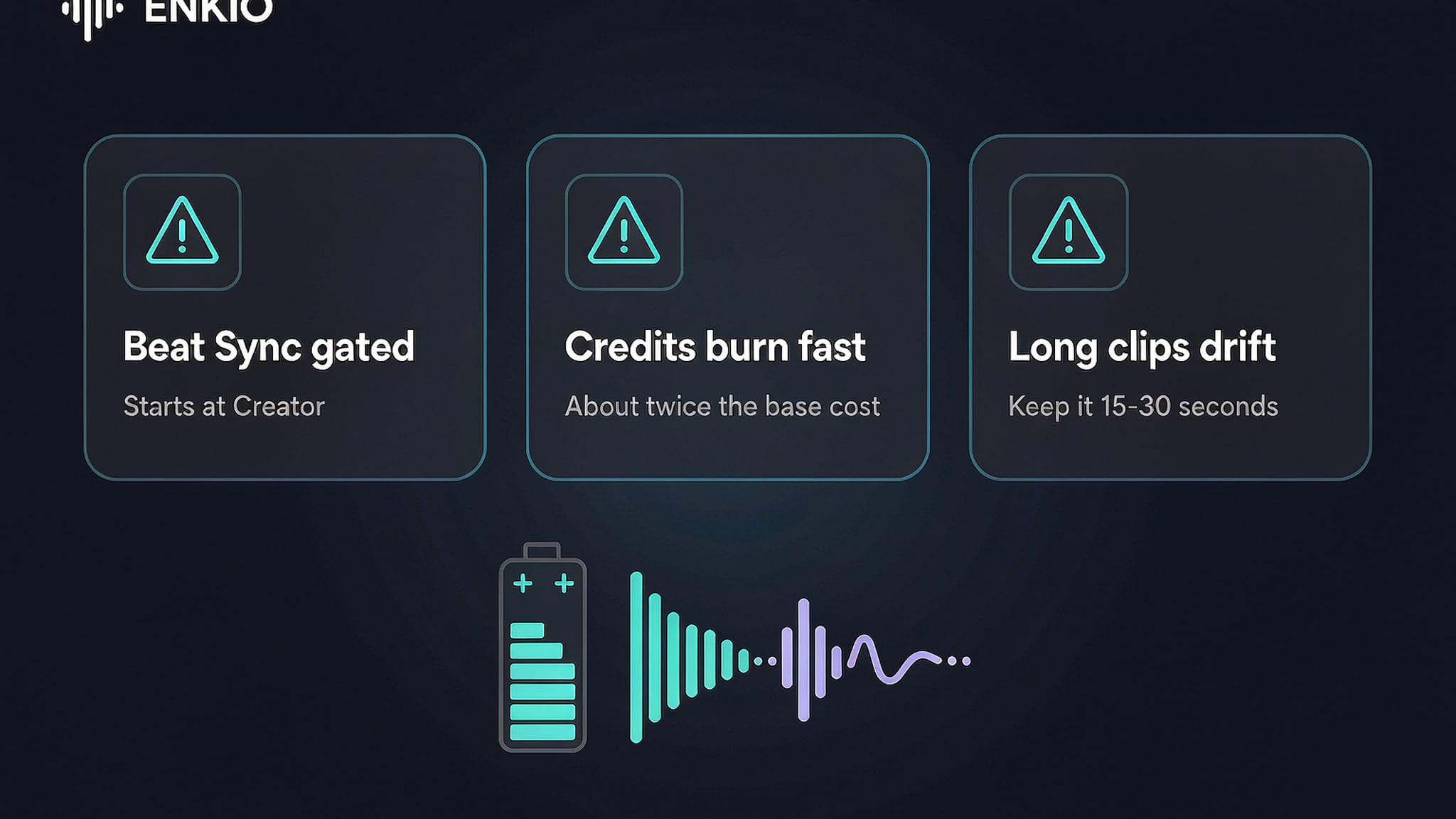
As of September 2026, this is the most consequential restriction, and it is written into the official pricing page rather than implied. The Starter plan at $10 per month lists "No access to Beat Sync," which means the auto-sync, lyric-detection, and Auto-Clip features that define a music video sit behind the $29-per-month Creator tier. For a creator whose whole brief is a track-locked clip, that gate is the central cost decision, not a minor extra. Check the vendor's pricing page for current terms.
If your brief needs beat-sync without moving to a higher tier, and you want the track and the video handled in one place, Enkio's AI Music Video Generator takes a finished song plus a visual direction and returns 720p and 1080p output across five aspect ratios, on credit-based plans with the current credit costs on its pricing page.
Credits run out faster than the headline suggests
As of September 2026, the finished-clip math is the second structural cost. A generated four-second clip costs about 32 credits, but adding the upscale brings a finished clip to roughly 65 credits, close to twice the pure-generation cost. The Starter tier's 500 credits therefore cover about eight finished four-second clips, which is a small number for anyone building a full release. Check the official pricing page for current rates.
Consistency slips on longer clips
Third-party reviews report that pieces past three minutes show character morphing, object drift, and style drift, while clips of 15 to 30 seconds stay the most stable. The tool is strongest on the loop and the hook, and weaker on sustained long-form edits.
General-purpose models lead on raw fidelity
Several independent reviews place general-purpose models ahead of Kaiber on fidelity, naming Runway, Kling, and Seedance as examples. Kaiber's strength is the audio-reactive, stylized look rather than photoreal sharpness, so a creator who needs literal, filmed-quality footage is comparing it against tools built for that goal.
Quality and cost track third-party models
Kaiber aggregates several outside video models, including Kling, Luma and Seedance, so output quality and per-credit cost shift with the underlying supplier. That is a normal arrangement for an aggregator, yet it means the product's ceiling moves with partners the vendor does not control.
There is no free tier
The only no-commitment entry is the $5-for-5-days trial, which converts to Creator unless cancelled. Creators who want to test the look without a charge have a narrow window, and there is no permanent free plan with a watermark in the official listing.
Aggregate user ratings sit low
Trustpilot shows a 3.2 out of 5 score across 152 reviews, a figure toolradar recorded on 2026-08-23. A low aggregate rating is not a verdict on output quality, but it is a signal worth weighing alongside the feature list when you choose a plan.
How It Compares With Runway
The closest reference point most reviews reach for is Runway, the general-purpose video model, because both turn prompts into footage from different starting points. The comparison below is a snapshot as of September 2026; Runway's specific prices were not collected for this review, so pricing varies; check the vendor's site.
| Dimension | Kaiber | Runway |
|---|---|---|
| Starting point | Music and style, audio-reactive | General prompt-to-video |
| Audio-reactive | Beat Sync auto-locks to music | Not music-first by design |
| Output style | Stylized, art-directed | General-purpose, cinematic-leaning |
| Timeline control | Superstudio canvas plus Timeline Edits | Editor-native timeline |
| Billing | Credit-based monthly tiers | Pricing varies; check the vendor's site |
| Best fit | Music-led clips and visual artists | Broad video tasks and filmmakers |
Kaiber wins where the job is a track-locked, stylized clip, and Runway wins where the brief is a general shot that needs photoreal control. The useful next step, once you have picked a direction, is deciding what to build from the clip.
Who the Kaiber AI Music Video Generator Is For Right Now
Our comparison splits by job, because that is where the tier gate and the credit math separate the fits from the misfits.
Kaiber suits visual artists and musicians who want a stylized, track-locked clip, hobbyists building hooks and loops, and creators who like a node-based canvas over a strict timeline. The AI Music Video Prompts guide helps once you have a direction and need wording for the generation.
It is a weaker fit for anyone who needs beat-sync on the cheapest tier, because that feature starts at Creator. It is also a poor match for creators who need long-form consistency past a few minutes, for those who want photoreal footage that general-purpose models lead on, and for teams that need a permanent free plan. If your priority is a short, expressive clip from a track you already have, this is a reasonable option in the music-video group.
From a Kaiber Clip to Something You Can Publish
A generated clip is usually the start of a piece of work rather than the end of one, and the next stage depends on what the clip is for. A hook made for a release becomes a video; a stylized loop made for a channel becomes a publishable asset.
If you already hold a track and want the visual half, Enkio takes the finished audio plus a visual direction and returns a music video in 720p and 1080p across five aspect ratios including 9:16 and 16:9. The track and the clip can come from the same project rather than two separate tools, since Enkio covers both music generation and music video generation.
One reminder applies whichever route you take: platform policies on AI-generated content differ, and several major platforms expect disclosure when music or video is machine-generated. Check the platform's current guidelines before publishing, particularly if monetisation is the goal.
Frequently asked questions
These are the questions we see most often about the Kaiber AI music video generator.
Is there a free version of the Kaiber AI music video generator?
There is no permanent free tier in the official listing. The only no-commitment entry is a $5-for-5-days trial that converts to the Creator plan unless you cancel, and it is limited to one per account. Creators who want to test the look without a charge have that short window, after which a paid tier is required.
As of September 2026, the official pricing page lists Starter at $10 per month with 500 credits, Creator at $29 with 1,500 credits and Beat Sync, and Pro at $99 with 5,000 credits and Auto-Clip. A custom Visionary tier offers unlimited credits by quote, and credit packs run from 300 credits for $5 to 20,000 for $250. Annual billing is advertised at 20 percent off, so confirm the figures on the vendor site because plans change.
Does Kaiber have a beat-sync feature?
Yes. Beat Sync auto-syncs visuals to music, detects lyrics for text overlays, and offers no-prompt image-to-video and Auto-Clip on higher tiers. The catch is tier access: the official pricing page lists "No access to Beat Sync" on the $10 Starter plan, so the feature starts at the $29 Creator tier. That gate is the main plan decision for music-video work.
Is there a Kaiber alternative, and which should I choose?
It depends on your brief. If you need a stylized, track-locked clip and want the song and the video handled in one project, Enkio covers both music generation and music video generation, returning 720p and 1080p across five aspect ratios on credit-based plans. If you need photoreal, general-purpose footage, a model like Runway is the more common reference. Match the tool to whether your priority is the music lock or the filmed look.
Can I use Kaiber videos commercially?
The official plan listings include commercial use on the paid tiers, and the trial converts to a paid plan after five days. Rights to specific outputs can depend on the third-party models Kaiber aggregates, so read the vendor's terms for the exact scope before any commercial step. For commercial usage terms, see Enkio's Terms of Use.
How long can a Kaiber video be?
Kaiber publishes no hard length cap; output length is bounded by your remaining credits. As of September 2026, independent estimates put a Creator plan's 1,400 to 1,500 credits at roughly 23 minutes of standard 1080p video, though third-party reviews note that consistency is strongest on clips of 15 to 30 seconds. Plan length around the short, stable range for the best result. Check the official pricing page for current rates.
Does Kaiber make photorealistic video?
No, not as its core brief. Kaiber is positioned for stylized, audio-reactive video, and several independent reviews place general-purpose models such as Runway, Kling, and Seedance ahead of it on raw fidelity. Treat Kaiber as the expressive, music-led option rather than a stand-in for filmed footage.
Conclusion
Kaiber takes a clear position in the music-video group. It delivers a distinctive audio-reactive look and a flexible Superstudio canvas. The trade-offs are equally clear: Beat Sync sits behind the Creator tier, finished clips cost close to twice the pure-generation credits, consistency fades past a few minutes, and general-purpose models lead on photoreal fidelity. If your priority is turning a finished track into a publishable video from the same project, Enkio takes that step from the audio you already have, without a timeline to learn.
Make more from your track.
Let Enkio create a complete AI music video from your song, with 720p and 1080p output across five aspect ratios.