





Why Look for a Suno Alternative?
None of the reasons below are complaints about quality. They are mismatches between what Suno is built to do and what a specific project needs — and each one points at a different kind of alternative.
Where Suno Is Still the Right Pick
Across the third-party comparisons we read, Suno stays the most consistent option for a complete song with sung lyrics from a text prompt, and its genre range is the widest of the tools compared here. Its ecosystem is also the largest, which matters more than it sounds: more public examples to learn from, more community answers when a prompt misbehaves, more third-party tutorials to follow. Start with Suno unless one of the four mismatches below applies to you.
Four Reasons Creators Shop Around
The first is rights. On several platforms, commercial use sits behind the paid tiers while free-tier output is restricted to non-commercial projects — a surprise that tends to arrive after publication rather than before.
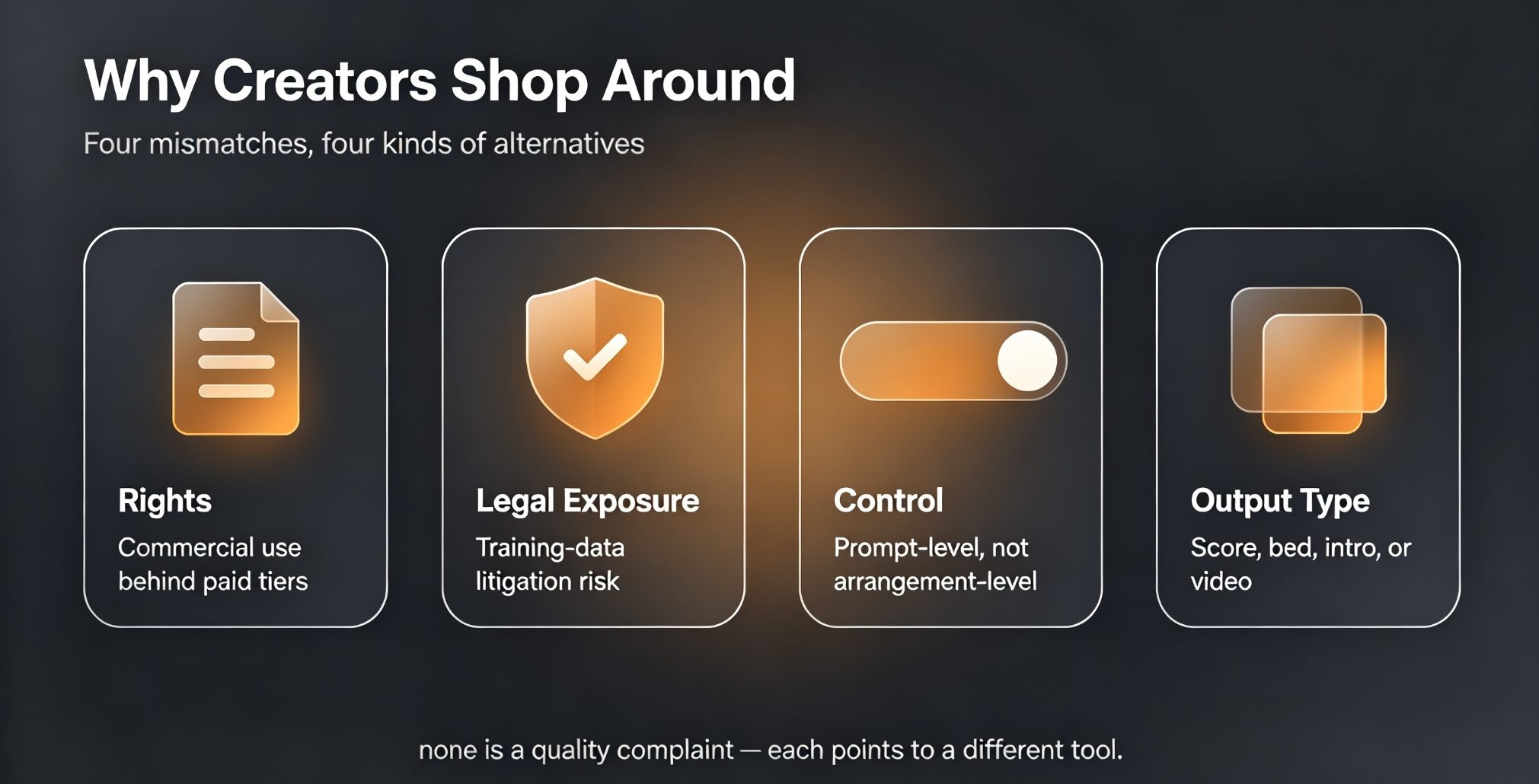
The second is legal exposure. Vocal-generation platforms have faced training-data litigation from major labels, and risk-averse brands increasingly ask for music built from licensed samples instead. That is a different product class, not a better version of the same one.
The third is control. Style steering in prompt-driven tools happens at the prompt level, not at the arrangement level, so producers who want to shape individual sections eventually outgrow it.
The fourth is output type. Not every project needs a song. A podcast intro, a game score and a product-video bed are three different jobs, and specialist tools handle each of them more directly than a generalist does.
What "Alternative" Means in This List
Two lanes appear below, and they are not interchangeable. Four entries are music generators that compete with Suno on the same terms: prompt to finished song. One is built around orchestral and instrumental scoring. One is not a music generator at the same layer at all — Enkio generates songs and then turns a track into a music video, which is the step every tool on this list leaves to someone else. We include it first because that gap is real, not because it competes on genre range.
Top 6 Alternatives to Suno AI Music Generator
We kept every entry below to the same five headings — positioning, price, strengths, weaknesses and who it suits — so the comparison stays legible rather than becoming a scoreboard. Prices are the figures published in third-party comparisons as of September 2026; vendor pricing changes, so confirm on each vendor's own site before subscribing.
| Tool | Positioning | Entry price (as of Sep 2026) | Weakness to know about |
|---|---|---|---|
| Enkio | Song generation plus music video generation | $19.99/month (3,000 credits) | Credit-based iteration costs money |
| Udio | Direct rival for vocal songs | Free tier · Standard $10/month | Download availability disputed during licensing transition |
| Mureka | Budget all-rounder with voice cloning | Free tier · Basic $8/month | Vocals trail the top two in refinement |
| AIVA | Instrumental and orchestral scoring | Free (3 downloads/month) · Standard €15/month | No vocal generation at all |
| Soundraw | Licensing-safe background music | Creator $11.04/month | Built for beds and loops, not full songs |
| Loudly | Fast library tracks at volume | Free tier · Personal $10/month | Less control over the final arrangement |
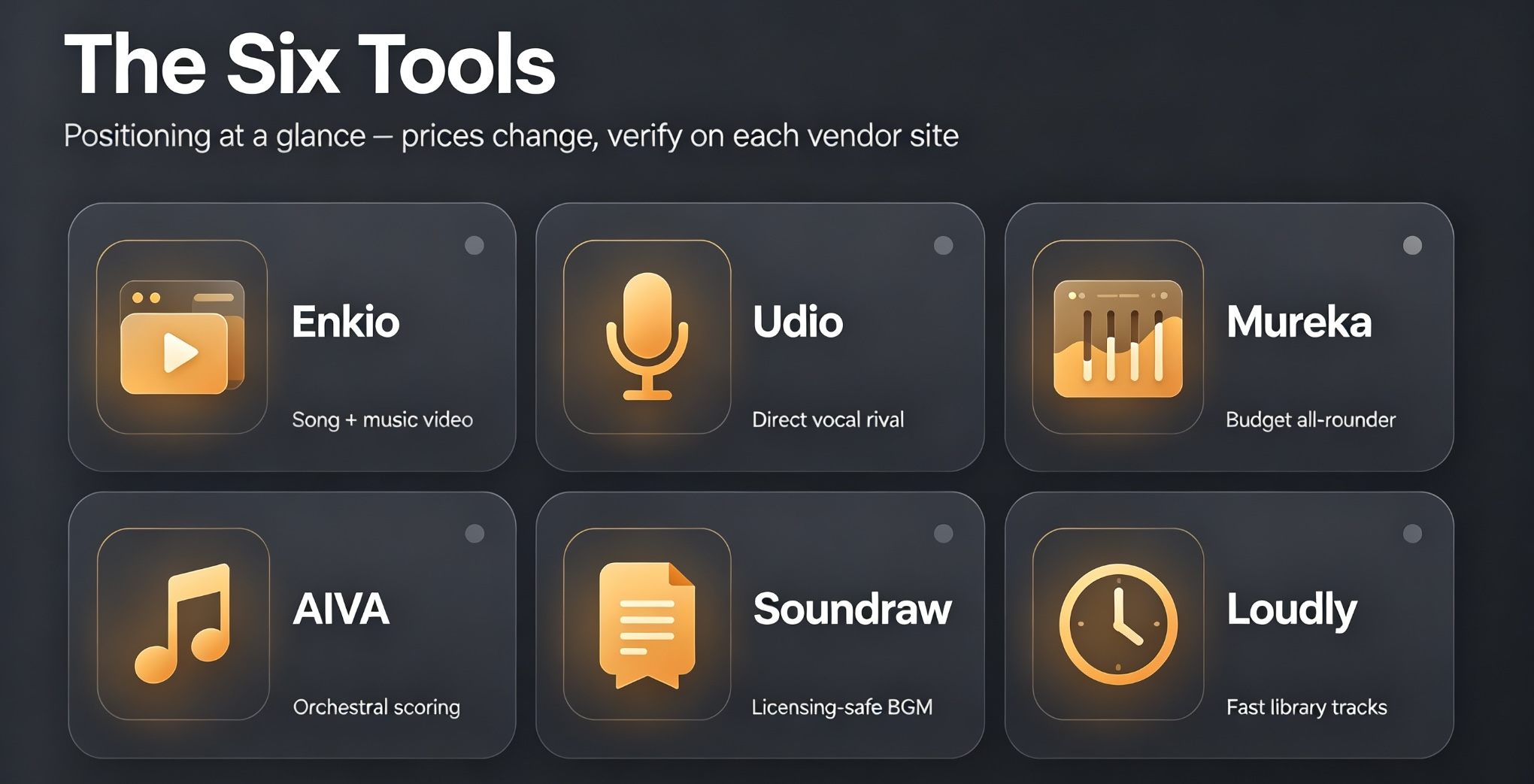
The table is a starting filter, not a verdict. Two tools can sit at the same price and still solve different problems, which is what the individual entries below are for.
1. Enkio — For Turning a Finished Song Into a Music Video
Enkio is an AI music video generator that also generates music, which puts it in two places at once. You can create a song from a text description — vocals included — or bring your own lyrics, then turn the finished track into a complete music video: upload the audio, add an image or a prompt describing the visual direction, and generate in the aspect ratio the destination needs. Output is 720p or 1080p across five ratios (9:16, 1:1, 3:4, 4:3, 16:9), which covers vertical feeds and widescreen uploads without re-framing.
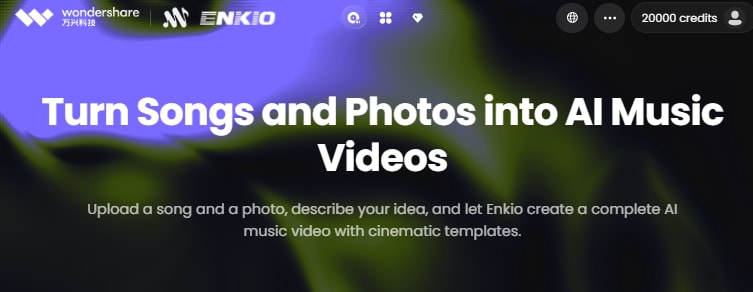
Price: as of September 2026, the monthly plan is $19.99 with 3,000 credits per month, and the yearly plan is discounted. Credits unlock the templates and features, and watermark-free downloads are available depending on your plan — check Enkio's pricing page for current figures. Weakness: the workflow is credit-based, so heavy experimentation with prompts costs money rather than just time, and anyone whose priority is genre exploration at volume will find a pure music generator better value for that specific job. It suits creators whose song exists and whose video does not — the step that otherwise means moving the audio into an editing tool.
2. Udio — The Closest Direct Rival
Udio plays the same game as Suno: full songs with sung lyrics from a prompt. Across third-party tests, its strongest takes carry more convincing vocals, particularly in rock and soul, while Suno tends to be the more consistent option across repeated generations and the better one at whole-song structure. Udio's section-level tools reward producers who iterate on a chorus instead of re-rolling the whole track.
Price: free tier (roughly 10 daily credits plus a monthly top-up), Standard around $10 per month, Pro around $30 per month, per third-party comparisons as of September 2026. Weakness: third-party sources disagree about whether downloads are currently available during its licensing transition — one reports downloads paused, another lists paid plans with exports — so verify export availability before subscribing for a project that needs files. It suits creators who want a second opinion on vocal character and are willing to verify the export situation first.
3. Mureka — The Budget All-Rounder
Mureka plans the song structure before generating audio, which produces arrangements that feel deliberately composed rather than synthesized in one pass. Its practical advantages are breadth and price: voice cloning from a clean vocal sample, support for more than ten languages, and a melody feature that builds a full track around a hummed or uploaded idea.
Price: free tier, Basic around $8 per month, Pro around $24 per month, per third-party comparisons as of September 2026. Weakness: vocal refinement trails Suno and Udio — mixing and mastering are competent rather than polished, and English vocal realism is the clearest gap. It suits songwriters working across languages, or anyone who needs usable tracks at a lower per-month cost and can accept a step down in vocal detail.
4. AIVA — Instrumental and Orchestral Scoring
AIVA occupies its own lane: cinematic and orchestral composition, with no vocals involved. For film, game and trailer work where the score should support a scene rather than compete with dialogue, nothing else in this list matches its instrumental depth, and its plan structure is oriented toward ownership.
Price: free tier with a small number of downloads per month, Standard around €15 per month, Pro around €49 per month, per third-party comparisons as of September 2026. Weakness: it does not generate vocals at all, which rules it out for anything resembling a song, and its contemporary genre coverage is thinner than its classical range. It suits composers who need a score bed and already know they do not need a singer.
5. Soundraw — Licensing-Safe Background Music
Soundraw builds every track from its own licensed samples, and licensing is the entire point of the product: for brands and creators who need music that clears a legal review, that structure is the feature. Tracks are generated by choosing a mood, genre and length rather than by describing a song, and the editing controls work at the level of sections and intensity.
Price: Creator tier around $11 per month, with artist tiers running up to roughly $32 per month, per third-party comparisons as of September 2026. Weakness: it is built for background beds and loops rather than complete songs with vocal hooks, so it will not replace Suno for a release. It suits content teams, podcasters and agencies whose first requirement is a clean licensing story.
6. Loudly — Fast Library Tracks for Social Content
Loudly targets volume and speed: short library tracks for social edits, apps and prototypes, generated or selected from a catalog and exported quickly. The vendor markets its paid tiers as royalty-free, aimed at creators who publish frequently across many platforms — verify the current terms on Loudly's own site before relying on that for a monetized project.
Price: free tier with a daily allowance and non-commercial use, Personal around $10 per month (less on annual billing), Pro around $30 per month, per third-party comparisons as of September 2026. Weakness: control over the final arrangement is limited compared with the generators above, and output leans toward library-style tracks rather than bespoke songs. It suits creators who need a clean, usable bed for a short video in a few minutes and are not trying to make a release.
How to Choose a Suno Alternative
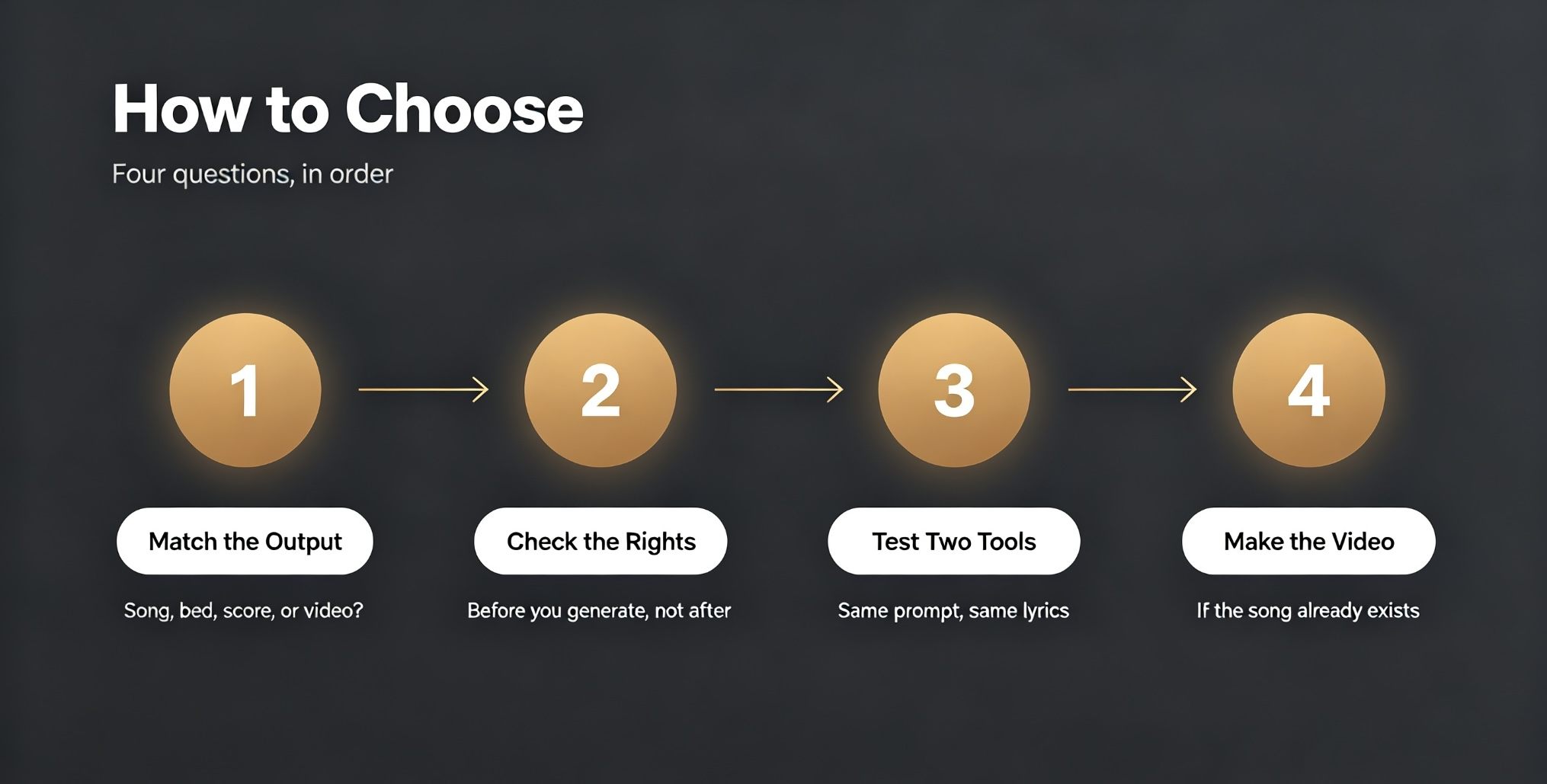
Four questions settle most of these decisions faster than a trial of every tool. Work through them in order, because the later ones matter less if the first one rules a tool out.
Match the Tool to the Output You Need
Ask what the deliverable is: a song, a background bed, a score, or a video. Each answer points at a different lane, and a tool that is excellent in one lane is often mediocre in another. Deciding this first eliminates half the comparison.
Check the Rights Before You Publish
The most common regret in this category is discovering a rights restriction after release. Read the free-tier terms before you generate, not after you publish — what a full review of Suno found about where the platform draws that line applies to most of its competitors too, with the specifics varying by vendor.
Test Two Tools With the Same Prompt
In the comparisons we read, the only fair test is identical input: keep one prompt and one set of lyrics and run them through two tools. Judge the chorus first, then the vocal, then the mix. Three generations each is enough to see a pattern; a single takedown of one tool based on one generation tells you very little.
If You Already Have a Finished Song
If your song already exists and sounds right, generating another one is not the problem to solve — the video is. step-by-step walkthrough of the Suno workflow covers how a track gets made, and the next step after it is the same regardless of which tool produced the audio.
Frequently asked questions
These are the questions that decide most purchases in this category, and the answers depend more on rights and output type than on audio quality.
Is there a free alternative to Suno?
Several tools here have free tiers, including Udio, Mureka and Loudly. What differs is what you may do with the output: on most platforms, free tiers are restricted to non-commercial use and paid plans are where commercial use begins. Treat "free to create" and "free to publish commercially" as two separate questions.
Which Suno alternative is best for background music
Soundraw is the most direct fit when licensing is the priority, because every track is built from its own licensed samples, and Loudly is the faster option when you need a usable bed in minutes. Neither is designed to replace a full song with vocals, which is the trade-off for that focus.
Can I use AI-generated music commercially?
It depends on the vendor's terms and on your plan tier, so there is no single answer that applies across tools. Check the specific vendor's current terms before publishing, and treat any claim that generated music carries no third-party rights as unverified unless the vendor states it in writing.
What should I do after I generate a song?
Decide where it publishes before you export, because platform policies on AI-generated content differ — check the platform's current guidelines. If the destination is video, the track becomes the audio input for a video tool, and that step is where the song either gets a visual or stays a file.
Conclusion
There is no single winner among these six, and any list that claims one is describing its own priorities rather than yours. Our practical ranking: test Udio if you want a closer vocal rival, choose Mureka when price leads, take AIVA for instrumental work, Soundraw for licensed background music, and Loudly for volume — and if what is missing from your project is the visual rather than the sound, Enkio is the one that picks up where the song ends.
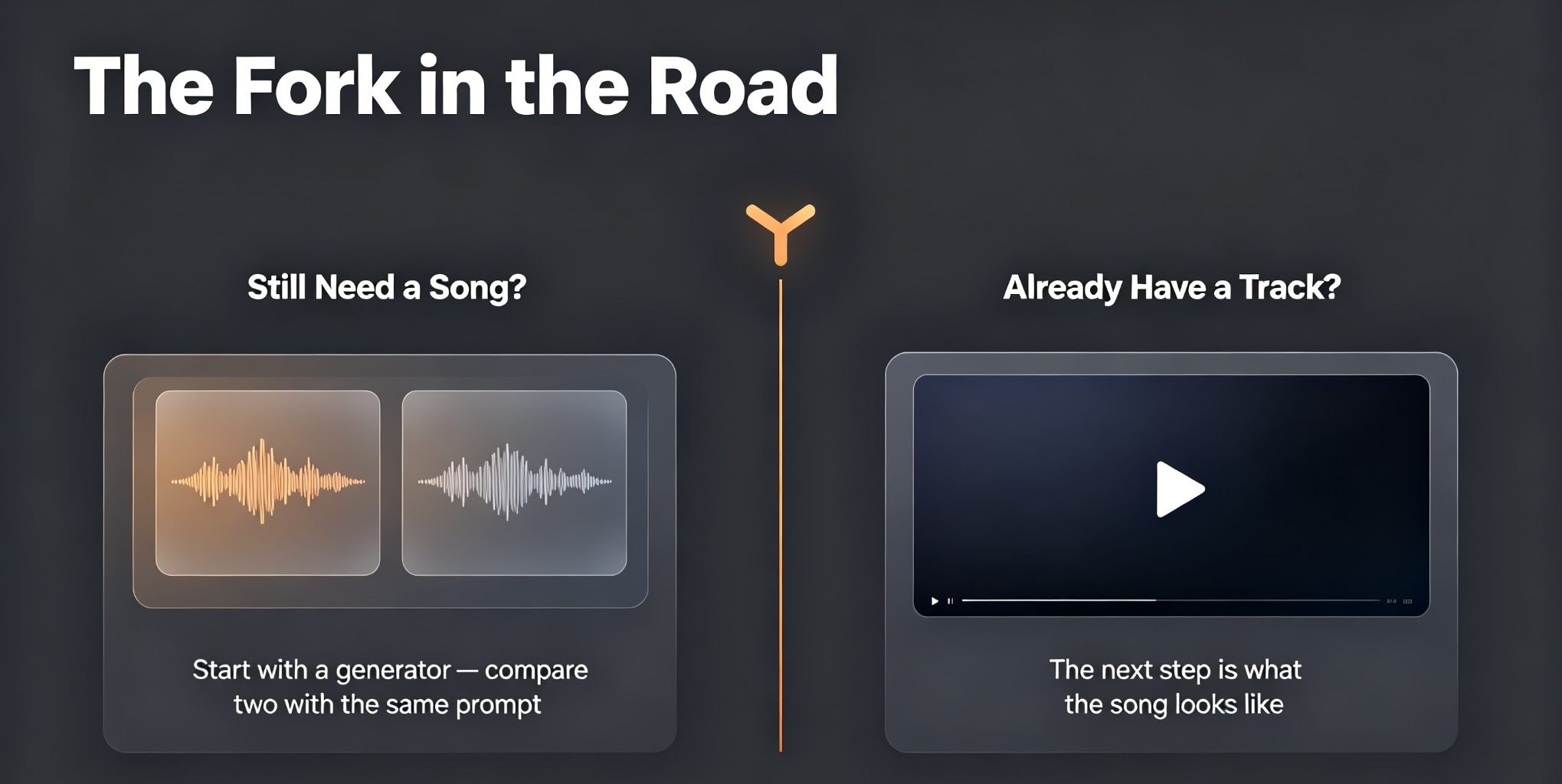
The fork in the road is simpler than the list makes it look. If you still need a song, start with a generator and compare two of them with the same prompt. If you already have one, the next decision is not which generator to try next but what the song should look like.
Already have your track? Make the video.
Upload a finished song, add one image or a visual prompt, and Enkio generates a complete music video in the ratio each platform needs.