





Vidnoz is best known for avatar and talking-head video, and it has added a song generator to the same account — which changes both what the tool can do and what it costs to use. Our review covers what the Vidnoz AI music generator is, how its song workflow runs, what the credits actually cost, and why the credit model is the most important thing to understand before you buy.
The short answer, after working through the vendor's own documentation and the independent material published this year: Vidnoz is a sensible choice if you want songs and simple performance videos from one account, and a poor fit if music is the main thing you are paying for, because the video side of the platform competes for the same credits.
What the Vidnoz AI Music Generator Is
Vidnoz runs in the browser at vidnoz.com and is part of a larger suite of generative video tools: digital presenters, text-to-video, image generation, voice-over and, since recently, music. The song generator turns a text description into a song with vocals, or into an instrumental, and the company's documentation describes two modes — one that produces a sung track, one that produces backing music — along with optional control over song structure.
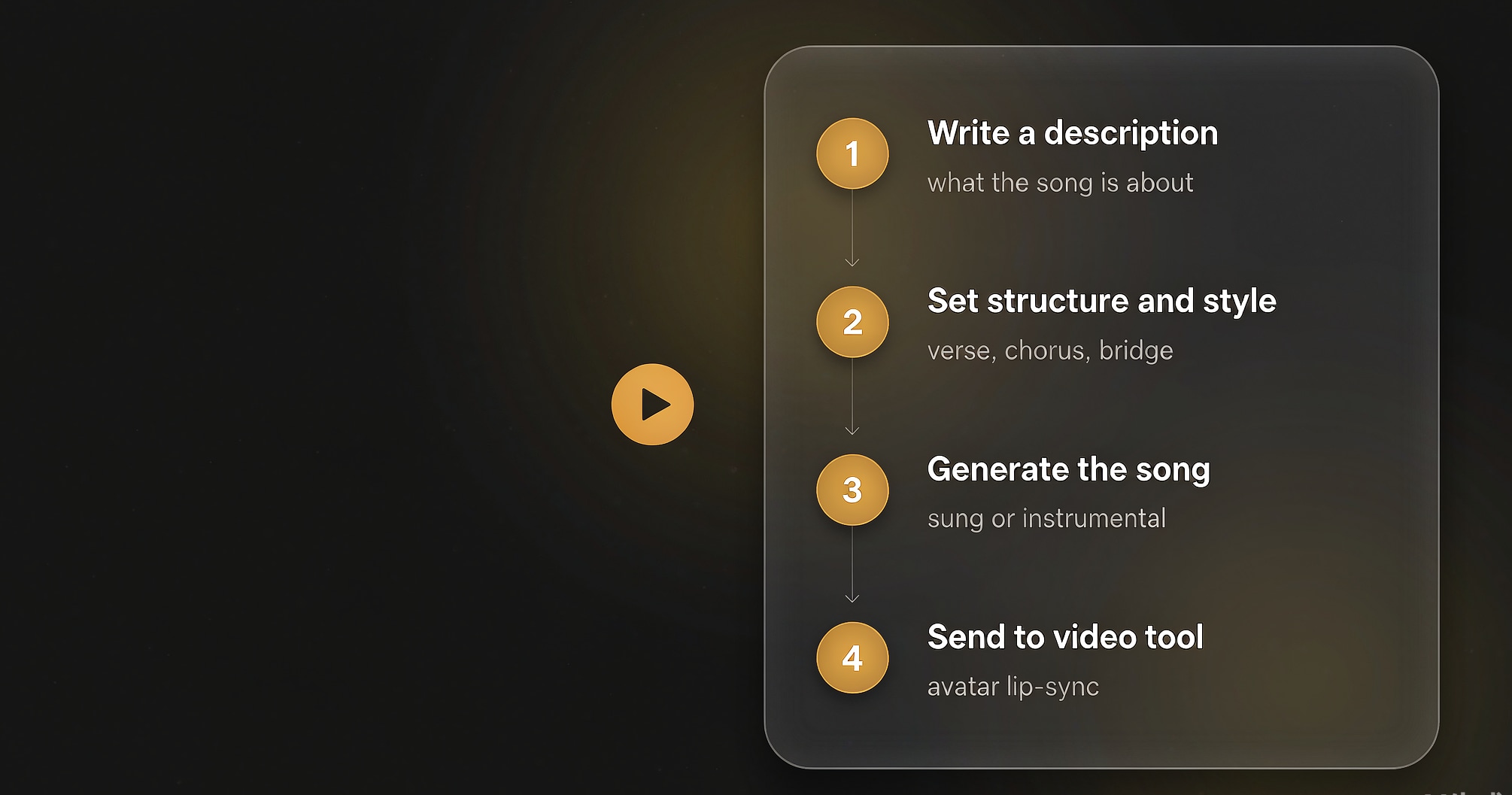
That places Vidnoz in a different category from the specialist generators. It is not trying to be the best tool for songwriting; it is trying to be the place you do everything. The company's own description of the workflow says as much: you write a description, optionally choose a structure and a style, generate, and then — if you want — push the track straight into the platform's music video tool, where you choose a digital singer or upload a photo and get a lip-synced performance video. For a creator who needs a complete piece of content rather than a song, that single-account path is the whole pitch.
Two boundaries are worth setting before the review proper. The first: the music generator is one module inside a suite, so its allowance is not separate from everything else you do on the account — this is the credit pool covered under pricing. The second: the video output the platform produces is a performance video built around an avatar or a photo, which is a different product from a cinematic music video built from generated visuals. Neither point is a flaw in itself; both decide whether the platform fits.
How Vidnoz Turns a Description Into a Song
The workflow is short and the documentation describes it clearly, which is one of the platform's better qualities.
Two modes: sung songs and instrumentals
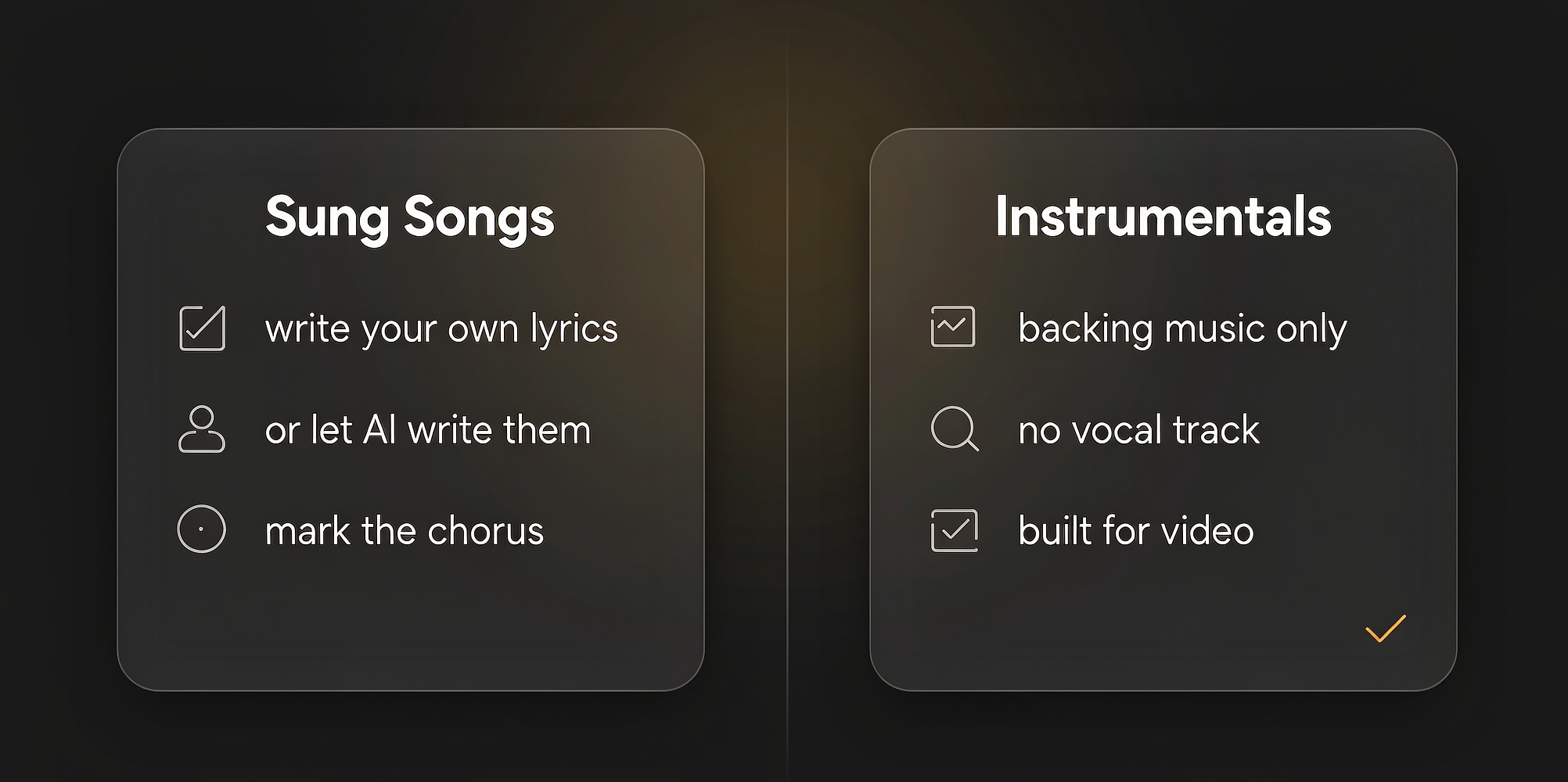
You choose between a song with lyrics and an instrumental bed. In the sung mode you can let the platform write the lyrics for you, and the documentation describes a prompt feature that generates both a lyric set and a song title when you have no idea where to start. In the instrumental mode you get backing music without a vocal, aimed at the work a video platform needs it for.
Structure you can specify rather than hope for
The generator lets you lay out a song's sections in advance — intro, verse, chorus, bridge — and mark which part is the chorus. That is more control than most one-pass generators offer, and it addresses the most common complaint about AI songs, which is a chorus that arrives without preparation or a structure that repeats because the model lost its place. Whether the arrangement lands as instructed is a separate question, but specifying it at all is a step most competitors skip.
Style and mood as a starting point
The vendor advertises a large library of style, mood and theme combinations to steer the sound, which functions as the equivalent of a preset list. It is a faster route to a usable result than writing a long prompt, and a narrower one — you are choosing from the platform's options rather than describing the song in your own terms.
What the Vidnoz AI Music Generator Gets Right
Four strengths stood out when we read through the vendor's documentation, and all four are specific to using music inside the platform rather than to songwriting on its own.
One account from song to published video
The strongest argument for Vidnoz is not the song generator by itself, it is the sequence around it. A track is generated, then handed to the music video module, where you pick a digital singer or supply a photo and get a performance video the same day, without moving between tools or exporting between them. For short-form work — a lyric video, a talking-presenter piece, a promotional clip — that continuity saves a real amount of time.
Free users can download an MP3
This is unusual and worth stating plainly: the free tier produces a downloadable MP3 rather than a locked preview. Most generators in this category let you listen but not keep, so an evaluation that produces a usable file is a genuine advantage. The higher-quality format sits behind the paid tier, which is covered below.
Structure controls that most generators lack
Being able to declare a song's sections and mark the chorus gives you a measure of arrangement control that prompt-only tools rarely provide. For anyone who has spent credits regenerating a track because the chorus never arrived, the value of specifying it first is obvious.
Predictable per-song credit maths
The platform publishes concrete figures: two songs cost a set number of credits, and a short music video clip costs another. In a category where most platforms quote an allowance in songs but charge in an opaque internal currency whose rate depends on the model, a published rate per output is easier to budget against — even when the absolute numbers are not generous.
Pricing and Credits
As of September 2026, Vidnoz sells monthly credit bundles rather than music subscriptions, and the free tier starts with no daily credits at all. The vendor's pricing page lists paid allowances of 180, 500 and 800 credits per month on the consumer tiers, with the cost per credit falling from roughly $0.07 to about $0.03 as the bundle grows.
Third-party records of the same plans put the entry tier at $19.99 per month when billed annually, with a business tier at $56.99 per month annually or $74.99 monthly, and monthly billing carrying a higher rate than the annual figure.
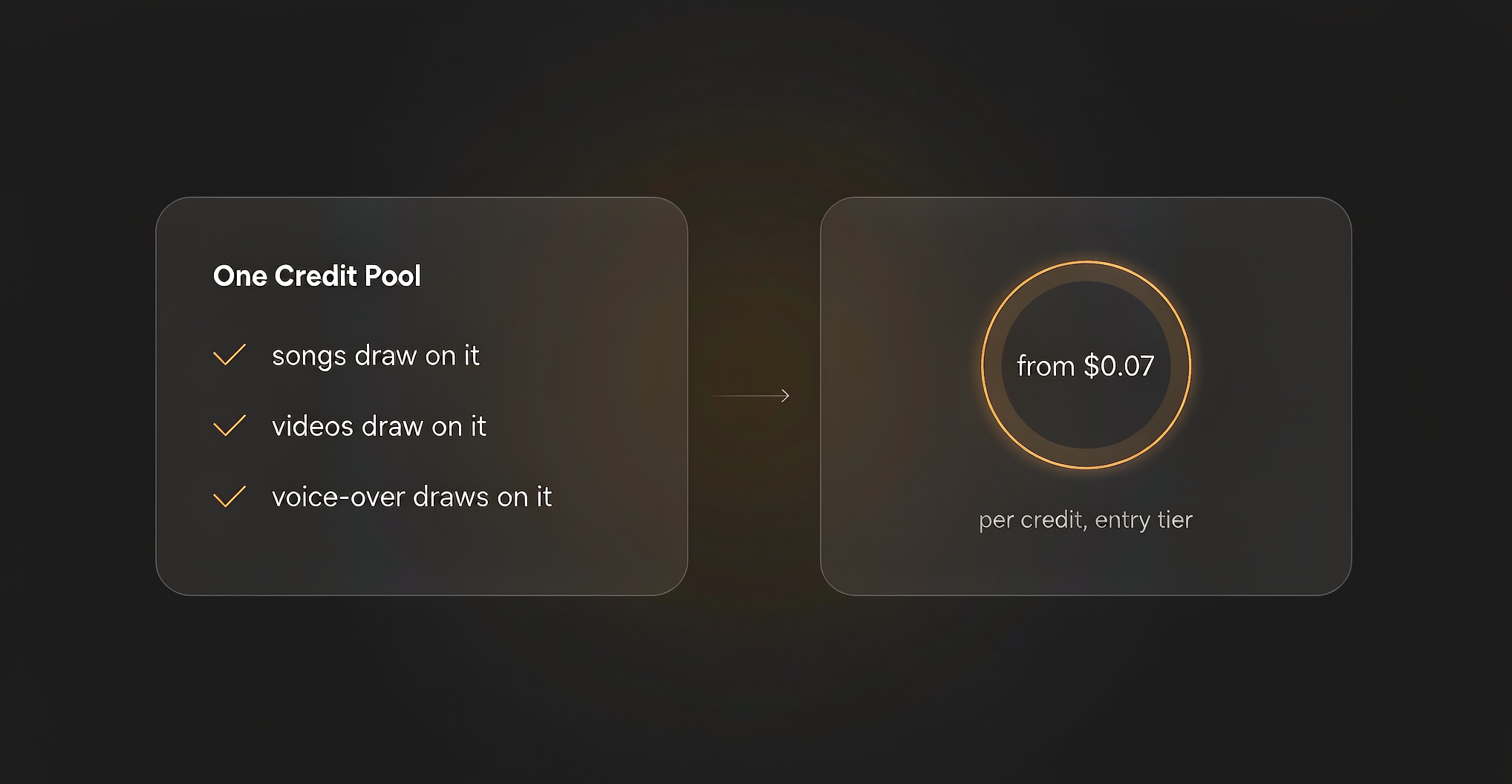
What matters far more than the tier price is how credits are consumed. The published rates are a few credits for a pair of songs, roughly one credit per five seconds of music video, ten credits for a text-to-video clip, three credits for a generated image, and a credit for every ten characters of speech. Music does not have its own allowance: songs, videos, voice-over and images all draw on one balance. A project that needs a song, a video and a voice-over spends from a single pool, so the number you bought is not the number available to music.
The vendor states that unused credits carry over, while at least one third-party record says they do not, so treat rollover as something to confirm with the vendor rather than assume. As of September 2026, check the current bundle sizes, per-credit rates and rollover rules on Vidnoz's own pricing page before you plan a project around a bundle, because the arithmetic changes with every module you use.
Compare what a plan includes.
Enkio plans include AI music video generation, templates, and watermark-free downloads depending on your plan.
Real Limitations
The limitations below are the ones we found in the platform's own documentation and in the independent material published this year, and the first is structural rather than temporary.
The shared credit pool makes music budgeting unpredictable
This is the limitation that shapes the rest. Because songs, videos, voice-over and images draw on the same balance, the cost of your music depends on what else you did that month. Someone who generates a handful of songs and nothing else spends very little; someone producing a video a day finds the music allowance gone before they notice, because the video module consumed it.
The per-credit rate is also higher at the entry tier than the equivalent spend on a dedicated music platform, which means you are paying a premium for the convenience of one account.
Higher-quality audio formats sit behind the paid tier
Free users can download an MP3, and the lossless format requires the paid tier. For most social video work an MP3 is entirely adequate, which softens this considerably. For anything that will be mixed, mastered or archived, the format you can actually take out of the platform is the deciding factor, and on the free tier it is the compressed one.
The licensing terms are thinner than a music platform's
The vendor's FAQ states that music generated on the free tier may also be used commercially, which is more generous than most competitors offer, and at least one third-party review notes that the music side does not publish the kind of standalone licence document that dedicated music platforms maintain.
Those two things can both be true: a permission stated in an FAQ is weaker evidence than a licence document you can read, keep and point a client to. Verify the terms before commercial use rather than relying on a summary, including this one.
The free tier has no daily credits
The free allowance begins at nothing — the platform's paid allowances are monthly credit bundles rather than a music plan with a free tier attached. In practice that means there is no way to audition the song generator repeatedly on the house; you either buy credits or work inside what a trial gives you. Compare that with the free preview tiers elsewhere in the category, and the cost of finding out whether you like the output lands on you.
How It Compares With Dedicated Music Generators
In our comparison, the useful question is not which generator writes the better song but which one fits the rest of your workflow.
| Dimension | Vidnoz | Dedicated music generators |
|---|---|---|
| Scope | Songs, video, voice-over and images in one account | Music generation only |
| Song inputs | Description, auto-generated lyrics, style presets, optional structure | Description, lyrics, reference audio or melody, depending on platform |
| Structure control | Sections and chorus marked in advance | Rare outside advanced modes |
| Audio export | MP3 on the free tier; lossless on paid | Varies; WAV and stems on higher tiers |
| Stems | Not described | Common on higher tiers |
| Music video | Built in, avatar or photo performance with lip sync | Usually a separate tool |
| Billing model | Monthly credit bundle shared across all modules | Subscription with a music-specific allowance |
| Entry cost | From around $20 per month on annual billing | From roughly $8 to $10 per month |
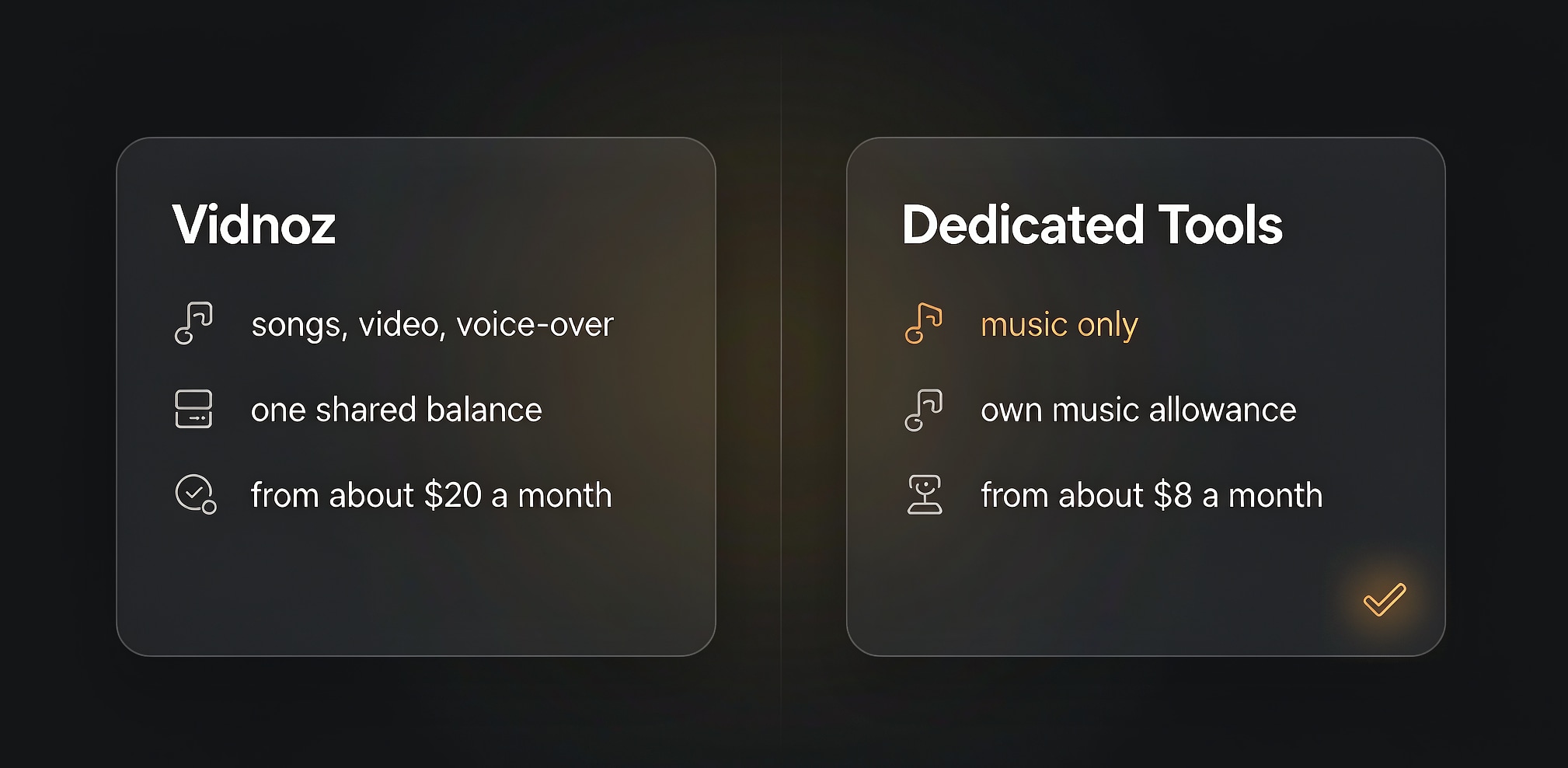
Both columns are a snapshot as of September 2026, and every platform here revises its models, formats and quotas regularly, so treat the table as a starting point rather than a settled ranking.
For the specialist side in more depth, our Suno AI music generator review works through one platform's output quality and terms, and our roundup of Suno AI music generator alternatives compares several on price and exports.
Common Misconceptions
Two assumptions came up so often in the material we read that each deserves its own section.
Misconception 1 the song generator is a standalone plan
Vidnoz sells credits, not music plans. A bundle that looks like good value for songs alone is being shared with the video and voice-over tools the platform is really built around, so the effective price of a song depends on how much of the suite you use. Work out what you will spend credits on across the whole account before comparing the bundle price with a music platform's own plan.
Misconception 2: one platform means one workflow
Having songs and videos in the same account removes the export step, not the creative ones. The video the platform produces is a performer or a photo singing the track, which suits lyric videos, presenter content and social clips well and does not attempt the cut-driven style of a film-style music video. Deciding what kind of video you actually need is the step that comes before choosing the tool, not after.
Who the Vidnoz AI Music Generator Is For Right Now
Choose Vidnoz if you are already producing short-form video, if you want a song and a performance video from one account without moving files between services, and if you value published per-output credit rates over an opaque allowance. The combination of structure control in the generator and a built-in video module is genuinely convenient, and the free tier's downloadable MP3 makes the first test cheap in time if not in credits.
Look elsewhere if music is the main thing you are buying. A dedicated generator gives you a lower cost per song, a music-specific allowance that video work cannot consume, and in most cases better export options — WAV files, stems, and in some cases an API. Those are the differences that show up over a month of regular use rather than in a single test.
From a Vidnoz Track to Something You Can Publish
Because Vidnoz already includes a video module, the question after generating a song is not whether you can make a video, it is which kind of video the track needs. The built-in path produces a performance video: an avatar or a photo, lip-synced to the track. If that is the format you want, the platform has already solved it.
If the track is going to a cinematic music video built from generated visuals rather than a performer, that is a different job. Enkio's AI music video generator takes a finished track plus a visual direction and returns a music video, with 720p and 1080p output across five aspect ratios including 9:16 for vertical platforms and 16:9 for YouTube. The sequence is the one most people already know: upload the audio, add an image or generate visuals, and optionally describe the mood and camera movement. Enkio runs on credits rather than per-video purchases, so check the current plans and credit costs before you build a release around it.
One reminder applies whichever route you take: platform policies on AI-generated content differ, and several major platforms expect disclosure when a track or video is machine-generated. Check the destination platform's current guidelines before publishing, particularly if monetisation is the goal.
Make more from your MV.
Let Enkio create a complete AI music video from your song with cinematic templates.
Frequently asked questions
These are the questions we see most often about the Vidnoz AI music generator, answered for the platform as we found it in September 2026.
Is the Vidnoz AI music generator free to use?
The song generator is available to free users, and the free tier produces a downloadable MP3 rather than a locked preview, which is more than most competitors allow. Free accounts start without a daily credit allowance, so the practical limit is what the trial provides. Check Vidnoz's own pages for the current free terms.
Does Vidnoz generate songs with vocals?
Yes. The generator offers two modes: a song with lyrics, where you can write the lyrics or have the platform generate them along with a title, and an instrumental mode for backing music without a vocal.
How much do Vidnoz credits cost?
As of September 2026, the vendor lists monthly allowances of 180, 500 and 800 credits on the consumer tiers, with the cost per credit falling from roughly $0.07 to about $0.03 as the bundle grows; third-party records put the entry plan at $19.99 per month billed annually.
Credits are shared with the video, voice-over and image tools, so the effective cost of a song depends on what else you use. Check the official pricing page for current rates.
Can I use the songs commercially?
The vendor's FAQ states that music generated on the free tier can also be used commercially, which is more permissive than most of the category. The music side does not publish a standalone licence document of the kind dedicated music platforms maintain, so read the terms yourself before you rely on the output commercially.
Can I download my Vidnoz songs?
Yes. Free users can download an MP3, and the lossless format is reserved for paid tiers. Stems and other separated parts are not described as available. Confirm the current export formats on vidnoz.com before choosing a bundle.
Can Vidnoz turn my song into a music video?
Yes, and that is the platform's main advantage: a generated track can be pushed into the same account's music video tool, where you select a digital singer or upload a photo to produce a lip-synced performance video. If you need a cinematic video built from generated visuals instead, that is a different tool and a different workflow.
Conclusion
Vidnoz approaches music generation from the direction of video, and the review should be read the same way. As a song generator it is competent rather than exceptional: two modes, structure you can specify, preset styles and a downloadable MP3 on the free tier. As part of a video suite it is more interesting, because a track turns into a published performance video without leaving the account.
The catch is the credit pool. Music shares its budget with every other module, the entry-tier rate per credit is higher than a dedicated platform's, and the licensing documentation is thinner than what a music specialist publishes. Buy it as a video tool that also makes music, and the arithmetic makes sense.
Buy it as a music tool and you are paying for capacity that other parts of the platform will claim. If your song is heading for a cinematic video rather than a performer, check what the music video step costs elsewhere before you commit a bundle to it.