





Mubert is a royalty-free music generator built for the moment after you have a video, a podcast, or an app and still need a bed of sound under it. Our review of the Mubert AI music generator covers what the engine and the API actually produce, how the four plans and the licence line up, and where the well-known gaps sit.
The short answer: Mubert has the cleanest rights story and the fastest mood-matched generation in this category, but it produces no vocals and its licence blocks standalone distribution, so it serves creators who need background music rather than songs they intend to release.
What the Mubert AI Music Generator Is
Mubert runs in the browser at mubert.com and has been on the market longer than most of the tools we cover, which matters because its positioning is specific rather than general-purpose. It is not a songwriting tool. It is a background-music generator, and the company describes its output as royalty-free AI music built from millions of samples contributed by hundreds of artists.
Four products share the Mubert name; telling them apart is the first reviewer task. Mubert Render is the consumer tool for content creators: you set a mood, a genre, a duration and sometimes an image, and it returns a track. Mubert Studio is the contributor side, where musicians upload samples and loops and earn when their material feeds the generative engine.
Mubert API is the developer product, a generative-music endpoint that returns files or live streams for apps, games and agents. Mubert Play is a listening app for the end user. When people search for the AI Music Generator category, Mubert is one of the names they meet, but its centre of gravity is the Render and API halves, not songwriting.
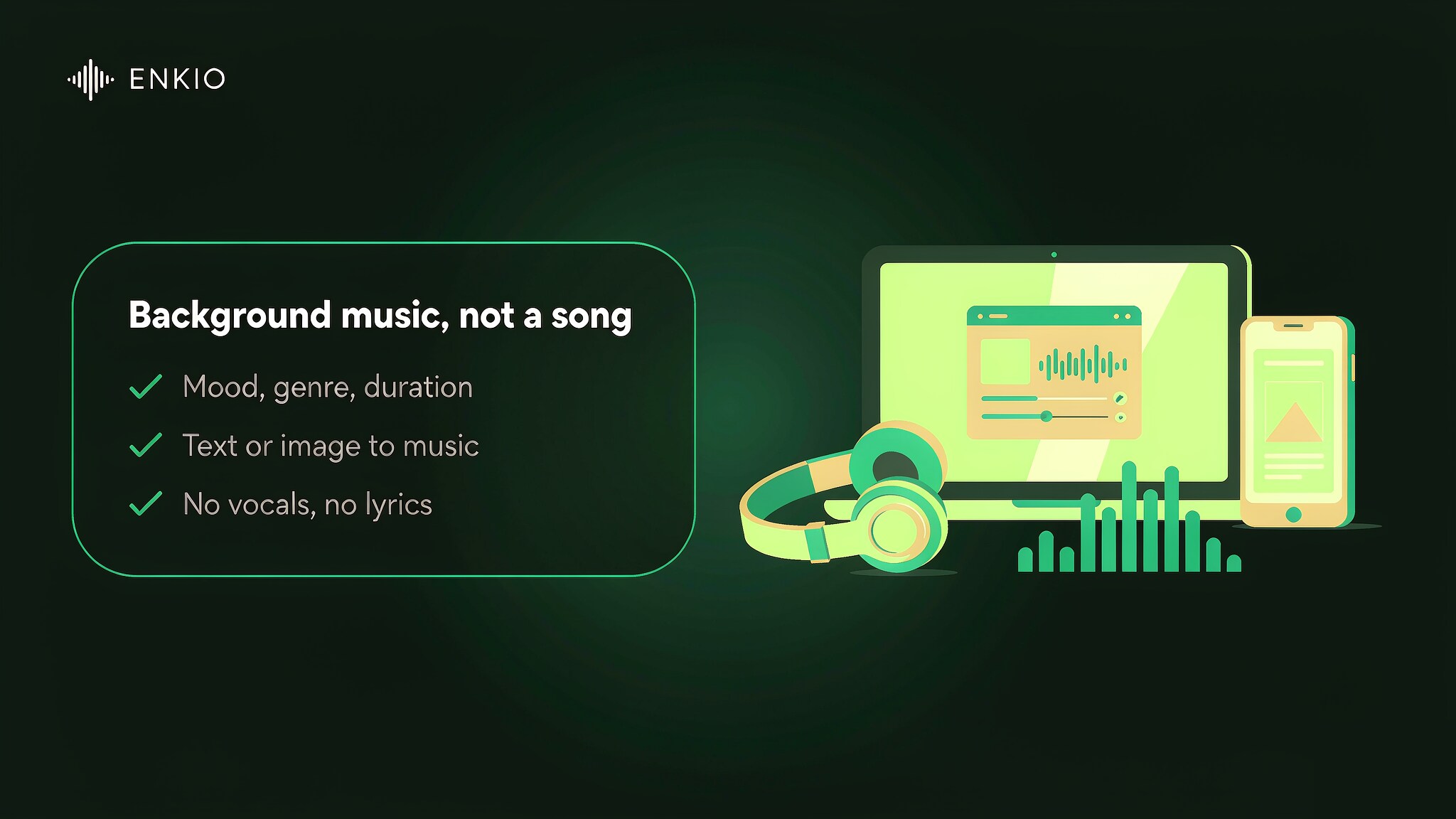
Two facts shape how the product should be judged. It is instrumental and text- or mood-driven, not lyric- or vocal-driven, and the company does not pretend otherwise; and the entire business is built around clean commercial rights, which is why most creators arrive here.
How Mubert Works in Practice
The workflow is short, and most of the work sits before generation rather than after it.
Describe the mood, not the theory
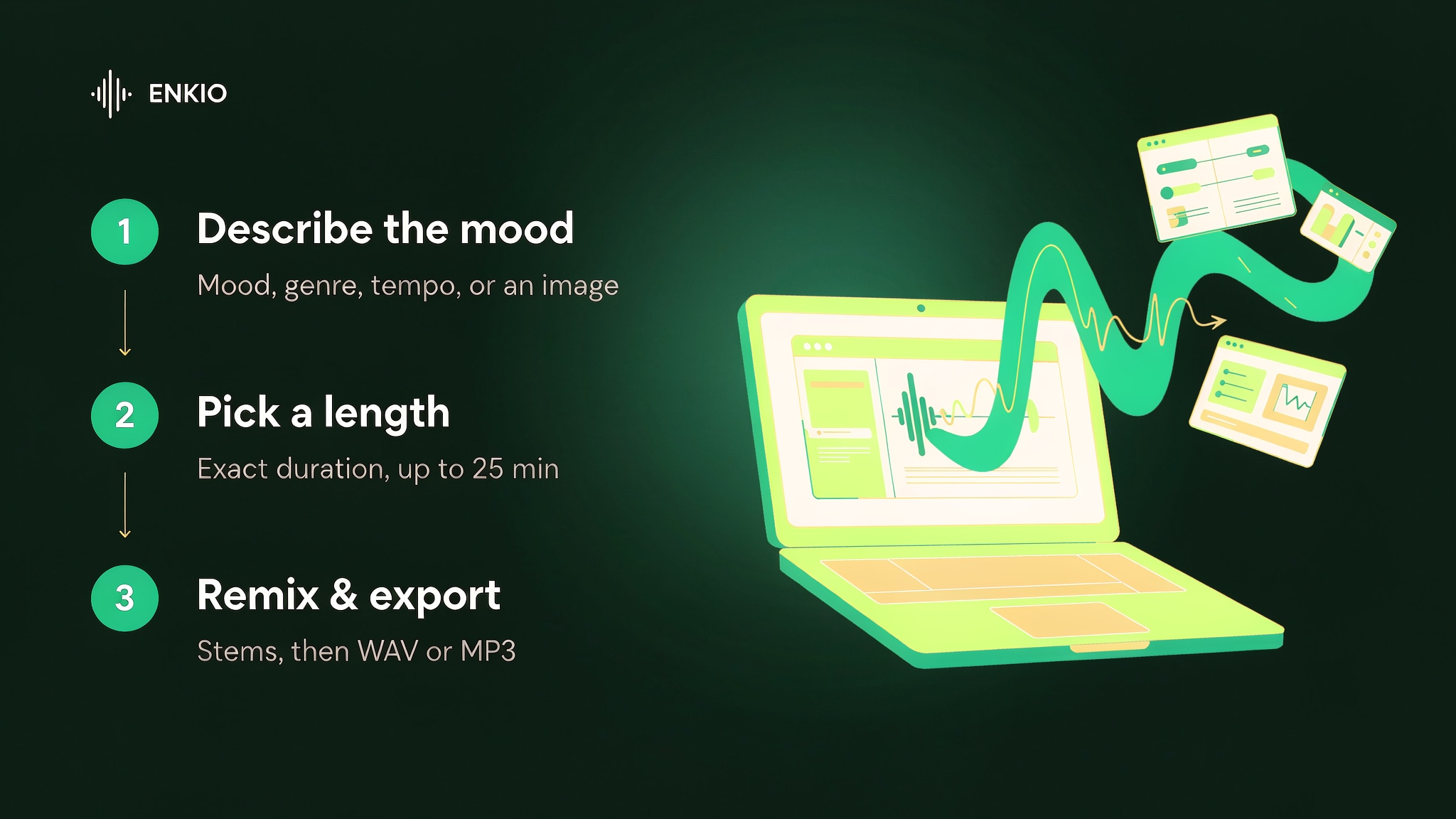
Generation starts from parameters a non-musician would naturally use: a mood such as focused or cinematic, a genre, a tempo, and a target length. There is also a text prompt and an image-to-music mode where the engine reads the mood of a picture. This is the entry point that separates Mubert from composition tools that expect you to think in keys and time signatures.
Pick a length and let it fill the slot
A track is generated to the exact duration you set, which sounds minor until you have spent twenty minutes looping a library track to fit a four-minute video. Paid plans allow lengths up to twenty-five minutes, and the output can be exported as MP3 on the free plan or as lossless WAV plus MP3 on paid plans.
Edit by remixing rather than rearranging
Editing works at the level of stems and sections rather than individual notes. Quick Remix, available on every plan, regenerates or removes a stem while keeping the rest. The full Track Editor, on Pro and Business, lets you change structure, BPM and key and generate a fresh version of the existing track. What you cannot do is open the result and rewrite the chord progression in a piano roll.
Publish to the platforms the licence allows
Because the product is organised around rights, export hands you a licence certificate with the file. That certificate, not an ownership claim, is what you show if a platform raises a false-positive flag. The boundaries of where the file may travel are strict, and they are the subject of the limitations below.
What the Mubert AI Music Generator Gets Right
Three advantages held up against the official documentation and this year's independent tests.
The rights story is the most honest in the field
Mubert markets its output as royalty-free under your plan's licence, and the mechanism behind that claim is unusual: the generative engine is built from producer-made stems with a revenue share to contributors, not scraped audio. For a creator monetising content, that is the difference between a safe workflow and a copyright claim that sinks a video. Our review found this positioning consistent across the official pages and the developer docs, and it is the single strongest reason to choose Mubert over a general-purpose song tool.
It is built for the creator's actual job
Most AI music tools are built for musicians. Mubert Render is built for people who need music in service of something else, which shows in small decisions: exact-length generation, mood-first navigation, and a copyright checker that flags platform conflicts before you publish. A comparison with the AIVA AI Music Generator Review is instructive: AIVA is also rights-conscious but aimed at composers, whereas Mubert is aimed at anyone with a timeline to fill.
The API is a genuine differentiator
No other consumer-facing music generator we cover exposes a streaming endpoint developers can build inside their own product. Mubert API takes text, image, BPM, genre and mood as inputs, streams with sub-second latency, and powers integrations that ship inside apps used by millions of people. For brands, game studios and AI agents, that endpoint is the product, and the music generator is the demo.
Pricing and Plans
As of September 2026, Mubert lists four consumer tiers plus a separate API line, and the prices below are annual-billing equivalents from the official pricing page, so check that page for current rates before you subscribe.
Ambassador is free and non-commercial: twenty-five tracks a month, a fixed duration, MP3 only, five downloads a month, and an attribution requirement. Creator is the non-commercial paid tier at about eleven dollars per month billed annually, with five hundred tracks a month, lengths up to twenty-five minutes, lossless exports and unlimited downloads.
Pro is the commercial tier at about thirty-two dollars per month billed annually, adding monetisation rights and the full Track Editor. Business is the agency tier at about one hundred fifty dollars per month billed annually, with a thousand tracks a month and the same editor. The Music API is quoted separately, with a roughly forty-nine dollar per month trial tier and scaled production plans.
The detail that decides value is the licence, not the price, because the cheap Creator plan stays non-commercial and the commercial use most channels need is a Pro question. Per-track economics are reasonable for anyone averaging dozens of downloads a month, and the free quota is enough to judge the sound. Independent listings quote different per-month figures than the official page, so treat the numbers above as a snapshot and confirm them on the vendor site.
Compare what a plan includes.
Enkio plans include AI music video generation, templates, and watermark-free downloads depending on your plan.
Real Limitations
The limits below are structural, and several are the direct cost of the rights model that makes Mubert attractive. Even a clean licence leaves the question of where the finished work goes, and the Music Video Marketing guide covers that part of the pipeline.
There are no vocals, and no song
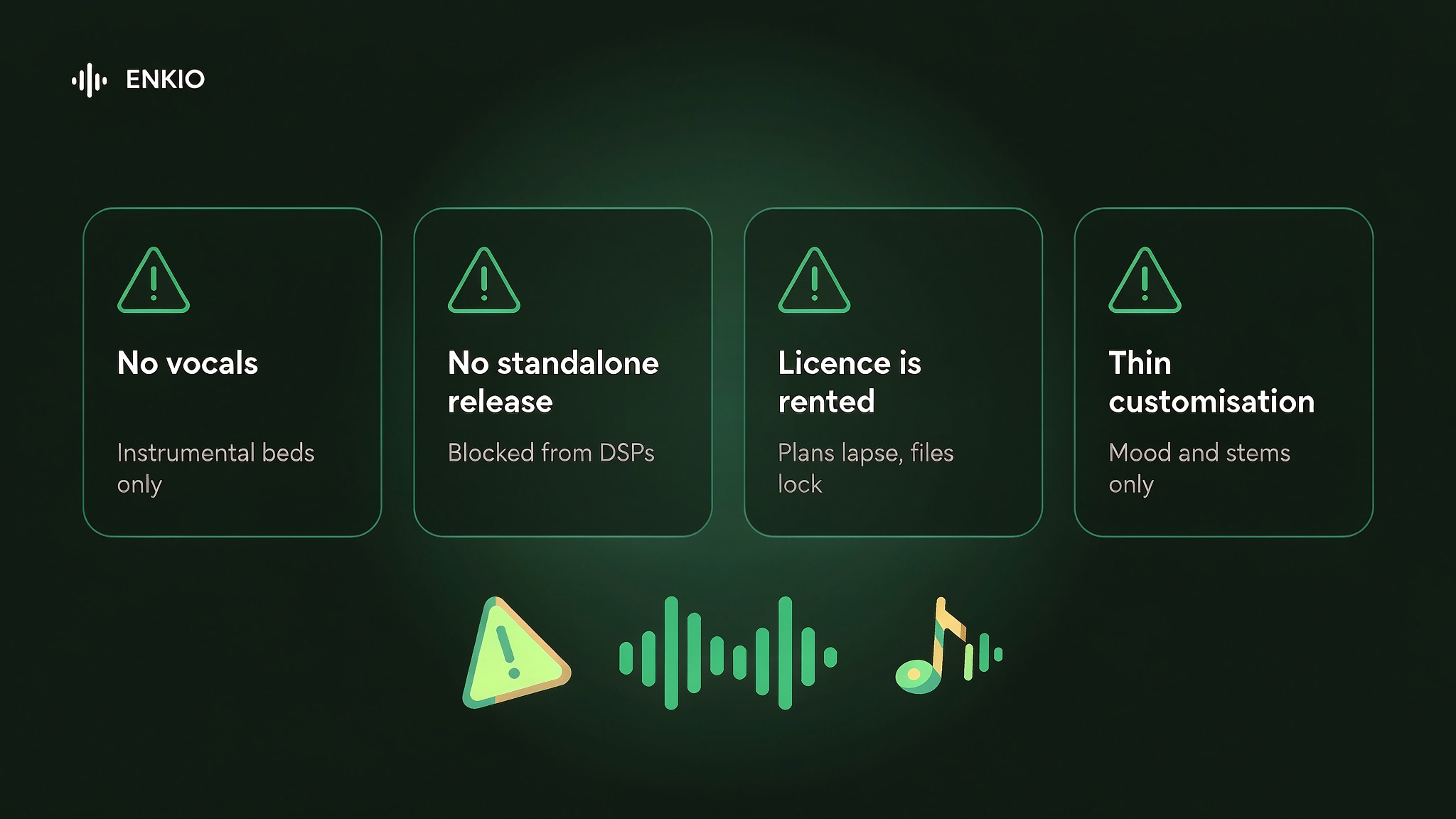
Mubert is instrumental and text- or mood-driven; there is no lyric input and no sung vocal, and the platform does not present itself as a songwriting tool. If the deliverable is a track with a voice on it, this is the wrong product and a vocal-first generator is the right one. This is the gap that defines the tool more than any interface decision.
The licence blocks standalone distribution
This is the most consequential restriction, and it is written into the terms rather than implied. Generated tracks cannot be sold or commercially distributed as music, cannot be published on streaming platforms such as Spotify, Apple Music or YouTube Music, cannot be registered in any Content ID system, and cannot be uploaded to stock or library platforms. They are licensed for use inside other content according to the plan, not as releases in their own right.
For a creator who wants a bed under a video, that is exactly right; for a creator who wants to put a track out as a song, it is a wall. That wall concerns releasing the track rather than using it: if your track is headed under a video instead of onto a streaming service, the missing piece is the picture rather than the rights, and Enkio's AI Music Video Generator starts from a finished track plus a visual direction, on credit-based plans with the current credit costs listed on its pricing page.
Cancellation locks past work out of new projects
When a paid plan lapses, you cannot use previously generated tracks in new projects, although projects already published while the plan was active can remain live and keep their licence. The music is effectively rented for as long as you pay, which is a different ownership position from tools that transfer rights outright. Anyone building a library should weigh this against the price, because it changes what survives if you leave.
Customisation is thin next to editors
Mubert offers mood, genre, tempo and stem controls, but no chord-progression or instrumentation control of the kind a composition tool provides, and the underlying palette is finite. Independent tests are consistent that electronic and lo-fi material lands well while classical and orchestral requests feel thin, and that recognisable patterns reappear after heavy use in a single style. For background work that is invisible; for anyone wanting a signature sound, it is the limit.
The free plan is restricted where it counts
Ambassador is free, but it requires attribution and blocks monetised use, and its five downloads a month cannot produce anything you are allowed to publish commercially. The free tier is a trial, not a publishing tier, and the leap to a commercial plan is a meaningful price step rather than a small one.
How It Compares With Soundraw and AIVA
The nearest competitors are not vocal song generators but other instrumental and rights-conscious tools. Both columns are a snapshot as of September 2026, and each vendor adjusts its plans, so verify specifics with the platform.
| Dimension | Mubert | Soundraw | AIVA |
|---|---|---|---|
| Core output | Background music to mood, length, image | Instrumental bed from genre and mixer | Composed instrumental score |
| Vocals | None | None | None |
| Written prompts | Supported, plus mood and image | Not the primary interface | Not the primary interface |
| Editing depth | Stem remix and section editor on paid tiers | Bar-level instrument toggles | Note-level piano roll |
| Distribution rights | Blocked from DSP and standalone | Restricted by tier | Tiered, copyright ladder |
| API | Yes, with streaming endpoint | Not offered | Not offered |
| Best fit | Beds for video, podcasts, apps | Fast control of a finished bed | Composition taken into a DAW |
Mubert wins where the job is background music at volume or inside a product, and where a clean licence matters more than per-note control. Soundraw wins where you want to steer a finished bed quickly with a mixer, and the Soundraw AI Music Generator Review covers that trade in detail. A vocal need is a different decision entirely, and the Suno Music Generator Review is the place to read about a tool built to write the song Mubert will not.
Common Misconceptions
Three assumptions come up often enough to be worth correcting.
Misconception one: royalty-free means I can release it as my song
The licence is clean for use inside content, not for releasing the track as a standalone recording. The terms explicitly block distribution to streaming platforms and Content ID registration, so a Mubert bed under a video is safe while the same bed uploaded as a single is not. Readers should separate "safe to use" from "mine to release."
Misconception two: the cheap plan covers my channel
Creator is positioned for personal and non-monetised content, and commercial usage and monetisation require Pro or Business depending on the use. A creator who buys Creator expecting to monetise a channel will find the licence does not cover the use, and the jump to Pro is roughly three times the annual-equivalent price. That rights business case, not the download count, justifies the jump.
Misconception three: AI music means a finished song
Mubert generates background music, not a song with a hook and a vocal, and treating it as a songwriting tool leads to disappointment. For work that has to carry a scene, that is the point; for work that has to be the scene, it is the wrong instrument.
Who the Mubert AI Music Generator Is For Right Now
Our comparison splits by job, because that is where the tiers and the rights separate.
Mubert suits YouTubers, podcasters, game developers and agencies that need a bed built to a mood and a length and licensed for commercial use; app and AI-agent builders who need a streaming endpoint rather than a file; and creators who publish often enough that a royalty-free plan beats paying per track or licensing libraries. The AI Music Video Ideas guide is a useful companion for creators deciding what to build once the bed is ready.
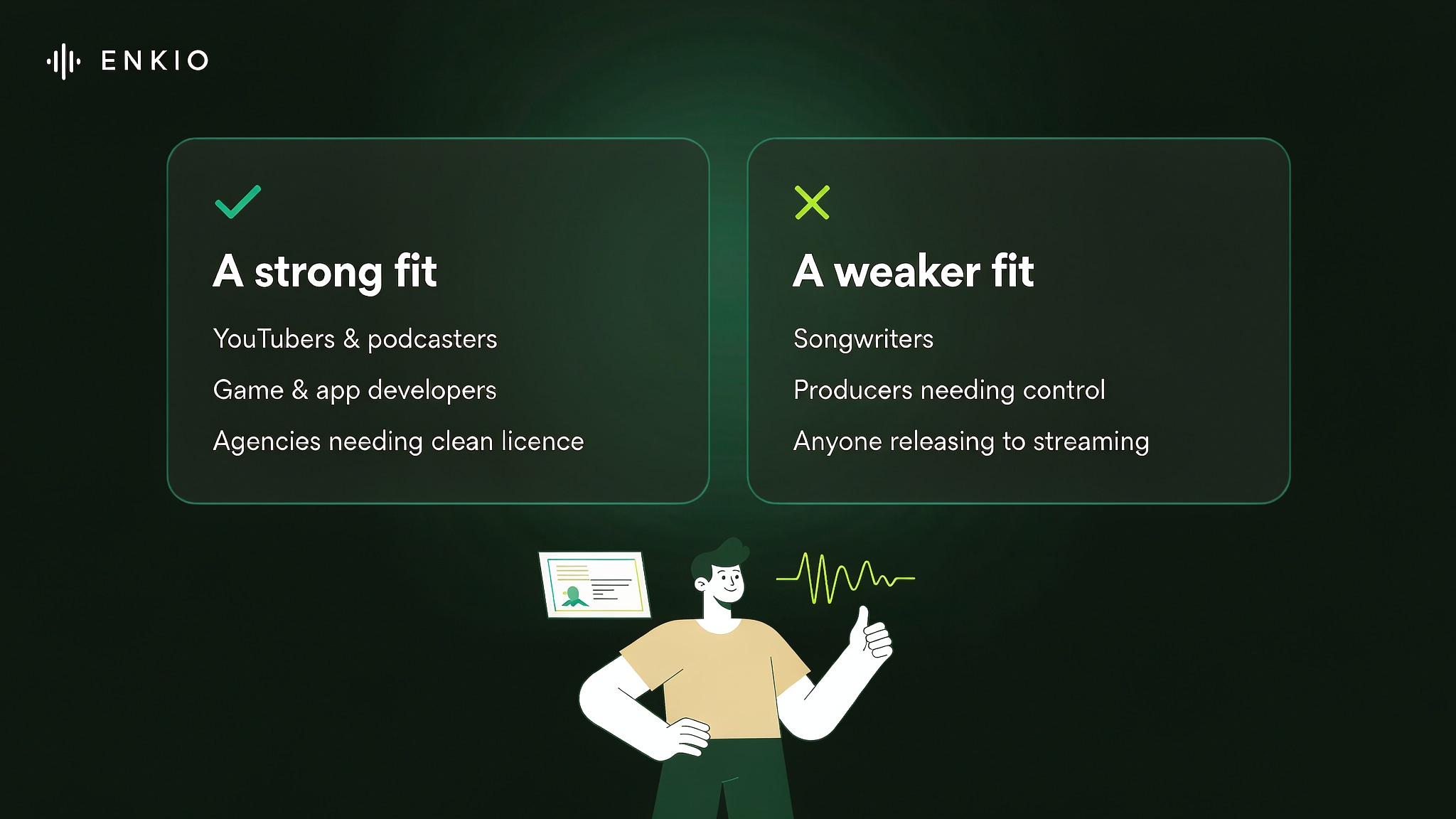
It is a weaker fit for songwriters who need a vocal, for producers who need arrangement-level control, and for anyone whose goal is to release a track to streaming, where the licence simply does not reach. If your priority is a clean, fast background bed rather than a release, this is one of the strongest options in the category.
From a Mubert Track to Something You Can Publish
A generated bed is usually the start of a piece of work rather than the end of one, and the next stage depends on what the track is for. A bed written for a scene becomes a video; a bed written for a channel becomes a release asset.
If you already hold a bed and a licence that cover the content you are publishing, Enkio takes the finished audio plus a visual direction and returns a music video, with 720p and 1080p output across five aspect ratios including 9:16 and 16:9. Instrumental beds suit this workflow particularly well, because there are no lyrics competing with the visuals, and a mood-matched track pairs cleanly with a generated video: shape the sound first, then give the finished audio a visual. Plans and credit costs are listed on the pricing page, so check the current numbers before planning around them.
One reminder applies whichever route you take: platform policies on AI-generated content differ, and several major platforms expect disclosure when music or video is machine-generated. Check the destination platform's current guidelines before publishing, particularly if monetisation is the goal.
Make more from your MV.
Let Enkio create a complete AI music video from your song with cinematic templates.
Frequently asked questions
These are the questions we see most often about the Mubert AI music generator.
Is the Mubert AI music generator free?
There is a free Ambassador plan with no card required: twenty-five tracks a month, a fixed duration, MP3 exports, five downloads a month, and an attribution requirement that blocks monetised use. It is enough to judge the sound and not enough to publish anything commercial. Check the official pricing page for the current free limits.
As of September 2026, the consumer tiers run from a free plan through Creator at about eleven dollars per month billed annually, Pro at about thirty-two dollars per month billed annually, and Business at about one hundred fifty dollars per month billed annually, with the Music API quoted separately. Creator is non-commercial; Pro and Business add commercial usage and the full editor. Third-party listings quote different figures, so confirm the current plans on the official pricing page.
Does Mubert generate vocals or lyrics?
No. The platform is instrumental and mood-driven, with no lyric input and no sung vocal, and it does not present itself as a songwriting tool. A project that needs a voice needs a different generator, and a common arrangement is to use Mubert for the bed and a vocal tool for the lead. If your project needs a vocal and a video, Enkio is one option to weigh: its music generation covers vocals and user-written lyrics, and its plans and credit costs are listed on its pricing page.
Can I use Mubert music commercially?
It depends on the tier. Ambassador and Creator are intended for non-commercial content, and commercial usage and monetisation require Pro or Business depending on the use case. The licence certificate supplied with a download is what confirms your right to use the track in eligible content, so read the plan you buy rather than assuming blanket coverage.
Can I publish Mubert tracks to Spotify or Apple Music?
No. The terms prohibit publishing generated tracks to music streaming platforms and registering them in any Content ID system, because the tracks are licensed for use within other content rather than as standalone releases. They can be licensed as music inside an eligible video, podcast or app according to your plan.
What is the Mubert API?
The API is a generative-music endpoint for developers and brands that returns files or live streams from text, image, BPM, genre and mood inputs, with sub-second streaming latency and tiers scaled for production use. It is the part of Mubert built to live inside other products rather than to be used by a single creator.
Which is the official Mubert AI music generator site?
The official product is mubert.com, and the generator, pricing and API all run from there. Directories and third-party pages reuse the name, so confirm that a page links back to mubert.com before you create an account or upload material.
Conclusion
Mubert takes the least glamorous position in this category and makes it useful. It generates royalty-free background music with a clean licence, hands creators exact-length tracks and an API no rival exposes, and it does the one job content producers actually have better than almost anyone.
The trade-offs are equally clear: no vocals, a distribution licence that stops at standalone release, a cancellation model that rents rather than sells the music, and a customisation ceiling well below a composition tool. If you need a bed you can trust under a video, a podcast or an app, this is a strong option. If you need a song to release, choose a tool built for that, and read the licence for whichever tier you buy before you build on it.