





SonAuto is a free AI music generator for creators who want full songs without paying. Our review tracks it through a name change that affects how you find and cite it. The short answer: the SonAuto AI music generator is now called Treblo, and it still makes full songs for free.
Its Melodia engine is a real alternative to token-based tools, but the commercial licence reads as unclear and the rename scatters its docs across two names. This sonauto ai music generator review covers what the engine produces and how the free and API tiers compare with Suno and Udio. It also looks at where the real limits sit and what changed when sonauto.ai became treblo.com.
What the SonAuto AI Music Generator Is
The SonAuto AI music generator is a browser tool that turns a prompt, a style tag, or your own lyrics into a complete song with vocals. It was founded by Ryan Tremblay and Hayden Housen. Our review of the public pages found the most important fact first: in 2026 the product was renamed Treblo. Sonauto.ai now redirects to treblo.com while accounts, saved tracks, and shared links keep working.
People still search for the sonauto.ai ai music generator by its old domain, and treblo.com is where the product now lives. When searchers look for the AI Music Generator category, SonAuto is one of the names they meet, though the live product answers to Treblo. The engine behind it is Melodia, a latent diffusion model that the vendor says works in a continuous space rather than the tokenized pipeline used by competitors such as Suno, and the Suno Music Generator Review covers the token-based side in detail.
How It Works in Practice
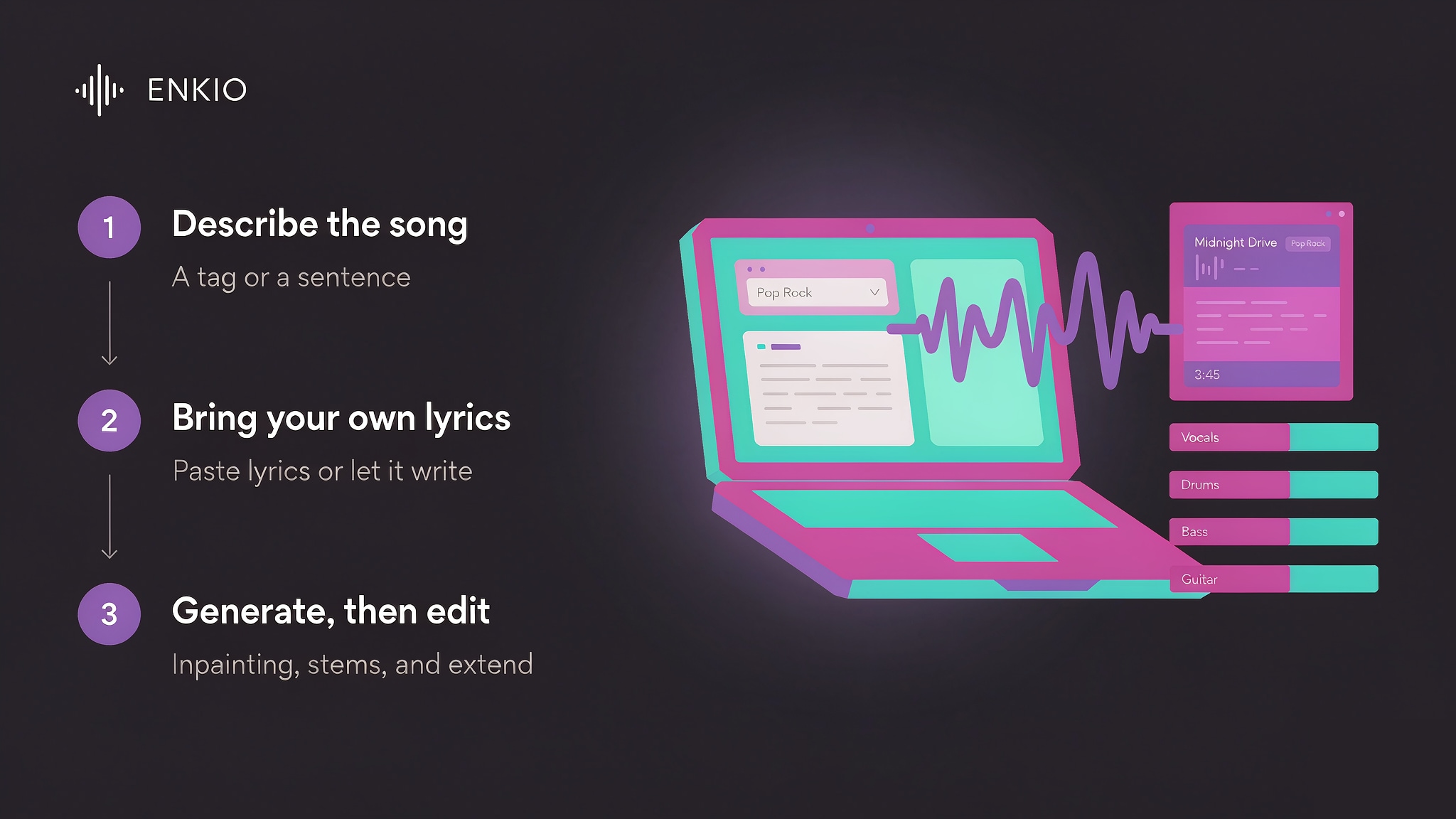
The workflow is short, and most of the effort sits in writing a clear prompt rather than in post-production. We read the official documentation and found the path from idea to finished track fits in four steps.
Describe the song with a tag or a sentence
Generation starts from style tags drawn from a catalogue the vendor puts above four thousand entries, or from a plain sentence that names the mood and genre. There is also an "in the style of" prompt for artists and eras you can name, which steers the result without you thinking in musical theory.
Bring your own lyrics or let it write them
You can paste lyrics you wrote, or let the model draft them in any language the interface supports. The vocal is synthesized from the text, so a tighter lyric tends to produce a tighter line, and a vague brief tends to wander.
Generate, then edit with inpainting and stems
A first pass returns a full song, and from there you can rewrite a line or a section with inpainting in auto or manual mode. The editor also separates vocals, drums, bass, and instrumental so you can pull a stem, and it can remix the arrangement without starting over.
Extend or publish
A track can be lengthened past its first pass by roughly sixty to eighty seconds or more, then downloaded in several formats. The extend and stem tools are what separate it from one-shot generators that hand you a single fixed file.
What the SonAuto AI Music Generator Gets Right
Four strengths held up when we read the official docs and set them against this year's independent tests. Our comparison with the paid leaders is the basis for the claims below.
Free and unlimited generation with no paid plan
The consumer product makes songs without a paid plan or a usage meter, which is the sharpest difference from Suno and Udio that charge once the free allowance runs out. For a creator who just needs a song to test an idea, the absence of a meter changes how freely you experiment.
A continuous-space engine that handles long lyrics
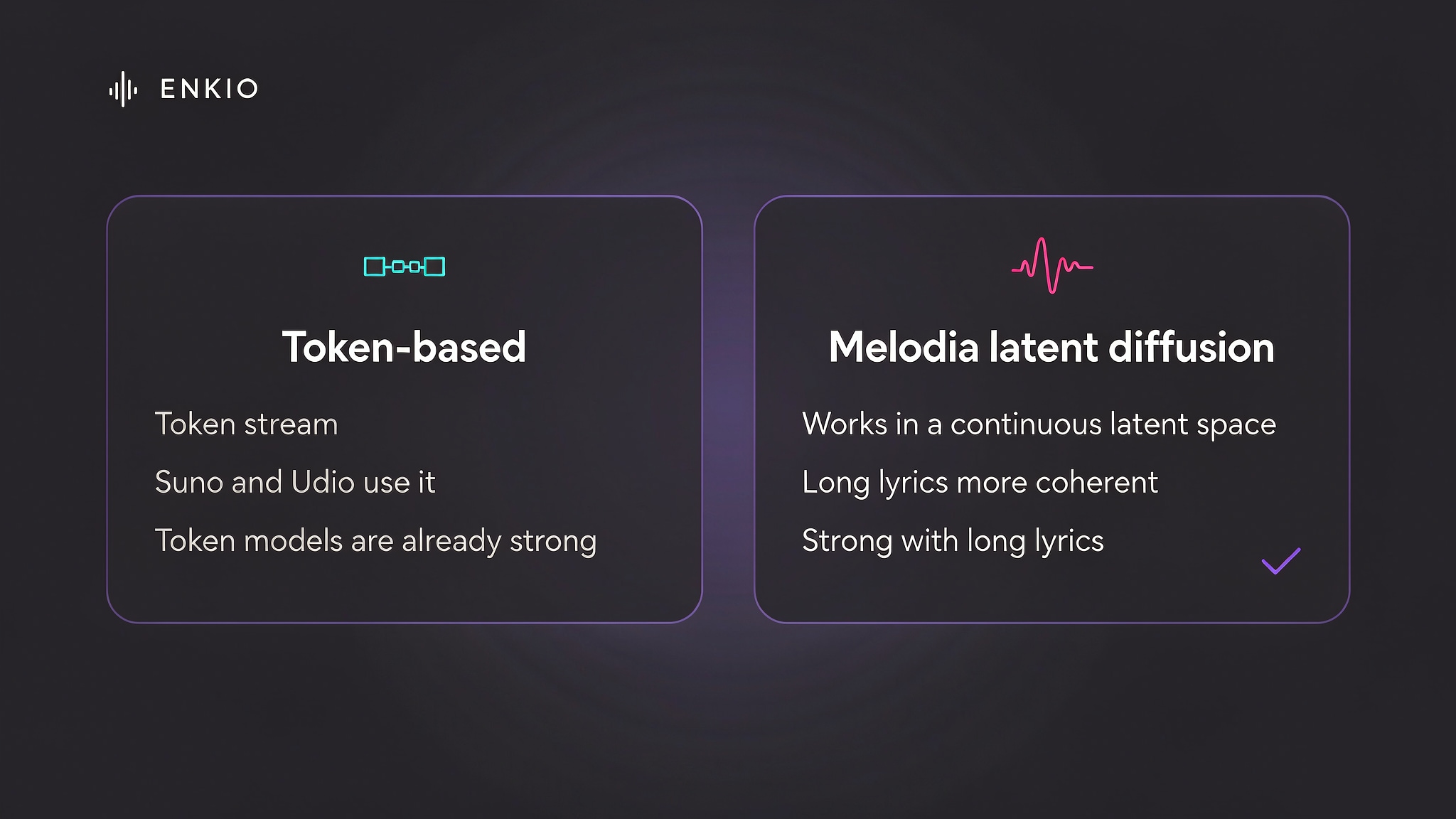
Melodia works in a continuous latent space rather than the token stream that Suno and Udio use, and the vendor argues this makes long lyrics more coherent from verse to verse. Our comparison found the claim plausible for longer forms, though the gap narrows on short pop hooks where token models are already strong.
Real editing: inpainting, stems, and extend
Most free generators stop at one file, while Treblo lets you rewrite a section, pull a stem, and lengthen the track. The Udio AI Music Generator Review shows how a token rival handles the same job, and Treblo's stem export is the piece paid users tend to miss most.
An API that exposes the same engine to developers
The Melodia API puts the generation engine behind an endpoint, so a developer can build songs into an app rather than only in the browser. A streaming competitor would need a different architecture, and the API is the part of Treblo built to live inside other products.
Pricing and Credits
As of September 2026, the consumer side of Treblo costs nothing: generation, inpainting, stem export, and extend are free and unlimited, with no points, credits, or subscription to spend down. The only paid surface is the developer Melodia API, and the figures below come from the vendor's published tiers, so check the official pricing page for current rates before you build on them.
The API starts with one thousand five hundred credits on signup at no charge. The Starter tier is about eleven dollars per month for twenty thousand credits, which the vendor frames as roughly two hundred songs. The Growth or Pro tier is about eighty-eight dollars per month for one hundred sixty thousand credits, and the Scale tier begins around three hundred thirty dollars per month. Extra credits beyond a plan run about six cents per hundred, and the rate falls below that on the eighty-eight dollar tier and above. At the Starter level the math is roughly five and a half cents per song, which is cheap but not the reason most people arrive here.
Independent listings quote different numbers than the official page, so treat the snapshot above as a moment in time and confirm the current plans on the vendor site. The consumer freedom is the headline; the API is for teams that need generation inside their own product.
Compare what a plan includes.
Enkio plans include AI music video generation, templates, and watermark-free downloads depending on your plan.
Real Limitations
The limits below are structural, and the first one changes how you can use what you make. We see the licensing question as the item most worth checking before you publish.
The commercial licence reads as unclear
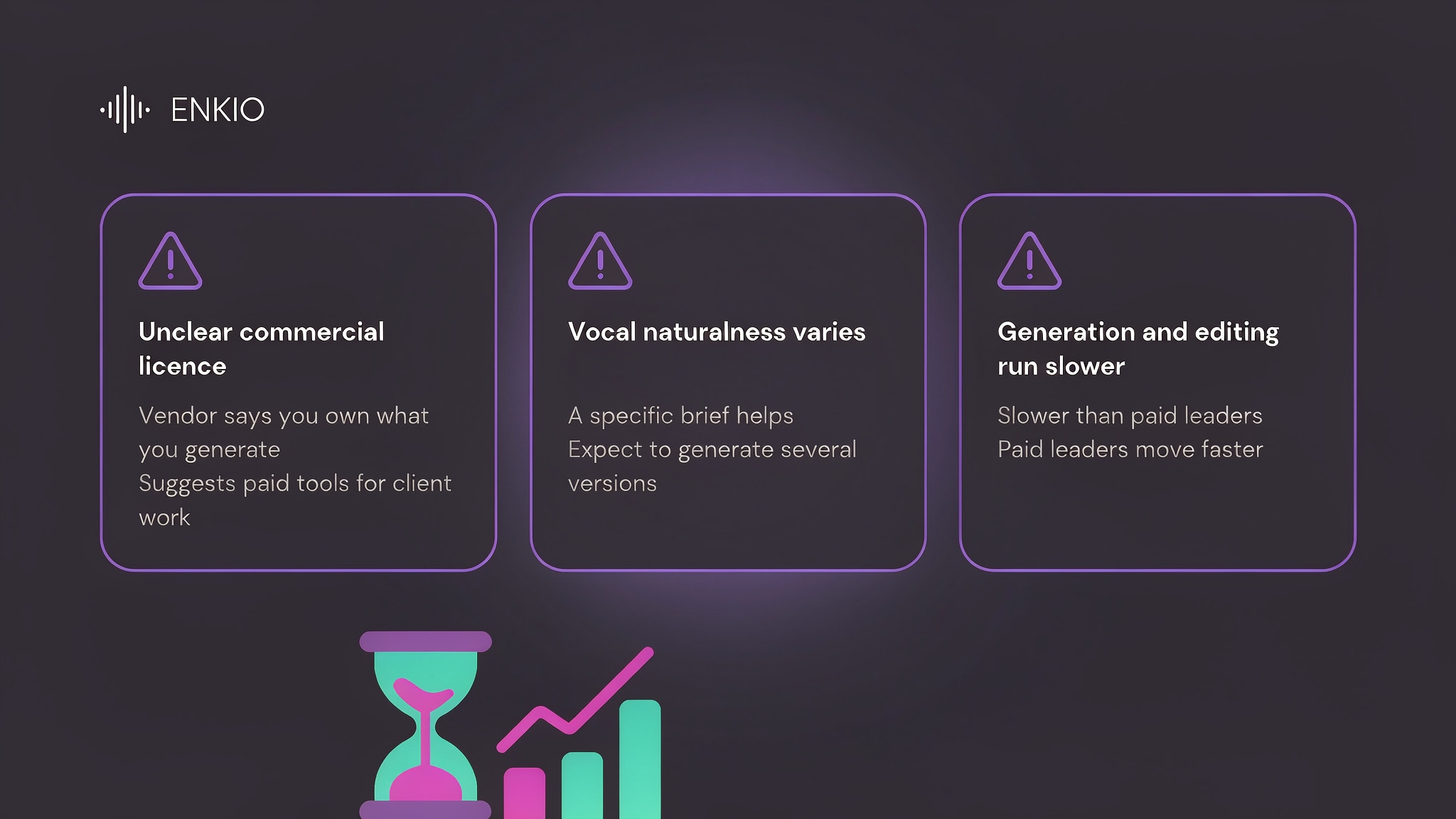
The vendor states that you own what you generate, yet several independent reviews and user reports describe the commercial licence as unclear and suggest paid tools such as Suno, Udio, or AIVA for serious client work. The two positions sit side by side, and we found no single clause that settles the question for a buyer. That uncertainty sits on the generation side rather than the audio quality.
If your next step is turning a finished track into a publishable video, Enkio's AI Music Video Generator takes the audio plus a visual direction and returns a music video in 720p and 1080p across five aspect ratios, on credit-based plans with the current credit costs listed on its pricing page. For commercial usage terms, see Enkio's Terms of Use.
Vocal naturalness varies and output swings with prompt detail
The sung voice is uneven across runs, and a vague brief can return a thin or off performance that needs another roll. Quality tracks with how specific the prompt is, so expect to generate several versions before one lands, which is normal for the category but heavier here than the marketing implies.
Generation and editing run slower than paid leaders
Creating a track and then inpainting or extending it takes longer than the paid leaders return a first pass, and the wait grows on longer songs. For a one-off idea the delay is minor, but a session of dozens of tries adds up against tools built for speed.
Fine control and advanced editing trail paid tools
You can rewrite a section and pull stems, but you do not get the arrangement-level or note-level control that paid editors advertise. The palette of styles is broad, yet deep customization of structure and instrumentation is thinner than tools aimed at producers who mix their own beds.
The rename scatters search results and citations
Because SonAuto became Treblo in 2026, guides, videos, and shared links still carry the old name while the product lives on the new domain. A reader following an old tutorial may land on a redirect and wonder whether the tool changed underneath, which our comparison found slows first-time trust more than any feature gap.
How It Compares With Suno and Udio
The nearest competitors are the two token-based leaders, and the table below is a snapshot as of September 2026, so verify specifics with each platform before you decide. The columns are not a scorecard of quality but a map of where each tool makes a different promise.
| Dimension | SonAuto (now Treblo) | Suno | Udio |
|---|---|---|---|
| Cost to generate | Free and unlimited, no credits | Free tier, then paid | Free tier, then paid |
| Engine approach | Melodia latent diffusion | Token-based | Token-based |
| Vocals | Yes, with lyric input | Yes | Yes |
| Stem export | Vocals, drums, bass, instrumental | Limited by tier | Limited by tier |
| Editing | Inpainting, extend, remix | Basic edit by tier | Basic edit by tier |
| Licence clarity | Vendor says you own it; reviews say unclear | Tiered, paid for commercial | Tiered, paid for commercial |
| API | Melodia API for developers | Yes | Limited |
| Best fit | Free full songs, long lyrics | Fast vocal songs | Style and extend work |
A vocal-first need is a different decision, and the Alternatives to Suno AI Music Generator guide maps the wider field beyond these two. If the goal is a video rather than a song, the AI Music Video Ideas guide is the companion read for what to build once the track exists.
Common Misconceptions
Three beliefs come up often enough to be worth correcting, and none of them overlap the limits above.
Misconception one: SonAuto shut down when it renamed
The rename to Treblo in 2026 was a rebrand, not a closure. The same team runs it, your login carries over, and old sonauto.ai links redirect to treblo.com, so a tutorial that says SonAuto is gone is simply out of date rather than reporting a dead product.
Misconception two: every AI music model works the same way
Suno and Udio use tokenized pipelines, while Treblo's Melodia works in a continuous latent space, which the vendor says helps long-lyric coherence. The approaches are different enough that the same prompt can return a different shape of song, so treating all generators as interchangeable misses the point.
Misconception three: a free generator only does basic one-shot output
Treblo gives inpainting, stem export, and extend on the free tier, not just a single fixed file. The limits that matter are licensing and fine control, not whether the tool can edit after the first pass, and free here means free rather than a trial of the real features.
Who the SonAuto AI Music Generator Is For Right Now
Our comparison splits by job, because that is where the free model and the licence separate.
Treblo suits hobbyists, prototypers, and creators who want a full song to test an idea without opening a billing page, plus developers who need the Melodia API inside their own app. It is a strong pick for long-lyric experiments where the continuous-space engine helps, and for anyone who would otherwise pay only to hear a rough draft. The Music Video Marketing guide is a useful companion for planning what happens to the track after it is made.
It is a weaker fit for teams that need a clean, defensible commercial licence before a client deliverable, for producers who want note-level control, and for creators on a deadline who feel every extra second of generation. If your priority is a free song to iterate on, this is one of the strongest options in the category; if your priority is a licence you can sign, read the terms first.
From a SonAuto Track to Something You Can Publish
If you already hold a finished track and a licence you understand, the next stage is usually the visual. Enkio takes the finished audio plus a visual direction and returns a music video in 720p and 1080p across five aspect ratios, and Enkio is one option when the song is done but the video is not. Plans and credit costs are listed on the pricing page, so check the current numbers before planning around them.
One reminder applies whichever route you take: platform policies on AI-generated content differ, and several major platforms expect disclosure when music or video is machine-generated. Check the destination platform's current guidelines before publishing, particularly if monetisation is the goal.
Make more from your MV.
Let Enkio create a complete AI music video from your song with cinematic templates.
Frequently asked questions
These are the questions we see most often about the SonAuto AI music generator and its rename to Treblo.
Is Treblo the same as SonAuto, and is it still available?
It is, under a new name. SonAuto was renamed Treblo in 2026, sonauto.ai now redirects to treblo.com, and your account, saved songs, and shared links carry over. The tool did not close; it rebranded, so old guides still point to a live product.
Is Treblo free to use?
The consumer side is free and unlimited, with no points, credits, or subscription for generation, inpainting, stem export, and extend. The only paid surface is the developer Melodia API, and As of September 2026 the Starter tier is about eleven dollars per month, so check the official pricing page for current rates.
Does Treblo generate vocals?
Yes. It synthesizes a sung vocal from lyrics you paste or from lyrics the model writes, in the languages the interface supports. Vocal naturalness varies between runs, so a specific brief helps, and you should expect to generate a few versions before one lands cleanly.
Can I use Treblo music commercially?
The vendor states that you own what you generate, but independent reviews describe the commercial licence as unclear and suggest paid tools for client work. The two claims sit side by side, so verify the current terms on the vendor's site before any commercial release, and for platform rules check the destination's guidelines.
How long is a Treblo song?
The current preview model returns tracks around four minutes and forty-five seconds, while earlier versions ran closer to two or three minutes. You can extend a track by roughly sixty to eighty seconds or more, so a finished piece can run longer than the first pass.
What is the Melodia API?
The Melodia API is the developer product that exposes the same generation engine behind an endpoint, with signup credits and monthly tiers scaled for production use. It is built for teams that need song generation inside their own app rather than in the browser alone.
Which site is the official Treblo (formerly SonAuto) page?
The live product is treblo.com, and sonauto.ai redirects there. Directories and old posts keep the SonAuto name, so confirm that a page links back to treblo.com before you create an account or upload material.
Conclusion
Treblo, formerly SonAuto, is the rare music generator that asks for no money and no credits to make a full song, and its Melodia engine is a real alternative for long-lyric work. The trade-offs are just as clear: a commercial licence that reads as unclear, vocals that need retries, slower generation than paid leaders, and a rename that scatters its own documentation. If the track is finished and the visual is the next thing on your list, Enkio takes that step from the audio you already have, without a new tool to learn.