





Tunee is a conversational AI music agent that also produces music videos inside one workspace. Our review covers the chat-based workflow, the pricing and credit math, and where the video side costs more than the music side.
The short answer: the Tunee AI music generator is a chat-driven song and video workspace, but its multi-clip video side spends credits far faster than the music side.
What the Tunee AI Music Generator Is
You meet the Tunee AI music generator as a conversational workspace rather than a single-button generator. The product is built by the Tianpuyue team under Quwan Group, and the vendor describes its engine as the TemPolor multimodal music model. The platform positions itself as one place for both a music agent and an MV Studio.
The category context helps place it. The AI Music Generator space now spans prompt-to-song tools, conversational agents, and video-linked studios, and Tunee sits in the last group with an emphasis on dialogue.
For a grounded comparison with the best-known song tool, the Suno Music Generator Review is the natural companion read, because both turn a brief into a sung track yet start from different input models.

Tunee states that it runs a conversational agent: you describe a mood, upload a reference audio, a melody, a video clip, or an image, and the agent asks follow-up questions before it converges on a track. The vendor also states that the agent keeps context memory and recalls style preferences across a session. The official page lists functions from model switching to voice cloning, lip sync, and a consistent AI character.
How It Works in Practice
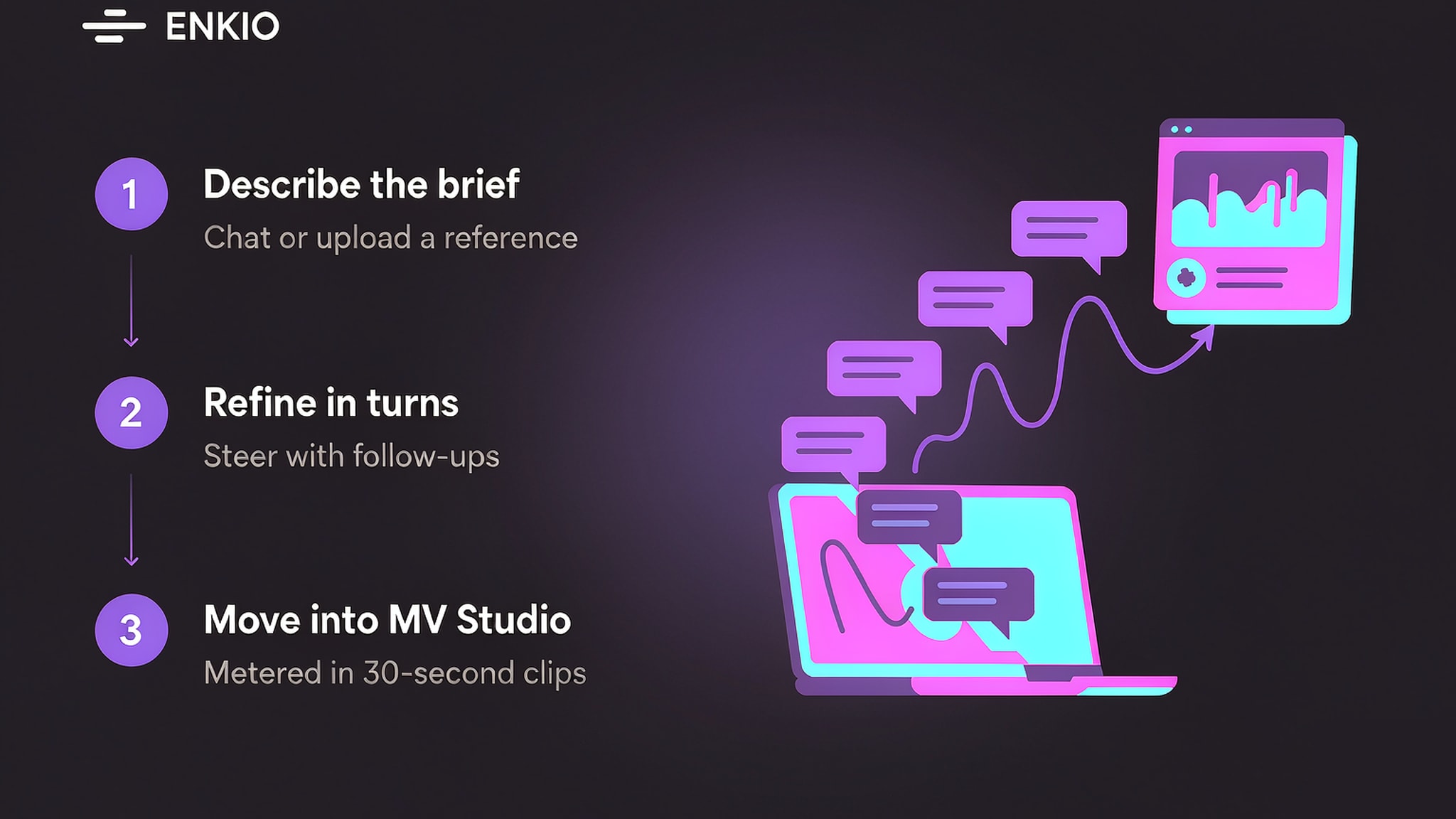
The workflow is built around a conversation, and most of the effort sits in describing the brief rather than editing the result.
Describe the brief in plain language
Generation starts from natural-language chat instead of a structured prompt form. You tell Tunee the mood you want, or you upload a reference such as a melody, an audio clip, a short video, or a picture. The agent then asks clarifying questions, which is the part that separates it from tools that expect one complete prompt up front.
Generate and refine through several turns
Once the brief is set, the engine returns a track and the conversation continues. You can steer the result with follow-up messages rather than starting over, and the vendor states that the agent remembers preferences from earlier in the session. The back-and-forth is the core loop, and it favors creators who think in scenes rather than in parameter lists.
Polish with stems and mastering
The post-generation step covers stem separation and mastering. The official page lists stem separation at two, four, or six tracks, splitting vocal, drums, bass, and melody, and it marks a free first trial on that feature. Smart Mastering is listed at four credits per track, and the vendor describes the mastering step as producing a polished, finished result rather than a raw export.
Move the track into MV Studio
The final step extends the song into a music video. MV Studio draws on third-party video models for the visual half, and the output is metered in short clips rather than full songs. That handoff is where the credit math changes most, which the pricing section below addresses directly.
What the Tunee AI Music Generator Gets Right
Three strengths held up against the official listings we read.
The conversational loop lowers the prompt burden
Tunee assumes you want to talk through a track instead of writing one perfect prompt. The follow-up questions and the stated context memory mean a vague first idea can converge over several turns, which is a gentler entry than tools that punish a thin brief. For a creator who thinks in mood and scene, that shape is the product's clearest advantage.
One workflow switches between several engines
The official page lists model switching inside a single flow, naming Mureka, Minimax, TemPolor, Ace-Step, and Kling, and it labels the set as nine models with auto-select. Keeping those engines in one workspace means you can compare outputs without leaving the project.
The Mureka AI Music Generator Review shows what one of those engines looks like on its own, which helps when you weigh how much the switching actually matters to you.
The post tools cover voice, face, and motion
Beyond the song, Tunee lists voice cloning, lip sync that lets a photo sing, motion control driven by an external video model, and a consistent AI character. That bundle is broader than most song-only generators, and it is the reason Tunee reads as a studio rather than a generator. The breadth is real, though the video half depends on models the vendor does not control.
Pricing and Credits
As of September 2026, the official English pricing page lists the plans below in US dollars, and the vendor may adjust them, so check the official pricing page for current rates before you subscribe. Annual billing is shown at about seventeen percent below the monthly rate, and the figures below are the vendor's stated values at the time of writing.
| Plan | Monthly price | Annual equivalent | Stated credits |
|---|---|---|---|
| Free | $0 | — | 0 daily refresh credits, about 15 songs |
| Basic | $18 | $15 per month, $180 per year | 1,800 per month plus 150 daily refresh |
| Plus | $38 | $30 per month, $360 per year | 4,000 per month |
| Pro | $89 | $68 per month, $816 per year | 9,200 per month |
| Ultra | $199 | $129 per month, $1,548 per year | 27,400 per month |
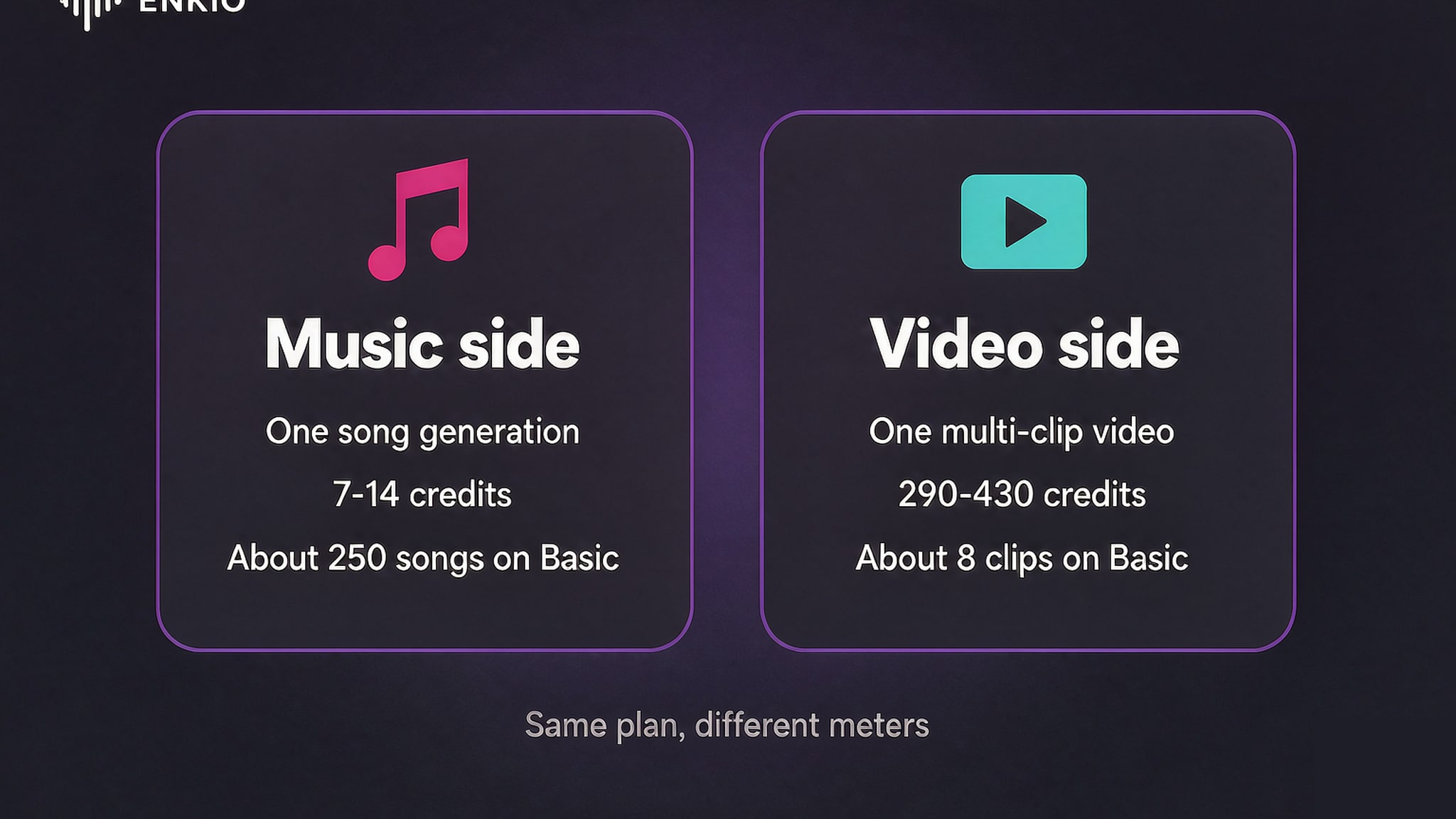
The detail that decides value is the per-unit math, not the headline. As of September 2026, a third-party compilation by musicseed.ai lists representative per-item credit costs: a single song generation runs roughly seven to fourteen credits across the music models, while a multi-clip music video runs about two hundred ninety to four hundred thirty credits. We report those figures as musicseed.ai's compilation rather than as Tunee's official statement, because the vendor's pricing page lists plan totals rather than per-action costs.
The structural point is the gap between the two sides. A Basic plan at 1,800 credits per month covers about 250 songs by the vendor's estimate, yet the same budget covers only about eight thirty-second music videos once multi-clip generation is counted. The music and the video are billed on different scales, and the video side is the expensive one. The vendor states that paid plans include a commercial licence, and the free plan limits use to personal projects with attribution. Confirm the exact limits on the official pricing page, because plan totals and per-action costs are presented separately.
Compare what a plan includes.
Enkio plans include AI music and music video generation, with credit costs listed on the pricing page.
Real Limitations of Tunee AI Music Generator
The limits below are structural, and the first one is the reason most video decisions turn on this platform rather than its sound.
The video side spends credits far faster than the music side
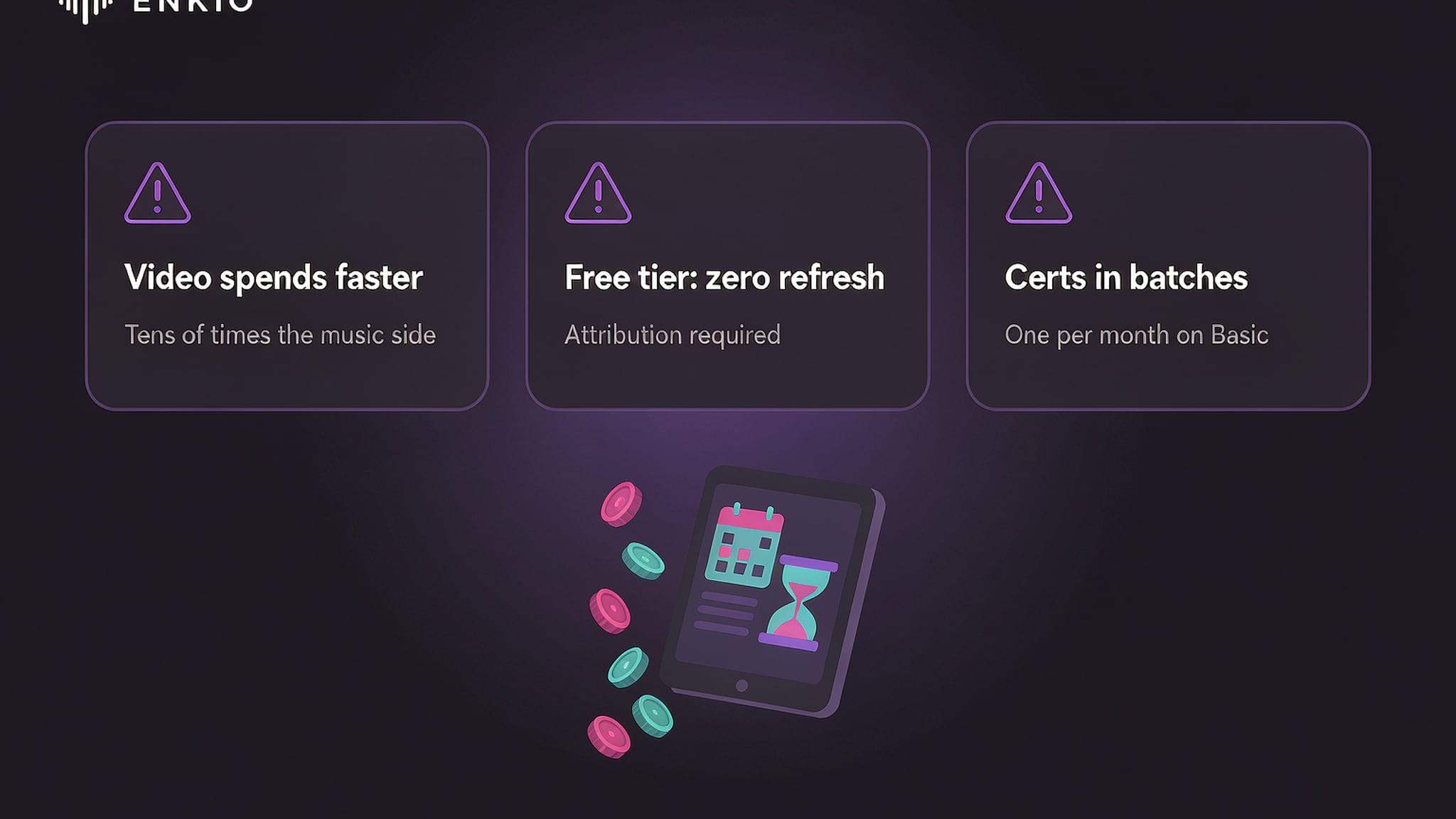
As of September 2026, a single song generation costs roughly seven to fourteen credits, while a multi-clip music video costs about two hundred ninety to four hundred thirty credits according to the musicseed.ai compilation. That is a gap of tens of times, and it means a Basic plan's 1,800 credits buy about eight thirty-second videos rather than hundreds of songs. The music and the video are not the same product at the meter.
That gap matters most once you already hold a finished song and want the visual half. If the piece you are missing is the video, Enkio's AI Music Video Generator takes a finished track plus a visual direction and returns 720p and 1080p output across five aspect ratios, on credit-based plans with the current credit costs on its pricing page.
The free tier carries no daily refresh credits
As of September 2026, the official pricing page lists the free plan at zero daily refresh credits, about fifteen songs, and a single parallel video project. Free works require attribution, and the vendor's example reads as a credit line such as "Created by Tunee AI." The free plan also limits use to personal projects and does not include the commercial licence that paid plans state. For anyone publishing, the free tier is a trial rather than a path.
Copyright certificates are released in batches by tier
As of September 2026, the vendor states that paid plans include a commercial licence, and it states that ownership of generated tracks belongs to the subscriber on paid plans. We report that as the vendor's wording and have not verified the terms directly. The certificate feature is metered by tier: Basic releases one certificate per month for a past song, Pro releases three, and Ultra releases six. Ownership is therefore claimed in batches rather than granted in full and automatic for every track.
The official FAQ adds a caveat of its own. It states that AI music copyright law is still evolving and that the vendor cannot make absolute assurances about copyright protection. We note that statement as the vendor's own disclaimer rather than as a legal conclusion.
MV quality follows the third-party video model
MV Studio relies on external video models such as Kling, Seedance, and Sora2, and the vendor does not control those engines. Independent feedback aggregated on tuneeai.net and in separate reviews reports that MV output can be inconsistent and that lip sync sometimes drifts. We attribute those reports to those sources rather than to our own testing, and the point stands as a dependency rather than a defect claim.
The MV is metered in thirty-second clips
The English pricing page measures music video output in thirty-second clips, while fuller-length video benefits appear on the Chinese-language page and on higher tiers. The wording is not identical across languages, so a buyer comparing plans should read both the English and the localized pages. We flag the inconsistency as a reading caution, not as a fault.
How It Compares With Enkio
The closest reference point is Enkio, the web-native song generator. The comparison below is a snapshot as of September 2026, and each vendor adjusts its plans, so verify specifics with the platform before you choose.
| Dimension | Tunee | Enkio |
|---|---|---|
| Starting point | Conversation with follow-up questions | Prompt with optional lyrics |
| Music engine | Several switched models in one flow | Its own generation pipeline |
| Stem separation | Two, four, or six tracks | Varies by plan |
| Music video | MV Studio with third-party models | Core feature |
| Billing unit | Plan credits plus per-action costs | Pricing varies; check the vendor's site |
| Best fit | Dialogue-driven songs plus video | Prompt-driven songwriting at a desk |
Tunee wins where the job is a talked-through song that then needs a video, and the Enkio review guide shows the prompt-driven path for a different kind of session.
Who the Tunee AI Music Generator Is For Right Now
Our comparison splits by job, because that is where the credit gap and the video dependency separate the fits from the misfits.
Tunee suits creators who want to talk a song into being and then extend it into a short video, hobbyists who value a broad tool set in one place, and teams that benefit from switching between several music engines without leaving the project. The conversational loop and the bundled voice, face, and motion tools make it a low-friction starting point for scene-led work.
It is a weaker fit for anyone who needs many full-length videos on a tight credit budget, because the video side spends credits tens of times faster than the music side. It is also a poor match for buyers who want ownership terms settled in one automatic grant rather than in monthly certificate batches, and for creators who need video quality that does not shift with an external model. If your priority is a talked-through song with an occasional short clip, this is a reasonable option in its category.
From a Tunee Track to Something You Can Publish
A generated track is usually the start of a piece of work rather than the end of one. A song written for a scene becomes a video, and a bed written for a channel becomes a release asset.
If you already hold a track and want the visual half, Enkio takes the finished audio plus a visual direction and returns a music video, with 720p and 1080p output across five aspect ratios including 9:16 and 16:9. Tunee songs pair cleanly with a generated video, since the mood already matches the picture: shape the sound first, then give the finished audio a visual. For commercial usage terms, see Enkio's Terms of Use.
One reminder applies whichever route you take. Platform policies on AI-generated content differ, and several major platforms expect disclosure when music or video is machine-generated. Check the platform's current guidelines before publishing, particularly if monetisation is the goal.
Make more from your track.
Let Enkio create a complete AI music video from your song with optional prompts up to 2000 characters.
Frequently asked questions
These are the questions we see most often about the Tunee AI music generator.
Is the Tunee AI music generator free?
As of September 2026, there is a free plan at $0, and the official pricing page lists it with zero daily refresh credits, about fifteen songs, and a single parallel video project. Free works require attribution and limit use to personal projects without the commercial licence that paid plans state. Check the official pricing page for the current free limits before relying on it.
As of September 2026, the official English page lists Basic at $18 per month, Plus at $38, Pro at $89, and Ultra at $199, with annual billing shown about seventeen percent lower. The vendor states monthly credit totals from 1,800 to 27,400 depending on tier. Confirm the figures on the official pricing page, because plan totals and per-action costs are listed separately.
Does Tunee generate music videos?
Yes. MV Studio extends a song into a music video using third-party video models, and the English pricing page meters output in thirty-second clips. A Basic plan covers about eight such clips per the vendor's estimate, while higher tiers cover more. Results vary by the external engine in use.
Can I use Tunee music commercially?
The vendor states that paid plans include a commercial licence and that ownership of generated tracks belongs to the subscriber on paid plans. We report that as the vendor's wording and have not verified the terms directly. The official FAQ also states that AI music copyright law is still evolving and that the vendor cannot make absolute assurances. Read the terms before any commercial step.
How many credits does a song cost versus a video?
According to a musicseed.ai compilation we cite as a third-party source as of September 2026, a single song generation runs roughly seven to fourteen credits, while a multi-clip music video runs about two hundred ninety to four hundred thirty credits. That is a gap of tens of times. We present those as musicseed.ai's figures rather than as Tunee's official per-action pricing.
Is there an alternative if I only need the video half?
If your song is already finished and the missing piece is the visual, you do not have to adopt a full music platform. In our Alternatives to Suno AI Music Generator guide we compare several options side by side. If your priority is turning an existing song into a video without learning a new timeline, Enkio handles the audio-to-video step from the track you already have.
Who makes Tunee?
Tunee is built by the Tianpuyue team under Quwan Group. Quwan stated in May 2026 that Tianpuyue and Tunee together had passed 62 million global users and 35 million AI songs created, which we attribute to the vendor's own announcement rather than to our measurement.
Conclusion
Tunee takes a distinctive position by turning music generation into a conversation and then extending that conversation into MV Studio. The strengths are clear: a low-friction dialogue loop, several music engines in one workflow, and a broad set of voice, face, and motion tools.
The trade-offs are equally clear: the video side spends credits tens of times faster than the music side, the free tier carries no daily refresh credits, ownership certificates release in batches by tier, and the MV depends on third-party models whose consistency varies. If the track is finished and the visual is the next item on your list, Enkio takes that step from the audio you already have, without a timeline to learn.