



DeepAI Music Generator removes most of the friction between a written idea and a downloadable song. We entered one controlled indie-pop brief, received a complete result in about 25 seconds, and downloaded a working MP3 without creating an account. The output was usable as a draft, but it ran 11.816 seconds longer than requested and exposed few ways to correct the structure. This review is published on our product site; we apply the same criteria to our own workflow and distinguish audio generation from producing a finished music video.
Already have the song? Plan the visual next.
Enkio turns finished audio and images into a guided music video workflow.
What DeepAI Music Generator Is
DeepAI Music Generator is a browser tool that turns a text description into a song, instrumental, or soundscape. The page asks for the musical direction rather than a DAW-style arrangement. A user describes genre, mood, instrumentation, vocals, and subject, then waits for one generated result to appear.
That narrow workflow is the attraction. There is no project setup, track routing, or visible theory panel to learn before the first run. It also defines the ceiling: DeepAI is closer to a quick idea generator than a production environment built around detailed revisions.
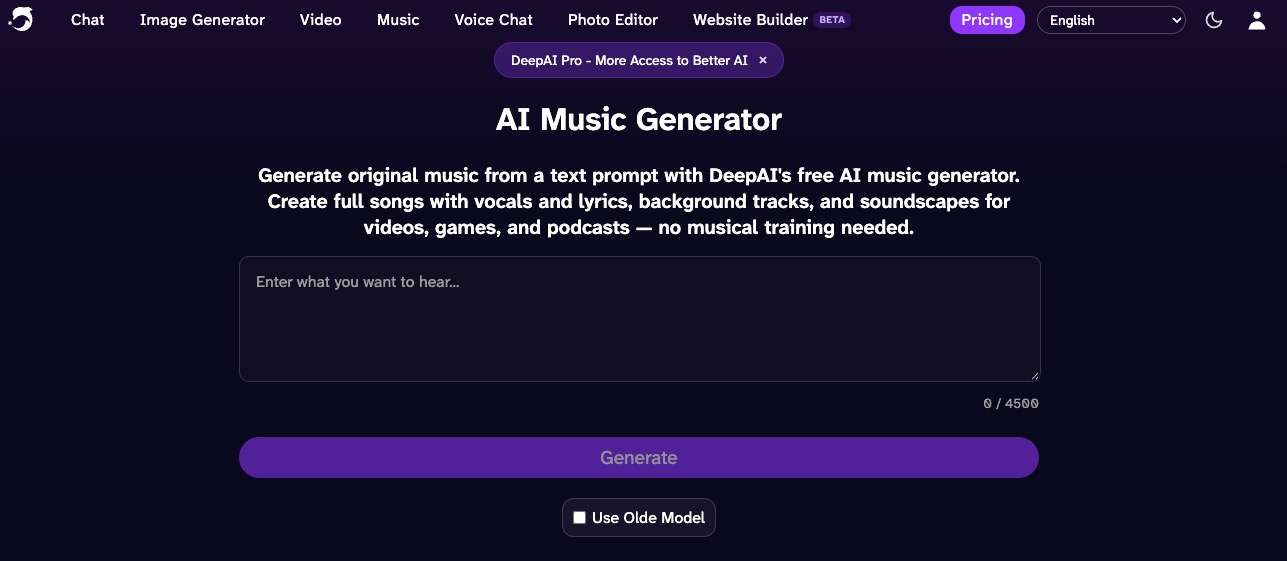
Within the wider Best AI Music Generators category, it competes on access and speed. Tools aimed at producers usually expose more control over lyrics, arrangement, stems, or revisions. DeepAI instead makes the first generation easy enough to try anonymously.
Enkio occupies a different point in the release workflow. The platform can generate music, but it also carries finished audio and visual inputs into an MV project. This review judges DeepAI as an audio generator.
How We Tested This Tool
How to Use DeepAI Music Generator
DeepAI works best when the prompt gives it one coherent musical direction. A list of conflicting genres and moods leaves the system to decide which instructions matter. Start with the deliverable, then add only the musical details that help define it.
-
Write the intended genre, mood, vocal state, core instrumentation, subject, and approximate duration. Keep the directions compatible rather than stacking unrelated styles.
Done whenThe prompt describes one song a musician could recognize.
-
Paste the brief into the music generator and start the task. Record the requested duration and any structure requirements before the result appears.
Done whenThe original input can be compared with the finished output.
-
Listen beyond the opening seconds. Check whether vocals, chorus placement, mood, instrumentation, and ending match the brief.
Done whenYou can list the instructions that passed and the ones that drifted.
-
Save the MP3, verify its actual duration and file properties, and retain the prompt with it. Do not assume the requested length equals the delivered length.
Done whenThe audio and its evidence record are stored outside the result page.
The same input discipline applies to an AI Music Generator, even when another interface exposes more options. If you want a more iterative example, How to Use Suno AI Music Generator shows how a longer revision workflow differs from DeepAI's one-prompt start.
What DeepAI Gets Right
DeepAI's strongest result is a short path from idea to file. Our session did not require an account, payment step, or plan selection before the first generation. That makes it useful for testing whether a broad musical concept is worth developing elsewhere.
The first result arrived quickly
The generated song appeared in about 25 seconds in our run. That number reflects one browser session and one prompt, so it is not a service-level benchmark. It is still useful evidence that a simple brief can produce a complete preview without a long setup sequence.
The download was a normal audio file
The downloaded result was an MP3 rather than an in-page preview that needed to be recorded manually. File inspection showed stereo audio at 44.1 kHz and 192 kbps. Those specifications are sufficient for reviewing an idea and placing it into a rough edit.
The interface keeps decisions to a minimum
There is value in not asking a beginner to choose key, time signature, stem layout, or generation model before hearing anything. DeepAI is accessible precisely because it hides most production decisions. Creators who know those decisions matter will reach the limits sooner.
Output Quality and Prompt Following
Our prompt requested a 45-second atmospheric indie-pop song about a midnight train, with soft female vocals, warm analog synths, gentle driving drums, a concise original chorus, and a bittersweet but hopeful mood. That gave the result both creative and measurable requirements.
The clearest finding was duration drift. The downloaded file measured 56.816 seconds, or 11.816 seconds longer than requested. It exceeded the target by about 26%. A social editor can trim the excess, but trimming may remove the ending or make a chorus land awkwardly. Exact-length buyers should treat the duration instruction as a preference, not a locked export setting.
We did not use one result to claim that a particular vocal timbre, genre, or mix is typical of every DeepAI generation. Those judgments require repeated prompts and controlled listening comparisons. The useful evidence here is narrower: the tool returned a complete vocal-song file quickly, while one objective instruction was not followed precisely.
Our Soundraw AI Music Generator Review provides a different decision point for readers who care more about structured background-music control than a fast text-to-song draft.
Access, Cost, and Public Sharing
The tested generation cost us $0 and did not require sign-in. That is the only cost conclusion this run supports. It does not prove that every feature, repeated generation, private storage option, or future use remains free.
The page also warned that generated audio may be shared publicly. That notice changes the decision for unreleased lyrics, client briefs, or private reference material. A creator should not interpret “no account required” as “private by default.” Use non-sensitive prompts unless the current policy and account controls clearly say otherwise.
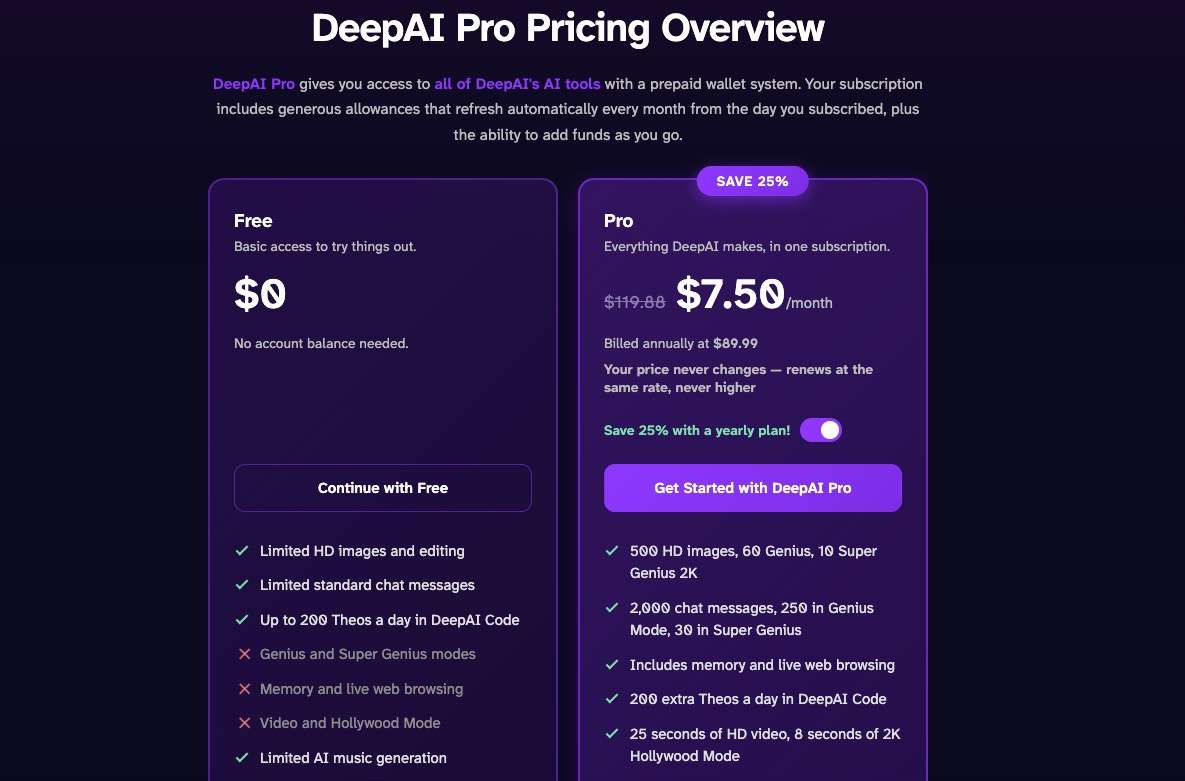
As of November 2026, DeepAI's public page promotes a Pro option. We did not subscribe or verify plan-specific music entitlements. Check the official pricing page for current plan terms before treating a general site plan as a particular number of music generations.
Price the whole release workflow.
Compare current audio, video, watermark, and credit benefits before committing to a plan.
Real Limitations
DeepAI's limitations come from the same design choice that makes it approachable: the interface avoids detailed production controls. That is acceptable for ideation and consequential for a fixed brief.
Duration is not locked to the prompt
Our 45-second request became a 56.816-second file. A difference of nearly 12 seconds can break an ad slot, intro sequence, or platform-specific cut. The user must verify the file and edit around the discrepancy.
Revision control is shallow
The tested page did not expose a timeline, section replacement, stem mixer, or parameter panel for correcting one part while retaining the rest. If the chorus, ending, or length misses the brief, another full attempt may be easier than a surgical fix.
Public sharing may conflict with private work
The visible sharing notice matters for unreleased concepts. It does not prove that every result is indexed or discoverable, but it is enough to make confidential prompts a poor fit without further policy checks.
The tested workflow stops at audio
DeepAI delivered a song file, not a planned visual release. If the song is finished and the missing deliverable is the video, an AI Music Video Generator can begin with the audio and reference images. The recommended workflow supports five aspect ratios and 720p or 1080p output; its credits, resolution ceiling, and plan-dependent benefits remain limits rather than reasons to overstate the comparison.
For this downstream recommendation, our rubric weights workflow fit 35%, control 25%, output usefulness 20%, and pricing/transparency 20%. Based on verified product facts, the weighted fit score is 8.3/10; it evaluates the song-to-video handoff, not DeepAI's musical quality.
Our verdict
A practical next step when a finished song still needs a visual.
Enkio continues from audio and images into a guided MV workflow while keeping its 1080p ceiling and metered plans visible.
Pros
- Guided MV workflow
- Five aspect ratios
- Segment review
Turn a finished song and images into an AI music video.
Create an AI MVHow DeepAI Compares With MusicGPT and Enkio
The comparison below uses workflow decisions rather than declaring one universal winner. DeepAI prioritizes the fastest first draft, MusicGPT exposes a broader modular audio workspace, and the publisher's product covers music plus visual production. Its column includes the workflow's own limits.
| Decision point | DeepAI | MusicGPT | Enkio |
|---|---|---|---|
| Starting input | Text song brief | Prompt, lyrics, or uploaded audio | Music brief, or song plus images for MV |
| Tested access | No sign-in for one run | Credit-based modular workspace | Account and metered workflow |
| Visible control | Prompt-led, few exposed settings | Separate generation and audio modules | Music controls plus guided MV settings |
| Evidence here | One downloaded MP3 | Separate published review | Verified product workflow and specifications |
| Final deliverable | MP3 song draft | Generated audio and related audio outputs | Generated music or 720p/1080p MV |
| Main limitation | Duration and revision control | Credit/spec details require current checks | 1080p ceiling and plan-dependent benefits |
The MusicGPT AI Music Generator Review explains its modular and credit-based approach in greater depth. The Udio AI Music Generator Review is another useful reference when editing and iteration matter more than an anonymous first result.
Enkio's broader deliverable does not make every row superior. Its video output currently tops out at 1080p, credits are metered, and benefits depend on plan. DeepAI remains the lighter choice when the only requirement is a rapid audio draft.
Who DeepAI Is For
DeepAI fits someone who wants to hear a concept before investing time in an account or a detailed production session. It is useful for testing a mood, drafting a background bed, or discovering whether a lyric premise works as a song.
It is a weaker fit for exact-duration commissions, confidential client material, section-level revision, and creators who need stems or predictable structure. The 26% duration overrun in our sample is the clearest reason not to build a fixed slot around the prompt alone.
The right decision is therefore procedural. Use DeepAI when a quick first pass has value even if it needs trimming or replacement. Choose a more controlled audio workflow when measurable musical settings are part of the brief.
From a Song Draft to a Publishable Visual
A generated MP3 is not yet a release package. A video-led channel still needs an image strategy, scene progression, aspect ratio, and a final file that can be reviewed before publication.
DeepAI's result can serve as the audio input to that next stage. Preserve the prompt and downloaded file, decide whether the visual should be performance-led, narrative, or abstract, and use images you own or have permission to upload. Platform policies on AI-generated content differ, so check the destination's current guidelines.
Frequently asked questions
Can DeepAI Music Generator create vocals and lyrics?
The public tool presents full songs with vocals and lyrics as a supported use case, and our result was a vocal song. Treat lyric accuracy and vocal quality as generation-specific because one result cannot establish consistency across genres.
Does DeepAI Music Generator require an account?
Our November 2, 2026 test reached generation and MP3 download without signing in. Account requirements can change or apply to other features, so verify the current page before planning a repeatable production workflow.
Are DeepAI music generations private?
The tested interface displayed a notice that generated audio may be shared publicly. That is not a complete privacy policy, but it is enough to avoid confidential lyrics, client material, or unreleased concepts until the current terms are checked.
Can DeepAI follow an exact song length?
Not reliably enough to skip verification. Our prompt asked for 45 seconds, while the downloaded file measured 56.816 seconds. Always measure the result and leave time for trimming or another generation.
What should I save with a DeepAI track?
Keep the original prompt, downloaded audio, generation date, and any visible terms or sharing notice. That record makes it easier to reproduce the creative direction, explain the source, and check whether current usage terms fit the intended release.
Conclusion
This DeepAI Music Generator review finds a useful fast-draft tool with a very low first-use barrier. It produced a complete MP3 in about 25 seconds without sign-in, but the 45-second brief became a 56.816-second result and the interface offered little surgical control over the mismatch.
Use DeepAI when hearing the idea quickly matters more than locking the arrangement. Measure every download, keep sensitive material out of a potentially public workflow, and expect to edit or regenerate. If the audio is finished and the next requirement is a visual release, Enkio can take over at the song-to-video stage without removing its own credit and resolution limits from the decision.