



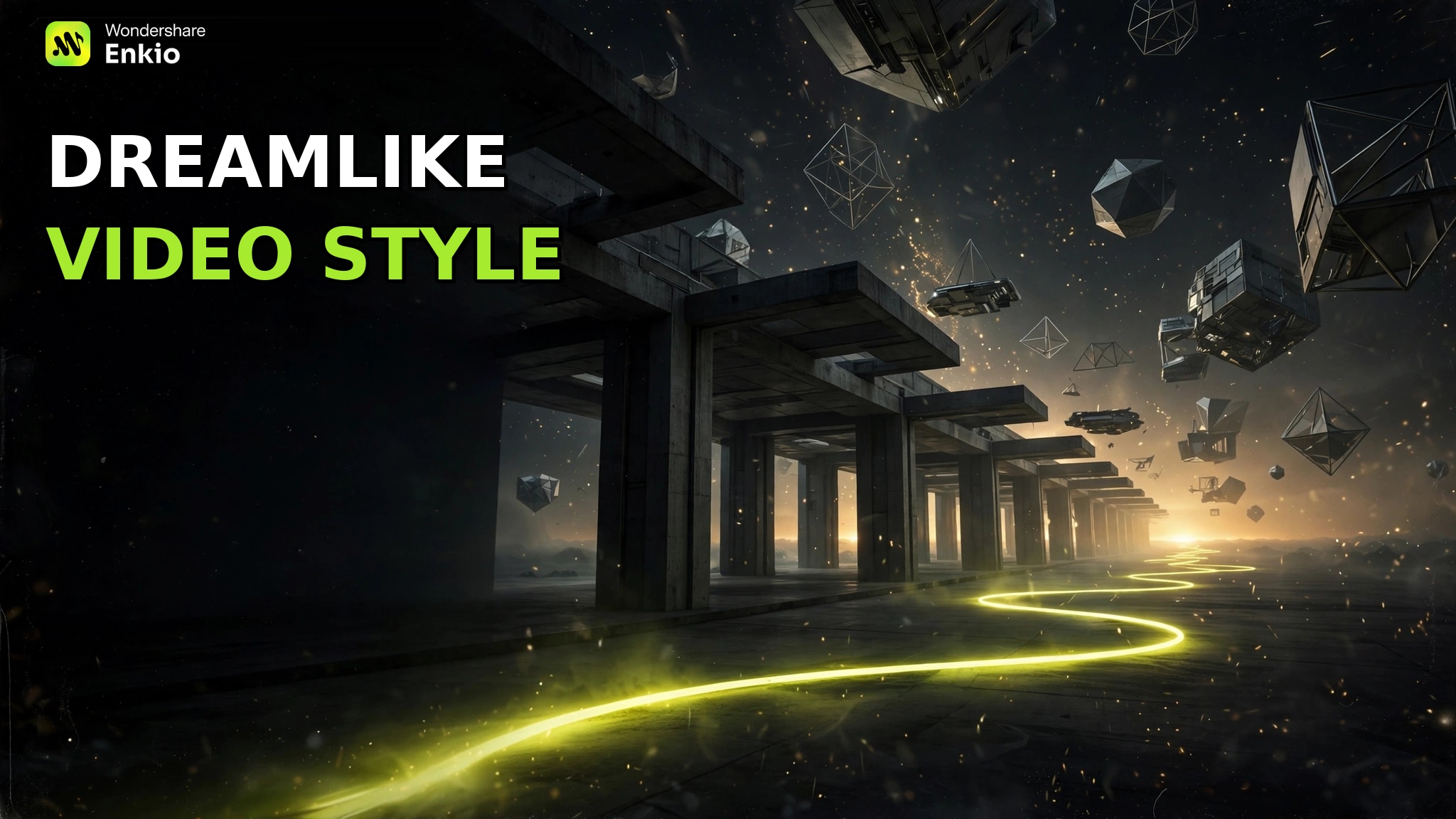
Dream Relic is built by expanding a recognizable dreamlike universe into original music and a visual album. It works because its sound and images share one emotional language. For creators who want to recreate a Dream Relic-inspired video style, Enkio is our recommended route: define original visual rules, bring in or create a song, and carry both into an MV.
Recreate a dreamlike music-video language with original assets.
Use Enkio to create music or bring a finished track, then guide the MV with your own reference image and visual rules.
We reviewed Suno's June 30, 2026 interview, Dream Relic's public music pages, and the official YouTube artist channel as checked on November 16, 2026. The workflow is a creator strategy, not permission to reproduce another artist's images, lyrics, characters, logos, or exact shots.
Is Dream Relic an AI Artist?
Dream Relic is better described as a human-led, AI-assisted artist project than as an autonomous AI performer. Vaughn supplies the lyrics, visual direction, selection, sequencing, and emotional judgment; generative tools help execute the music and imagery.
In Suno's 2026 interview, Vaughn described Dream Relic as a feeling rather than a place. Vintage grain, star particles, retro-futurism, dark fantasy, and liminal spaces make separate images and songs feel related.
The music also has a human starting point. Vaughn said he had played instruments, kept personal lyrics in his Notes app, and knew the intended feeling before he could produce finished tracks.
Recently, in additon to research on Dream Relic style, we also reviewed Best AI Baby Dance Video Generators and Best AI Gospel Music Generators.
How Dream Relic Built a Visual Identity Before Making Music
Dream Relic established a visual identity first, then used music to deepen it. Vaughn told Suno that he began making AI visuals about two years before the June 2026 interview, giving the project time to develop recognizable textures before its first full-length music release.
That order matters. Dream Relic repeats a small set of emotional signals—distant light, aged texture, cosmic scale, dreamlike architecture, and memory—until they become identity. We found that more reusable than any single image.
Write a short visual bible before generating: define a palette, texture, camera behavior, recurring symbol, character boundary, and intended feeling. If the song is developed in Suno, How to Use Suno AI Music Generator provides the mechanics; the bible keeps the result attached to an original identity.
The Viral Post That Turned Dream Relic Into a Music Project
The turning point was audience demand for the song, not a planned announcement. In the 2026 Suno interview, Vaughn recalled posting a late-night video with one of his generated tracks and receiving hundreds of comments asking for the song name and where they could hear it.
The response changed music from background into something viewers wanted independently. Vaughn said it differed from earlier producer-made tracks because the audience asked specifically for the audio.
Track comments that reveal intent: requests for a title, full version, lyrics, release date, or streaming link. Those signals are stronger than a generic compliment. If the requested sound is not yet a finished release, an AI Music Generator can turn original lyrics and direction into vocal or instrumental options. Selection and platform disclosure remain the creator's responsibility.
From Individual Tracks to the Enter the Dream Visual Album
Dream Relic expanded the idea from individual posts into a catalog where songs and videos reinforce one another. In the June 2026 interview, Vaughn identified Enter the Dream as the project's first full-length album and said a complete visual album would accompany it on YouTube.
The official YouTube artist channel shows that expansion publicly. On November 16, 2026, it displayed about 8,860 subscribers and 71 videos. Its music-video shelf showed roughly 820,000 views for “Time is a Limited Allowance,” about 220,000 for “The Names the Stars Forget,” and more than 100,000 each for several other tracks. These are snapshots, not evidence of repeatable reach.
The strategy is catalog building. One song can support a main video, visualizer, vertical excerpts, cover art, and compilations when each asset has a purpose. The Suno MCP Music Video workflow illustrates the finished-song-to-MV handoff.
What Creators Can Reuse Without Copying Dream Relic
Borrow Dream Relic's system of coherence, not its finished identity. Identify why the work feels unified, then choose different symbols, characters, environments, colors, and narrative details.
The following framework turns the observed case into a reusable implementation. We compare visual continuity, music handoff, revision control, publishable formats, and originality checks. The Music Video MCP Server article adds a technical version of the finished-song-to-video handoff.
| Decision | Dream Relic lesson | Workflow implementation | Verify before publishing |
|---|---|---|---|
| Emotional anchor | Sound and image aim at the same unnamed feeling | Put mood, story, style, and camera direction into one optional creative prompt | The video and song imply the same emotion |
| Original visual rules | Recurring grain, particles, scale, and atmosphere create recognition | Upload an original reference image and keep a short visual bible beside the project | No copied frames, characters, logos, or artist assets |
| Music starting point | Personal lyrics and visual ideas existed before the finished tracks | Generate music from an original description or lyrics, or bring in a finished song | You have permission to use every input |
| Song-to-video handoff | Songs continue into music videos and a visual album | Use the song, reference image, mode, aspect ratio, and optional prompt in the MV workflow | The selected format matches the destination |
| Revision boundary | Human taste decides what belongs in the world | Review the character views, blueprint, timecode, visual materials, and individual shots | Remove outputs that break the visual rules |
How to Recreate a Dream Relic-Inspired Video Style With Enkio
Enkio is our recommended way to recreate a Dream Relic-inspired video style when the goal is an original dreamlike audiovisual world rather than a literal copy. It can create music or accept an existing track, then use an original reference image and visual direction to carry that song into an MV. It can also recognize a Suno audio URL; this handoff does not imply a partnership, shared account, shared credits, or licensing relationship.
Use the AI Music Video Generator when the song and reference are ready. The workflow supports Solo, Two-Person, and Ultra modes; five aspect ratios; 720p and 1080p output; an optional prompt; character confirmation; and individual shot changes. Results vary, credits depend on the plan, and output stops at 1080p. See our Enkio Review for the broader assessment. For commercial usage terms, see Enkio's Terms of Use.
Our 10-point workflow-fit rubric weights visual continuity at 35%, source flexibility at 25%, creative control at 20%, and export fit at 20%. We score the documented workflow 8.7/10—not as a promise of stylistic fidelity—because it connects music creation or import, reference-led generation, and shot review while retaining a 1080p ceiling and metered credits.
Our verdict
Recommended for recreating a Dream Relic-inspired video language with original assets.
The platform connects original music or a recognized Suno audio URL to a reference-led MV workflow. Outputs still require review for style consistency, current exports are documented at up to 1080p, and credit needs vary by plan.
Pros
- Create music or import a track
- Reference-led MV workflow
- Shot-level review and changes
Turn your original track and visual rules into a dreamlike AI music video.
Create Your MV-
Choose your own palette, texture, camera behavior, recurring symbol, environment, and emotional sentence. Use broad traits such as dreamlike, retro-futuristic, vintage grain, luminous particles, and liminal architecture without copying a Dream Relic frame.
Done whenYou can describe what stays consistent without naming a finished Dream Relic work as the target.
-
Generate an original song from your own description or lyrics, upload a song you may use, or provide a Suno audio URL that the platform can recognize for the MV handoff.
Done whenThe final audio is selected and you have permission to use it.
-
Create or upload a character and environment that belong to your own visual world. Avoid copied faces, logos, characters, cover art, and stills.
Done whenThe reference is original, readable, and consistent with the visual bible.
-
Choose the appropriate performer mode, resolution, and aspect ratio. Add a concise optional prompt covering mood, story, movement, texture, lighting, and camera behavior.
Done whenThe creative direction connects the song to the reference image.
-
Check the character views, blueprint, timecode, visual materials, and each shot. Revise isolated segments that drift from the chosen world instead of accepting every generated scene.
Done whenThe saved video feels coherent without duplicating Dream Relic's protected creative assets.
Frequently asked questions
Is Dream Relic an AI artist?
Dream Relic is a human-led, AI-assisted artist project created by Broc Vaughn. Vaughn writes lyrics, defines the emotional and visual direction, selects outputs, and sequences the finished work while using generative tools in the production process.
Who is Broc Vaughn?
Broc Vaughn is the visual creator behind Dream Relic. In Suno's June 2026 interview, he described building the project first as a surreal visual world and later expanding it into music and a full visual album.
What genre is Dream Relic?
Dream Relic moves through electronic, dream-pop, and atmospheric dance territory, but its identity is more consistent at the level of mood: distant vocals, nostalgia, dreamlike imagery, vintage texture, and cinematic scale.
Does Dream Relic use Suno?
Yes. Vaughn told Suno that he used its Create feature with personal lyrics and iterative direction, and that songs made through the platform became part of the Dream Relic project. That does not mean the project lacks human authorship or creative judgment.
Can Enkio recreate a Dream Relic-inspired video style from a Suno song?
Yes. The platform can recognize a Suno audio URL and use the song in a reference-led MV workflow. Treat Dream Relic as a source of broad visual principles—dreamlike space, aged texture, luminous particles, and cinematic scale—then supply your own imagery, symbols, characters, and shot direction. The goal is a Dream Relic-inspired language, not an exact imitation.
Conclusion
Dream Relic shows that AI-assisted music becomes more memorable when it enters a world that already has recognizable emotional rules. The transferable sequence is clear: define an original visual language, make the song serve that language, watch for genuine audience demand, and expand the strongest connection into a catalog of related visual releases.
If you already have the lyrics, song, or Suno audio URL, we recommend Enkio as the practical route for recreating a Dream Relic-inspired video language in one guided project. Recreate its discipline—coherent mood, recurring texture, deliberate camera behavior, and shot review—not the artist's finished work.
Build your own Dream Relic-inspired audiovisual world.
Create music or bring a finished track and original reference image into Enkio, then guide the mood, texture, movement, and shot review yourself.