



Lyria attracts attention for realistic vocals and polished audio, but “Lyria” does not describe one identical user experience. We reviewed three Reddit threads covering Google Flow Music, Google Vids, and Lyria 3 Pro. The repeated positive signal was vocal and mix quality. The repeated caution was control: posters described bugs, moderation friction, crowded backing, export constraints, and less convincing niche styles.
Plan what happens after the song is generated.
Enkio handles the separate step of turning finished audio and reference images into a guided music video workflow.
Introduction to Lyria Reviews
Lyria is Google's music-generation family, and current discussions use several labels: Lyria 3, Lyria 3 Pro, and Lyria 3.5. The user-facing surface matters as much as the version name. A feature inside Google Vids can have different export behavior from Flow Music, even when both rely on a Lyria model.
This review therefore does not merge every claim into one product profile. It treats Google Flow Music, Google Vids, and Lyria 3 Pro as distinct reported contexts. A comment about an MP4 export in Vids does not automatically prove that Flow Music lacks audio downloads. A short built-in generation does not define the length of another interface.
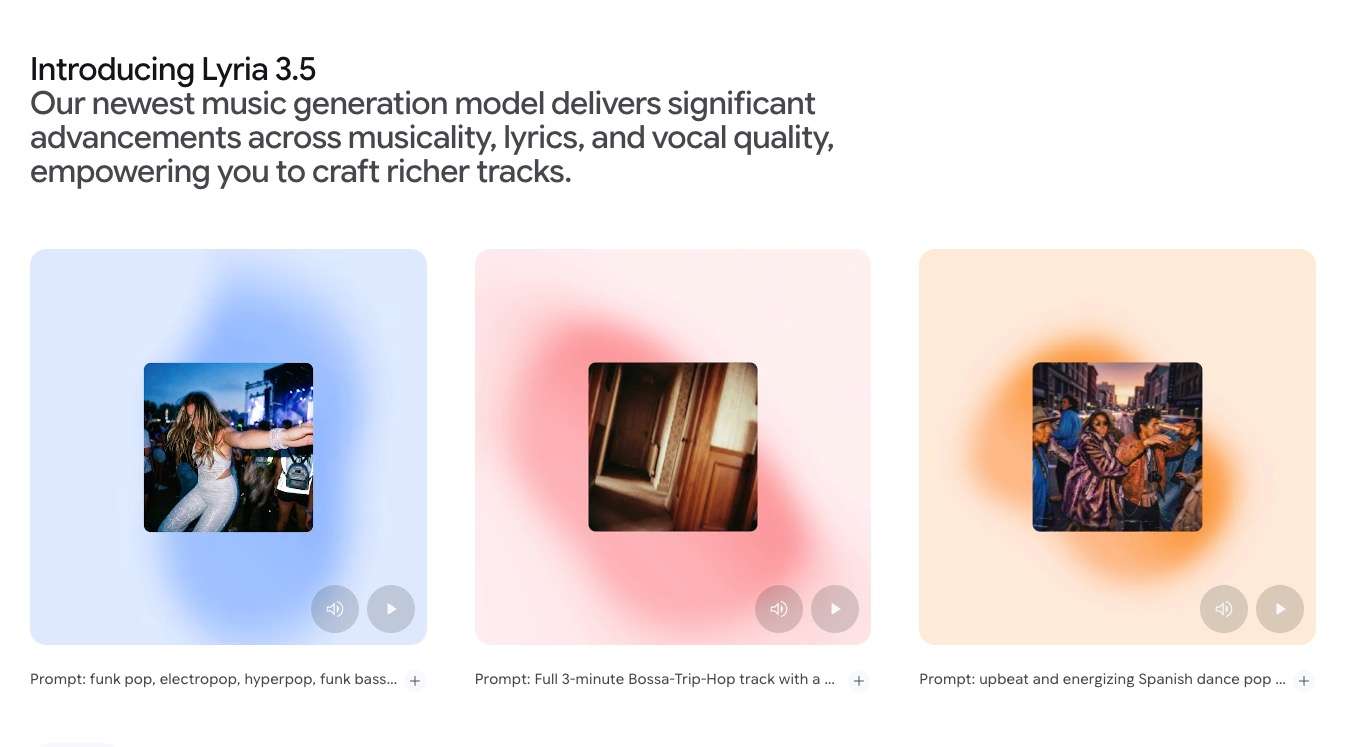
That distinction is useful across the Best AI Music Generators category. A model name describes the underlying generation family; the application controls prompts, limits, moderation, storage, and downloads.
How We Analyzed Reddit User Reports
What Users Praised Most
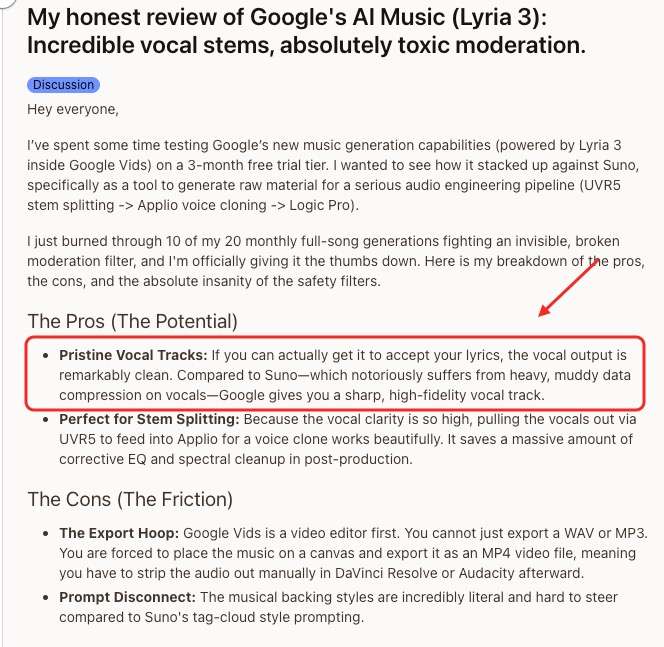
Vocals are the strongest repeated positive signal. The Flow Music poster described Lyria 3.5 vocals as unusually realistic. The Google Vids poster emphasized clean vocal stems. The Lyria 3 Pro report also singled out vocal realism alongside fidelity and mixing.
Three reports do not prove that every genre, language, or voice behaves alike. They do make vocals the first controlled test: include exposed syllables, sustained notes, consonant-heavy lyrics, and a quiet section where artifacts cannot hide.
Mix quality also recurred as a strength. The Pro report described solid balance and fidelity, while the Flow Music post praised overall sound. Yet one poster found some backing loud or crowded, showing how prompt-specific those judgments remain.
Prompt following received positive comments for mainstream material. Verify that with measurable instructions: tempo range, vocal state, section order, instrument exclusions, and one lyric phrase that must remain unchanged.
Our Suno v6 Review provides a current comparison point for readers evaluating how another leading song workflow balances composition, control, and output.
Where the Experience Reports Diverge
The biggest disagreement is not whether the audio can sound good. It is what the surrounding application allows the user to do with it.
The Google Vids report described an MP4-only export, which is awkward for someone who wants an audio master or stems. That observation belongs to the Vids surface. Commenters argued that Flow Music should be evaluated separately. Repeating “Lyria only exports MP4” without that context would turn one interface experience into a false model-wide fact.
Duration creates the same risk. A short generation inside a general assistant or video application should not be used to define a music-first tool's full-song capability. Before comparing Lyria with another generator, record the exact page, version label, duration control, and downloaded format.
The threads also differ in emphasis. The Lyria 3 Pro poster focused on fidelity and genre fit. The Flow Music poster focused on app behavior and control. The Google Vids poster focused on stems, export, and moderation. Those differences are useful because buyers experience the application, not a model benchmark in isolation.
Control, Moderation, and Workflow Friction
Limited control appears in more than one form. The Flow Music report said there was not much steering and described occasional rhythmic stumbles. The Lyria 3 Pro post was more positive about prompt adherence but still found some genres safer and less authentic than requested. These are compatible observations: a model can follow broad prompts while resisting a very specific performance style.
Moderation was the sharpest friction in the Google Vids thread. The poster described rejections or substitutions that felt opaque. Community reports can reveal that frustration, but they cannot establish the exact policy, error rate, or reason. A controlled review should save the rejected prompt, displayed message, account context, and whether credits were consumed.
Application bugs were mentioned in the Flow Music discussion. One user's session does not prove chronic instability. It does tell a deadline-sensitive creator to test saving, retry behavior, project history, and export before committing a release to the platform.
Daily generation limits were mentioned in the Lyria 3 Pro report. Until a current primary account or official page confirms the number and refresh rule, the safe conclusion is that usage may be capped. The exact allowance should not be copied from a Reddit post into a buying calculation.
Genre Fit and Arrangement Tradeoffs
The community reports suggest that Lyria's strongest demonstrations may come from mainstream styles. The Lyria 3 Pro poster praised overall fidelity and prompt following but described aggressive rock as comparatively safe and niche or retro styles as less authentic. The Flow Music thread also raised weaker niche-style performance.
This is a test-design lesson rather than a universal ranking. A pop prompt can hide whether the model understands a specific regional rhythm, production era, guitar articulation, or recording texture. Buyers working outside mainstream pop and electronic styles should evaluate their actual genre rather than extrapolating from vocal demos.
The Suno Music Generator Review is useful when composition and arrangement are the decision focus. The Udio AI Music Generator Review provides another reference for generation and iteration. Neither article turns a different prompt set into a controlled winner against Lyria.
A fair three-tool test would use the same original lyric, section order, tempo range, instrument list, forbidden elements, and target duration. It would then score lyric preservation, structure, genre authenticity, mix balance, artifacts, and ease of revision. The Reddit threads do not supply that shared test, so this article stops short of a winner.
Real Limitations of the Available Evidence
The strongest limitation in this review is the evidence design. Community posts are valuable precisely because they surface problems that product pages omit, but they cannot replace a controlled test.
The sample is small and self-selected
People with unusually good or frustrating results are more likely to post. Three threads can identify questions worth testing; they cannot estimate how often each outcome occurs.
Interfaces and versions are mixed
Flow Music, Google Vids, and Lyria 3 Pro have different surrounding workflows. Export and control claims must remain attached to the surface that produced them.
Inputs and plans were not standardized
The posters did not use one shared prompt, account tier, language, or target genre. Differences may come from the brief, interface, version, or generation variance.
The reports stop at audio or app workflow
They do not evaluate a consistent path from the finished track into a visual release. If that separate deliverable is the buyer's next requirement, an AI Music Video Generator can start from exported audio and reference images. The recommended workflow covers that downstream stage, not the unanswered question of which model makes the better song. Its credits, plan conditions, and 1080p output ceiling remain part of the choice.
Our downstream rubric weights workflow fit 35%, control 25%, output usefulness 20%, and pricing/transparency 20%. Verified product facts yield an 8.1/10 fit score for turning completed audio into an MV; the score is independent of Lyria's community-reported audio quality.
Our verdict
A downstream option when the generated track is finished and the video is not.
Enkio takes audio and reference images into a guided MV workflow while retaining metered credits, plan conditions, and a 1080p ceiling.
Pros
- Song-to-MV workflow
- Five aspect ratios
- Segment review
Turn a finished AI song and images into a music video.
Create an AI MVHow Reported Lyria Experiences Compare With Suno and Enkio
This table separates evidence types. Lyria cells summarize community reports, Suno points to a tested review, and the publisher's column uses verified product records with its limitations stated alongside its workflow.
| Decision point | Lyria reports | Suno | Enkio |
|---|---|---|---|
| Primary task | AI song generation across several interfaces | Prompt-led song generation | AI music plus guided music-video workflow |
| Strongest evidence | Reported vocals, fidelity, and mixing | Dedicated published testing | Verified product workflow and specifications |
| Control signal | Mixed: good broad adherence, limited fine steering | Generation and revision controls covered separately | Music settings plus MV blueprint and segments |
| Export signal | Interface-specific; Vids poster reported MP4-only | See dedicated review | Audio download or 720p/1080p MV depending on workflow |
| Genre signal | Mainstream strength; niche/rock concerns reported | Evaluate with the same genre brief | Not scored here as an audio-quality comparison |
| Main caveat | Mixed versions, small community sample | Features and plans change | Metered credits and 1080p video ceiling |
The MusicGPT AI Music Generator Review adds a modular audio-platform comparison. The broader release workflow does not make its product the audio winner; it solves a different production gap and still depends on current plan terms.
Who Should Pay Attention to Lyria
Lyria deserves a controlled test from creators who prioritize vocal realism, clean stems, and polished mainstream production. Those are the most consistent positive signals across the three discussions.
It deserves more cautious testing from aggressive rock, niche, retro, or rhythm-specific creators. The reports suggest those briefs can sound safe, crowded, or less authentic. Users who need granular revisions should also inspect the exact controls in their intended interface rather than the model name alone.
Someone choosing an AI Music Generator should write the evaluation brief before opening any tool. That prevents an impressive demo from changing the criteria after the fact.
From a Generated Track to a Visual Release
Audio quality is only one release decision. A finished track still needs cover imagery, social clips, or a full MV, plus the correct aspect ratio for each channel. The tool that makes the song does not have to be the tool that makes every visual.
Save the audio master, lyric sheet, prompt, version label, and usage terms before moving downstream. Use only images and music you own or have permission to upload. Platform policies on AI-generated content differ, so check the destination's current guidelines.
Frequently asked questions
What would make a fair controlled Lyria test?
Use an original lyric, fixed section order, target duration, tempo range, required instruments, forbidden elements, and one named genre. Save every prompt, result, interface label, elapsed time, and download format, then run the same brief in comparison tools.
Can realistic vocals prove that the lyrics are accurate?
No. Vocal timbre and lyric preservation are separate criteria. A voice can sound convincing while changing, skipping, or mispronouncing words. Compare the rendered vocal with the original lyric line by line.
Why should MP4 and audio exports be evaluated separately?
An MP4 may be convenient inside a video application but awkward for mastering, stems, or another editor. Record whether the intended interface exports audio, video, stems, or a project file instead of assuming every Lyria surface behaves alike.
How should a niche genre be tested?
Use genre-specific rhythm, instrumentation, performance, and production instructions that a generic pop result cannot satisfy accidentally. Compare authenticity and arrangement, not only overall fidelity.
What evidence should a buyer save before subscribing?
Save the current plan page, generation allowance, refresh rule, export options, moderation message, project-retention policy, and applicable usage terms. Community reports should guide these checks, not replace them.
Conclusion
This Lyria AI music generator review finds strong community signals around vocals, fidelity, and mixing, with uncertainty about control, moderation, genre authenticity, bugs, and interface-specific exports. The threads support a better test, not a universal verdict.
Treat the application surface as part of the product. Verify Flow Music, Google Vids, or Lyria 3 Pro on its own terms, with the genre and export path you actually need. If the resulting track is complete and the unresolved task is a visual release, Enkio can take over at that downstream stage without turning Reddit reports into claims of an audio-quality win.