



Suno v6 landed on September 9, 2026 as the company's biggest reset yet: three model tiers, plain-language song editing, and a training set rebuilt on licensed music from Warner Music Group, BMG, and Believe. Three weeks later, the reception is the roughest of any Suno launch — the most upvoted post on r/SunoAI is a cancellation notice, and Universal Music Group and Sony Music have filed a second lawsuit calling v6 "the fruit of the same poisoned tree."
This Suno v6 review covers what the three models actually do, where the backlash comes from, where the lawsuits stand, and the step Suno still leaves out: turning a finished track into a music video, which is where Enkio enters the picture. The bottom line: v6 is Suno's most ambitious model and its most disputed launch.
What Suno v6 Is
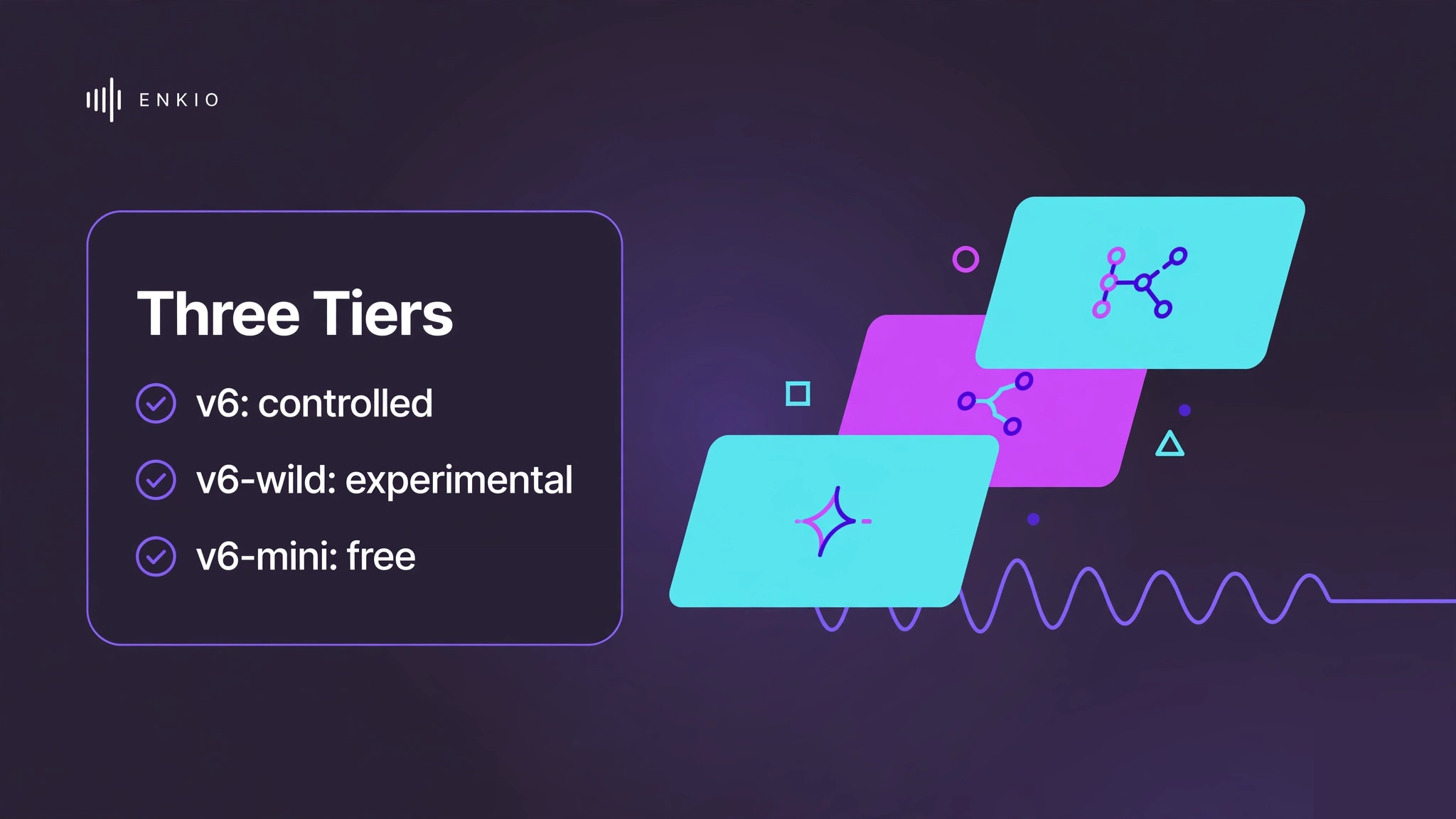
Suno v6 is the sixth-generation model family behind the AI music generator at suno.com, replacing the v4.5/v5.x line for new generations. It ships in three tiers. The base v6 model, for paying users, is positioned as the reliable, steerable default for controlled outputs. Suno v6-wild, also for paying users, is the experimental tier built for ideation and unexpected results. Suno v6-mini is the fast, lightweight tier available to everyone, including free users. Suno says it plans to retire the older models from generation entirely; existing user libraries stay untouched.
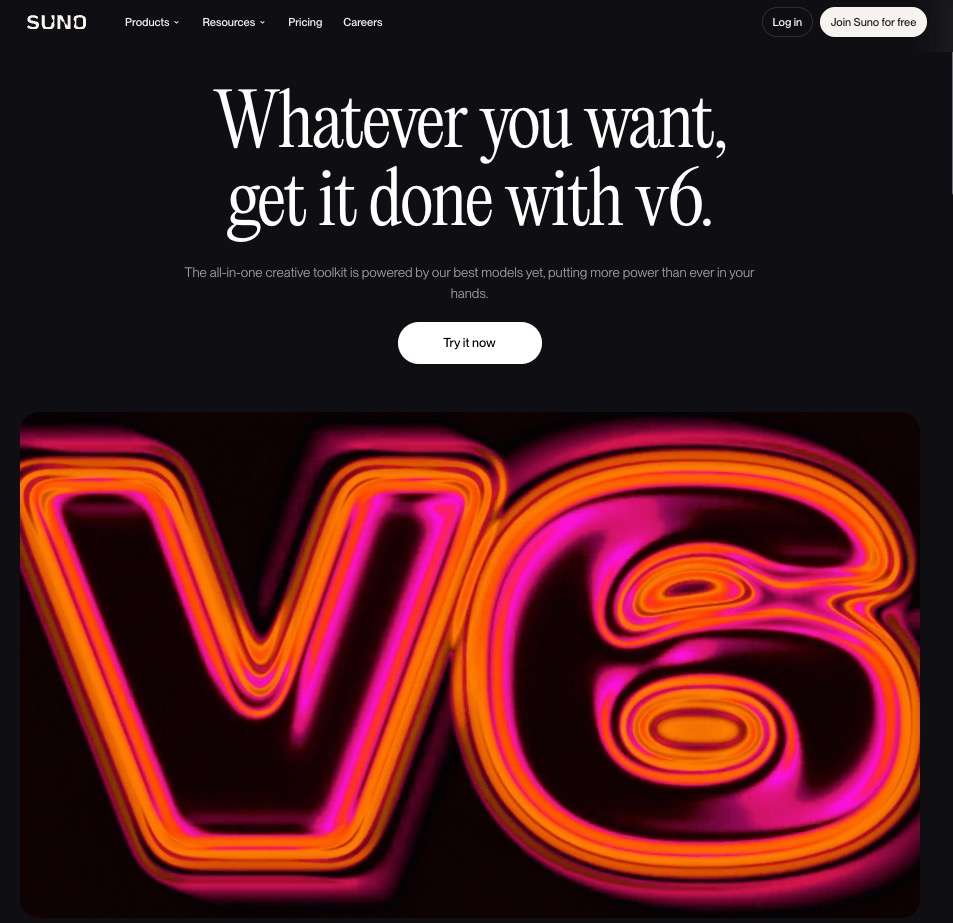
The headline change is the training data. Suno says v6 was trained from the ground up on licensed music, and chief product officer Jack Brody told TechCrunch the new model "does not include the same data" as its predecessors. The licenses come from Warner Music Group — with whom Suno settled its earlier dispute in 2025 — plus BMG, under a deal struck in August 2026, and Believe, which joined in early September. That licensing pivot is the company's answer to the copyright lawsuits that have followed it since 2024, and it is also the thing the new lawsuits now attack directly.
What has not changed is the core loop: describe a song in plain language, get back a complete track with vocals, lyrics, and arrangement. For context on where v6 came from, our Suno Music Generator Review covers the previous generation in detail; this article is about v6 only.
How It Works in Practice
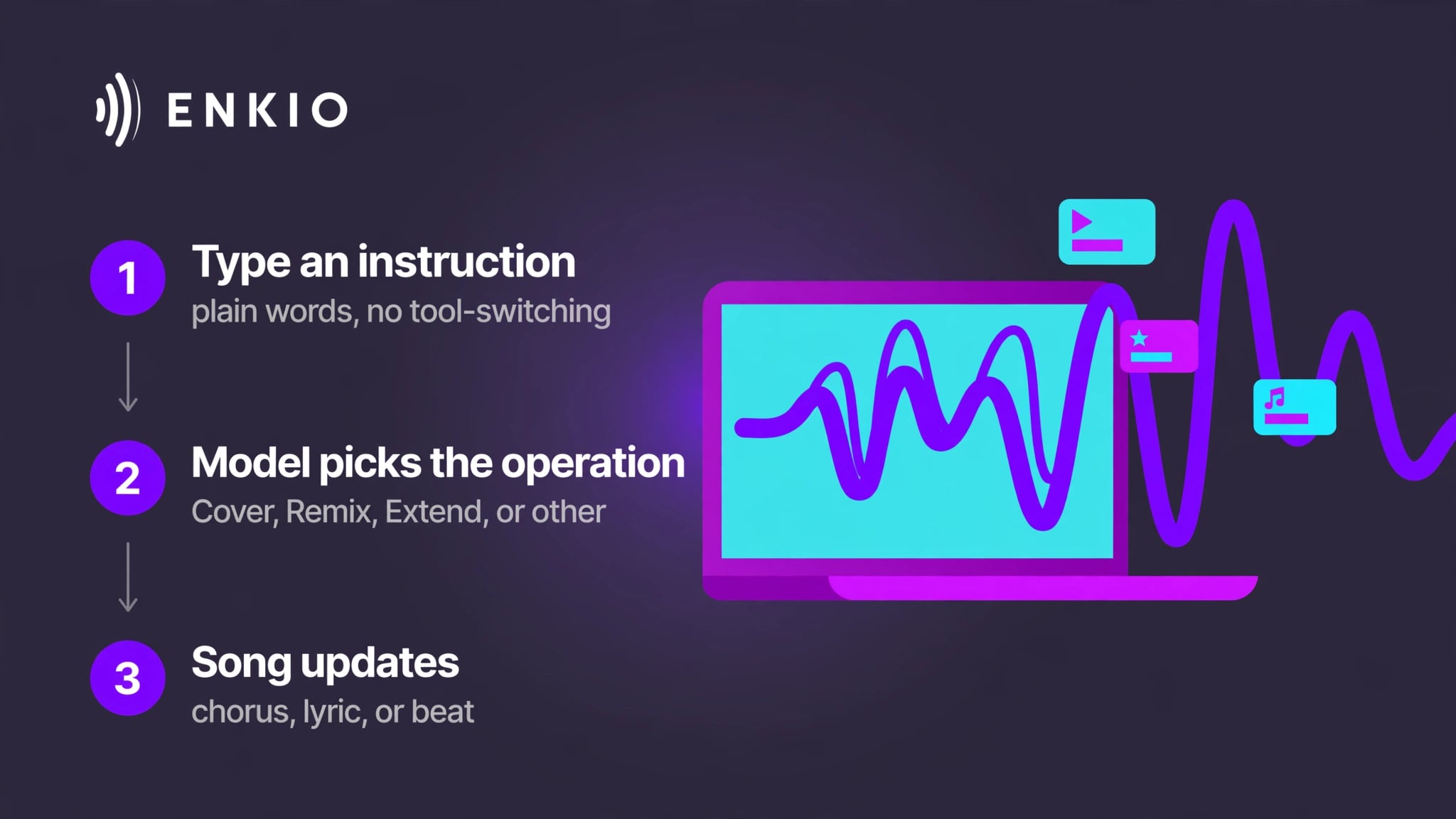
The most visible new capability is plain-language editing in Simple Mode. Instead of picking separately between tools like Cover, Remix, and Extend, you type an instruction and the model works out which operation the request calls for. Suno's own examples: "Change the chorus so it's sung by a gospel choir" and "Change the lyric from 'love' to 'light.'" You can also build mashups that combine the vocals from one song with the drums of another plus new lyrics, separate a track's instruments to rebuild its beat, and feed text, images, or video in as creative references.
Two caveats matter before you plan a workflow around this. First, the instruction box is a Simple Mode feature — the Advanced and Custom views, including the Replace Section editor, have no plain-language input, so precise surgical edits still go through the older manual controls. Second, launch-week reports from the community describe section edits as uneven: the model sometimes rewrites more of the song than the instruction asked for. Treat the first edit as a draft, not a final.
If you want the fundamentals first, How to Use Suno AI Music Generator walks through the core generation workflow step by step; the v6 editing layer sits on top of that same loop.
What It Gets Right
Strip away the noise and v6 gets four things right. The licensed-data reset is a genuine strategic move: whatever the courts decide about the old models, training the flagship on Warner, BMG, and Believe catalogs gives Suno a cleaner story to tell labels, distributors, and risk-averse commercial users. The three-tier split maps to real use cases instead of marketing labels — controlled generation, wild ideation, and fast free drafts are three different jobs, and pricing them separately is honest product design.
The free tier is the third win. Putting v6-mini in front of every user, including non-paying ones, means the curious can judge the new sound without spending anything. And plain-language editing, uneven as it is at launch, points in the right direction: the users who struggled most with the old tool-switching workflow were beginners, and Simple Mode is built for exactly them.
Pricing and Credits
As of September 2026, Suno's own pricing page lists three tiers. Free costs $0 with 50 credits per day on v6-mini — no monthly song downloads and no commercial rights. Pro is $10 per month ($8 per month billed annually): 2,500 credits per month, 20 song downloads per month, commercial use rights. Premier is $30 per month ($24 per month billed annually): 10,000 credits per month, 60 downloads per month, commercial use rights. Credits included in subscriptions do not carry over from month to month. Plan names, credit amounts, and prices have moved before, so check Suno's pricing page for the current figures before you pay.
Two cost details deserve attention. The per-tier download limits are now explicit on the official page — 20 songs per month on Pro, 60 on Premier — and r/SunoAI threads complain about extra download fees on top of the subscription, with one widely shared post citing a $2.99 charge for additional downloads. The other recurring complaint is structural: unused credits do not roll over between billing cycles, so a light month still costs the full subscription. Neither is unusual for credit-metered AI tools, but both change the effective price per finished song, which is the number that actually matters.
Real Limitations
The backlash is the story, so here it is in the users' own documented words. Within twelve hours of launch, the most upvoted post on r/SunoAI was a cancellation notice titled "Bye bye Suno, I'm cancelling my subscription," with 351 points and nearly 500 comments.
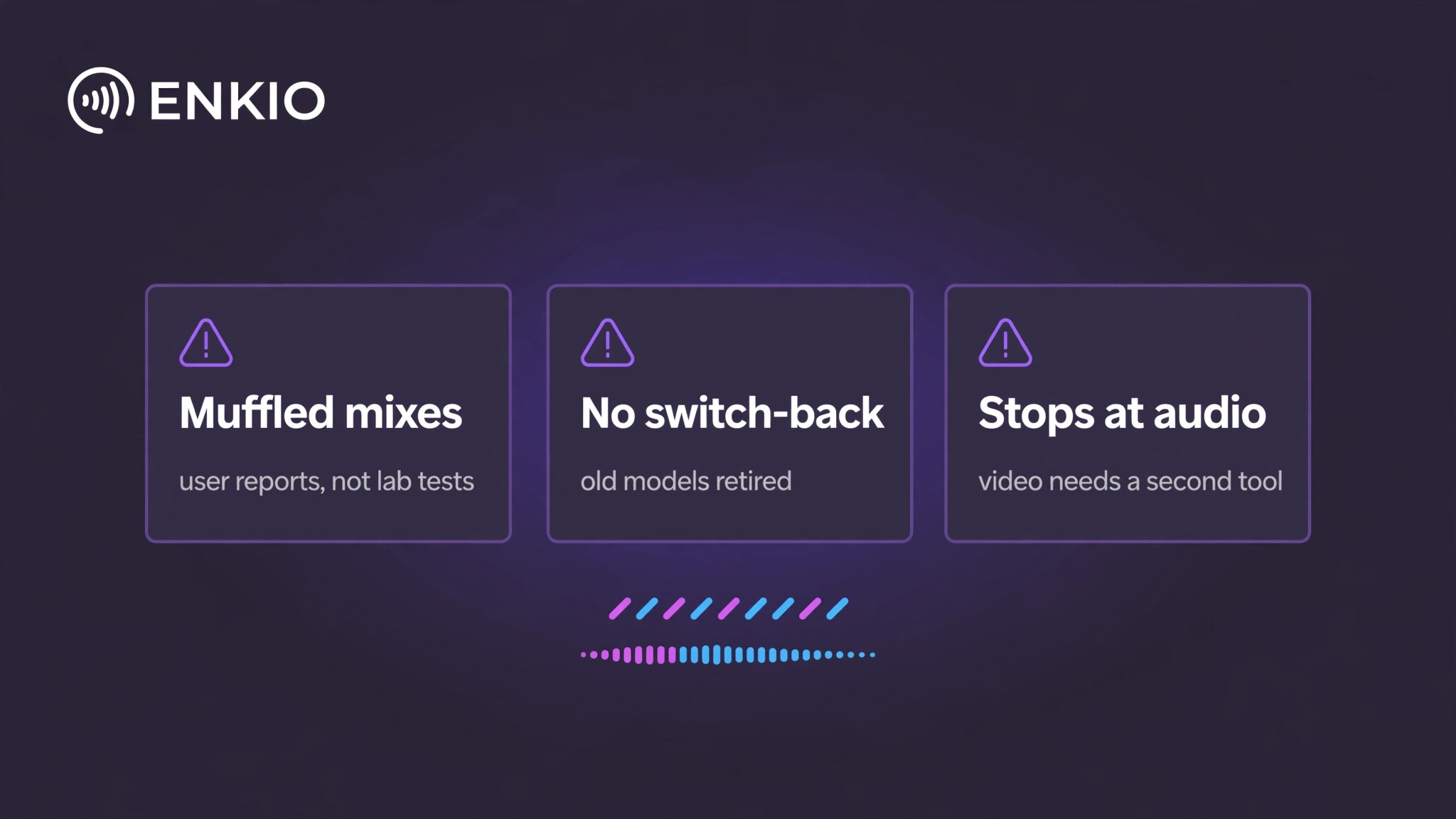
The recurring sonic complaints, gathered across Reddit threads and music press coverage, are "muffled" and "muffled mixes," "dull, generic and heavily compressed," "buried vocals," a "lack of high-end clarity," and "generic songwriting" with "less convincing melodies and instrumentation." Threads titled "v6 is garbage and a joke" and "They actually made a perfect slop machine" capture the temperature, if not the nuance. These are user reports, not lab measurements — but when the complaint is this consistent this fast, it is data about the product's reception as of September 2026.
1. The structural limitation is the retirement of the old models.
Suno plans to end generation on every pre-v6 model, which means users who preferred v5.5's sound have no switch-back — the "just let me keep the old version" option that softened past model transitions is not on the table this time. Combined with the per-tier download limits, long-time subscribers read the launch less as an upgrade than as a forced migration.
2. Another limitation is the one that decides your toolchain
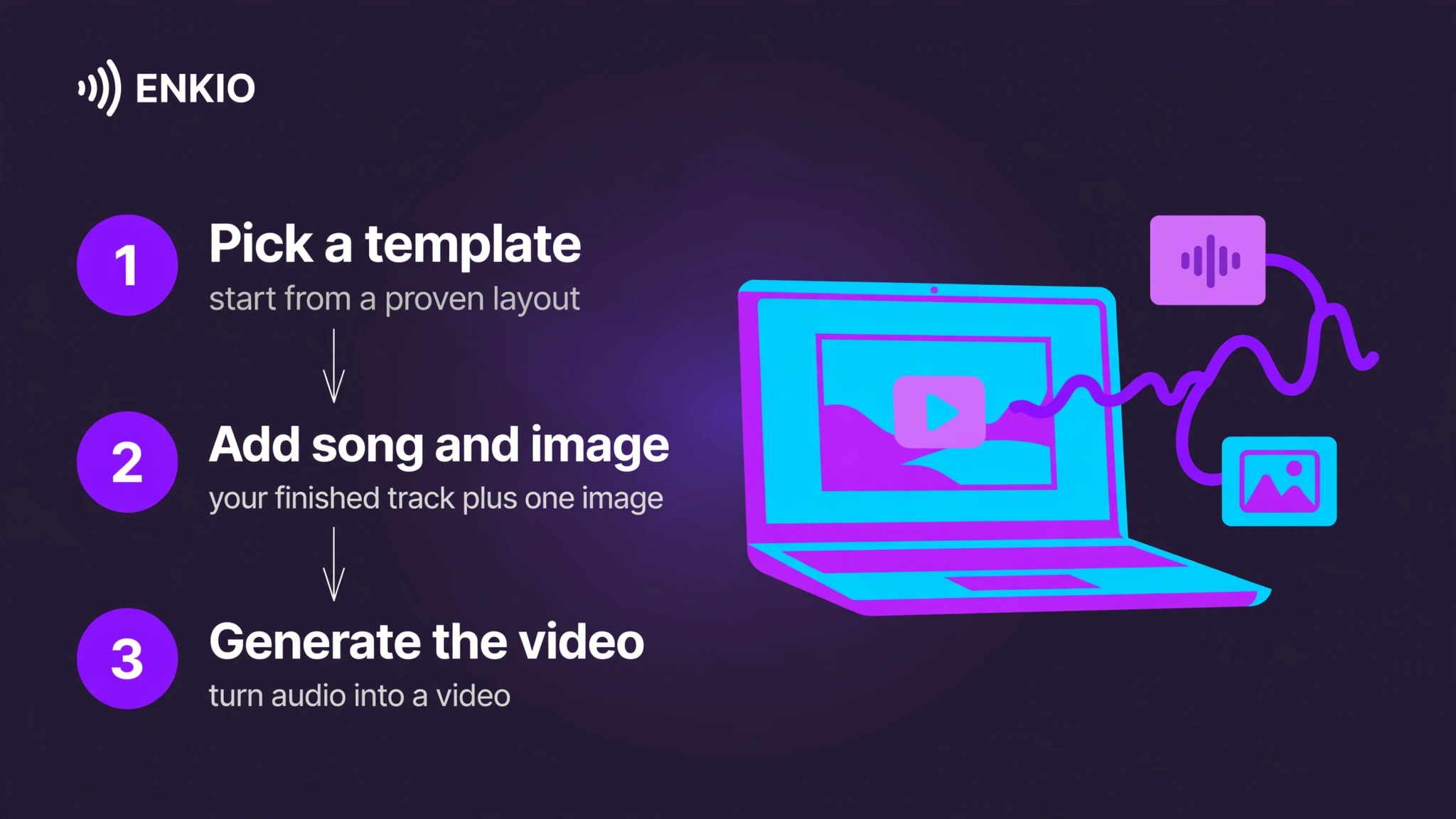
Suno stops at the audio file. A finished track is not a publishable video, and every path from one to the other — editing software, a separate video generator, a template app — is another app to learn, another render queue to manage. That is the gap Enkio's AI Music Video Generator is built to close: pick a template, add the finished song and an image, and generate the music video from the track itself — templates and asset limits depend on your plan. You still supply the music and the visuals; the template only removes the prompt-writing and editing steps in between.
Finally, the legal overhang is a practical limitation, not just a headline. With the GEMA ruling in Germany, a second UMG/Sony suit in Massachusetts, and a class action surviving dismissal, anyone planning commercial releases on v6 output should read the timeline below and Suno's own terms before committing a catalog to the platform. This is not legal advice — it is project hygiene.
How It Compares With Suno v6 and Enkio
The honest comparison is not "which is the better song generator" — it is "which tool finishes your release." Suno v6 generates the song; Enkio generates music too, through its AI Music Generator, and then continues into the music video, which is the step Suno does not take.
The other best-known lyrics-to-song tool, covered in our Udio AI Music Generator Review, plays the same song-only role as Suno, so the table below keeps the comparison to the two tools that represent the two ends of the workflow.
| Suno v6 | Enkio | |
|---|---|---|
| What it generates | AI song as an audio file, with vocals and lyrics | AI-generated music plus AI-generated music videos |
| Editing model | Plain-language instructions in Simple Mode; manual section tools in Advanced | Template-first video workflow (Solo, Two-Person, and Ultra MV modes); custom lyrics for songs |
| Output specs | Audio track; per-tier download limits apply | Music video in 720p and 1080p |
| Entry price (as of September 2026) | Free tier via v6-mini ($0, no downloads); paid tiers from $10/month | $19.99/month for 3,000 credits; yearly works out near $5/month — check the official pricing page |
| Commercial terms | Per Suno's plan terms | See Enkio's Terms of Use |
| Legal backdrop | GEMA ruling in Germany; UMG/Sony second suit pending; class action surviving dismissal (see timeline) | Publishes a copyright-claim channel; terms per plan |
The other column deserves the same plain treatment: video output tops out at 1080p, credit allowances, asset caps, and task retention all depend on your plan, and the commercial terms live in the Terms of Use rather than in this article. The table is a snapshot of September 2026 — both products move fast enough that the pricing rows will age first.
The Copyright Issues Timeline of Suno
The lawsuits are moving faster than the product reviews, so here is the sequence as reported — facts and filings only. This section reports court records and press coverage; it is not legal advice.
July 31, 2026
GEMA wins in Munich. The Munich Regional Court I ruled largely in favor of GEMA, the German collecting society, in case 42 O 763/25. The court held that storing protected songs inside the model infringes the reproduction right, and that making songs available through generated outputs infringes the public communication right — and that US-based training is still actionable in Germany. According to case reporting, Suno accepted that its dataset included the six works at issue — including "Forever Young" and "Big in Japan" (Alphaville), "Mambo No. 5" (Lou Bega), "Daddy Cool" and "Rasputin" (Boney M), and "Atemlos" (Kristina Bach) — extracted via stream-ripping from YouTube.
Suno was ordered to cease the infringement, disclose revenue, and pay damages in an amount still to be determined. The judgment is not final, and Suno is considering an appeal. GEMA CEO Tobias Holzmüller said AI providers "must pay for licenses rather than helping themselves to our members' works free of charge."
September 9, 2026
Suno v6 launches on licensed data. Suno's answer to the litigation: a model trained from the ground up on Warner, BMG, and Believe catalogs, which Brody says excludes the old training data.
September 18, 2026
UMG and Sony sue again. Universal Music Group and Sony Music filed a 45-page second complaint in the District of Massachusetts (case 1:26-cv-14275) targeting v6 itself and naming 60,202 recordings. The labels' theory, which they call "model laundering," is that v6 was trained via knowledge distillation on the outputs and preference signals of the earlier allegedly infringing models — including, per the complaint, user interactions and creations.
Their words, from the filing: "V6 is not a fresh start; it is the fruit of the same poisoned tree." And: "Training a 'new' model on the outputs of an infringing model does not eliminate the infringement; it launders it." These are allegations in a complaint, not findings of a court.
September 28, 2026
the class action survives dismissal. In Justice et al. v. Suno, Judge F. Dennis Saylor IV of the District of Massachusetts denied Suno's motion to dismiss the 17 U.S.C. §106(2) derivative-work claim brought by independent artists as a putative class action. The court held the plaintiffs need not identify specific infringing outputs at the pleading stage; the complaint's 100 examples of outputs closely imitating existing songs, allegedly built from songs downloaded from YouTube, support a plausible inference.
The DMCA §1201(a)(1) claim also survives; a Tennessee consumer-protection claim was dismissed. A denied motion to dismiss is not a verdict — it means the case goes forward.
Who Suno v6 Is For Right Now
Suno v6 still makes sense for three groups. Casual experimenters who live on the free tier get v6-mini at no cost and can judge the new sound themselves. Beginners who like conversational tools may genuinely prefer Simple Mode's plain-language editing to the old tool-switching workflow. And users who buy into the licensed-data direction — people who want their generator moving toward label deals rather than away from them — get the clearest version of that bet Suno has ever offered.
Everyone else should think twice. Paying subscribers attached to the v5.5 sound face a forced migration with no switch-back. Producers who need reliable section-level editing will find Simple Mode's uneven rewrites frustrating. And anyone whose release plan includes a video is buying half a workflow: the song comes out of Suno, but the visual half still needs a home. Readers weighing a move should also skim our Alternatives to Suno AI Music Generator roundup for the wider field before deciding.
From a Track to Something You Can Publish
Here is the practical gap v6 does not address: a song file is not content until it has visuals. TikTok, YouTube, and Instagram distribute video; Spotify canvases and release campaigns want motion. Suno's job ends at the audio render, so the "publish" step is always a second tool — unless the generator covers it.
Enkio covers it with a template-first workflow. Pick a template, add the finished song and an image, and generate the music video — Solo MV Mode for a single performer, Two-Person MV Mode for duets ("Two Characters. One MV."), arranged around group singing and shared frames. You still supply the music and the image assets yourself; the template removes the prompt-writing and the editing timeline in between. The music and the video sit in one workflow, so a finished track can become a matching video within the same working day.
One policy note before you publish anywhere: platform policies on AI-generated content differ — check the platform's current guidelines on labeling and disclosure for AI-generated audio and video.
Compare what a plan includes.
Enkio plans include AI music and music video generation, with credit costs listed on the pricing page.
Frequently asked questions
These are the questions we see most often about Suno v6.
What is Suno v6?
Suno v6 is the sixth-generation model family behind the AI music generator at suno.com, launched September 9, 2026. It comes in three tiers — v6 (controlled generation for paying users), v6-wild (experimental ideation for paying users), and v6-mini (fast, free for everyone) — and Suno says it was trained from the ground up on licensed music from Warner Music Group, BMG, and Believe.
What's the difference between v6, v6-wild, and v6-mini?
The base v6 is the reliable default for controlled, steerable outputs and is available to paying users. V6-wild is the experimental tier for ideation, also for paying users. V6-mini is the fast, lightweight tier open to all users including free accounts. Suno plans to retire all older models from generation. For how the wider field compares on price, vocals, and rights, our Best AI Music Generators roundup keeps a current comparison table.
Why are Suno users upset about v6?
The documented complaints cluster around sound quality — "muffled mixes," "dull, generic and heavily compressed" audio, "buried vocals," and a "lack of high-end clarity" — plus "generic songwriting" with less convincing melodies. Users are also angry that older models are being retired with no switch-back, and that per-tier download limits and extra download fees arrived with the launch. The most upvoted r/SunoAI post within twelve hours of launch was a cancellation notice.
Can I still use older Suno models like v5.5?
Not for new generations. Suno says it plans to retire the older models from generation entirely, keeping existing user libraries untouched. If you preferred the older sound, there is no official way to keep generating on it — which is the core of the forced-migration complaint.
Is music made with Suno v6 safe to use commercially?
No reviewer can answer that for you. The legal picture is genuinely unsettled: GEMA won a first-instance ruling in Munich (under appeal), UMG and Sony filed a second lawsuit in September 2026 alleging v6 is "the fruit of the same poisoned tree," and an independent-artist class action survived a motion to dismiss on September 28. Commercial use of any AI-generated music should be checked against the platform's current terms and, for real releases, a lawyer. This is not legal advice. For Enkio's own commercial terms, see its Terms of Use.
I have a finished Suno track — what's the simplest way to turn it into a video?
If the song is done and you want a video without learning editing software, Enkio's template workflow covers that step: pick a template, add the song and an image, and generate the music video, in Solo or Two-Person mode. You still supply the music and the visuals yourself.
Conclusion
Suno v6 is the company's most ambitious release and its most contested one. The technology is real — three sensibly split tiers, genuinely useful plain-language editing, and a licensed-data reset that few competitors have attempted at this scale. The reception is equally real: its own users call the mixes muffled, the old models are gone with no way back, and the courts will be deciding the training-data question for years. If you generate on the free tier or love conversational editing, v6 is worth your evening. If you pay for the old sound, or your release ends on a feed rather than in a file, look at the whole workflow before you renew.
If your release plan ends with a video on a feed, Enkio is built for that last step — the track goes in, the music video comes out, and the publishing queue finally has one fewer tool in it.
Turn your track into a music video.
Upload your finished song and an image, pick a template, and generate an AI music video without writing a prompt.