





Soundverse is an agent-led AI studio that turns text, lyrics, and reference audio into full songs, voices, and music videos inside one connected workspace. This review covers the conversational Agent One workflow, the token-based pricing and per-unit math, the real limits of its video side, and how it stacks up against Suno.
The short answer: the Soundverse AI music generator is a strong all-in-one studio for creators who want music, voice, and video on a single timeline, but its token economy is hard to forecast and its commercial terms ask for human involvement in the final track.
What the Soundverse AI Music Generator Is
You meet the Soundverse AI music generator as a conversational studio rather than a single-button song tool. The product is built by Soundverse, an applied AI company, and the platform presents itself as one place for an AI assistant, a set of magic tools, and a multitrack arrangement studio.
The category context helps place it. The AI Music Generator space now spans prompt-to-song tools, conversational agents, and video-linked studios, and Soundverse sits in the studio group with an emphasis on dialogue. For a grounded comparison with the best-known song tool, the Suno Music Generator Review is the natural companion read, because both turn a brief into a sung track yet start from different input models.
Soundverse states that it runs a conversational agent called Agent One, which picks tools, remembers context across a session, and chains steps together. The official page lists functions from text-to-music and stem separation to voice cloning, lip sync, and similar-song generation. The platform also describes an Artist DNA marketplace where musicians license their own sound or train a rights-cleared voice model.
How It Works in Practice
The workflow is built around a conversation, and most of the effort sits in describing the brief rather than editing the result.
Describe the brief in plain language
Generation starts from natural-language chat instead of a structured prompt form. You tell Agent One a mood, a genre, or a story, or you upload a reference such as a melody, an audio clip, or a picture. The agent then asks clarifying questions, which is the part that separates it from tools that expect one complete prompt up front.
Generate the first track
Once the brief is set, the engine returns a track and the conversation continues. You can steer the result with follow-up messages rather than starting over, and the vendor states that the agent remembers preferences from earlier in the session. The back-and-forth is the core loop, and it favors creators who think in scenes rather than in parameter lists.
Refine with stems and post tools
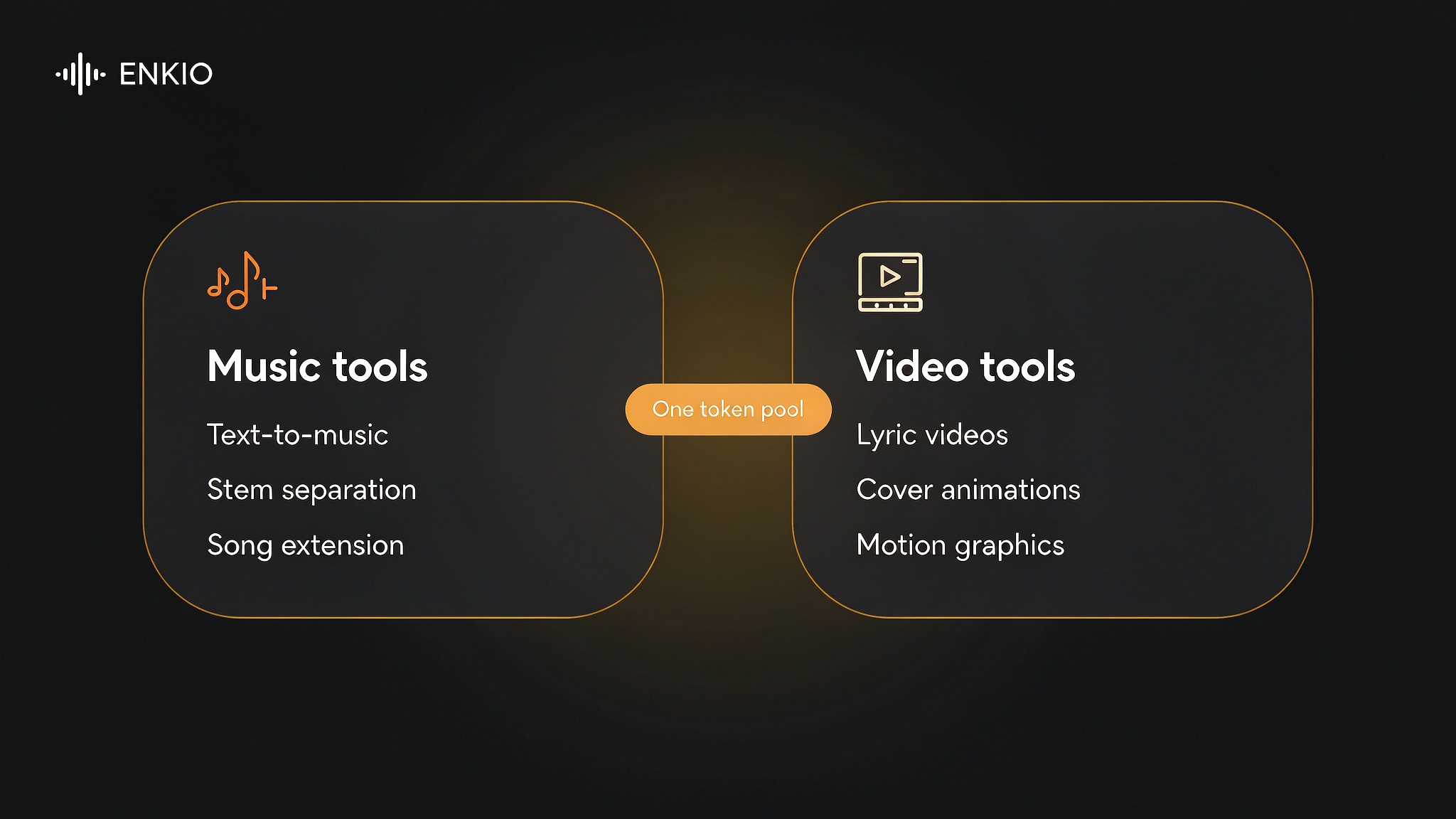
The post-generation step covers stem separation, song extension, inpainting, auto-complete, and arrangement editing. The official page lists stem separation that pulls vocals, drums, bass, and other parts from any song, and an Arrangement Studio where you build intro, verse, drop, and outro sections.
For a sense of how a lyrics-and-vocal tool differs, the Soundraw AI Music Generator Review covers an instrumental-only neighbour that skips the voice half entirely.
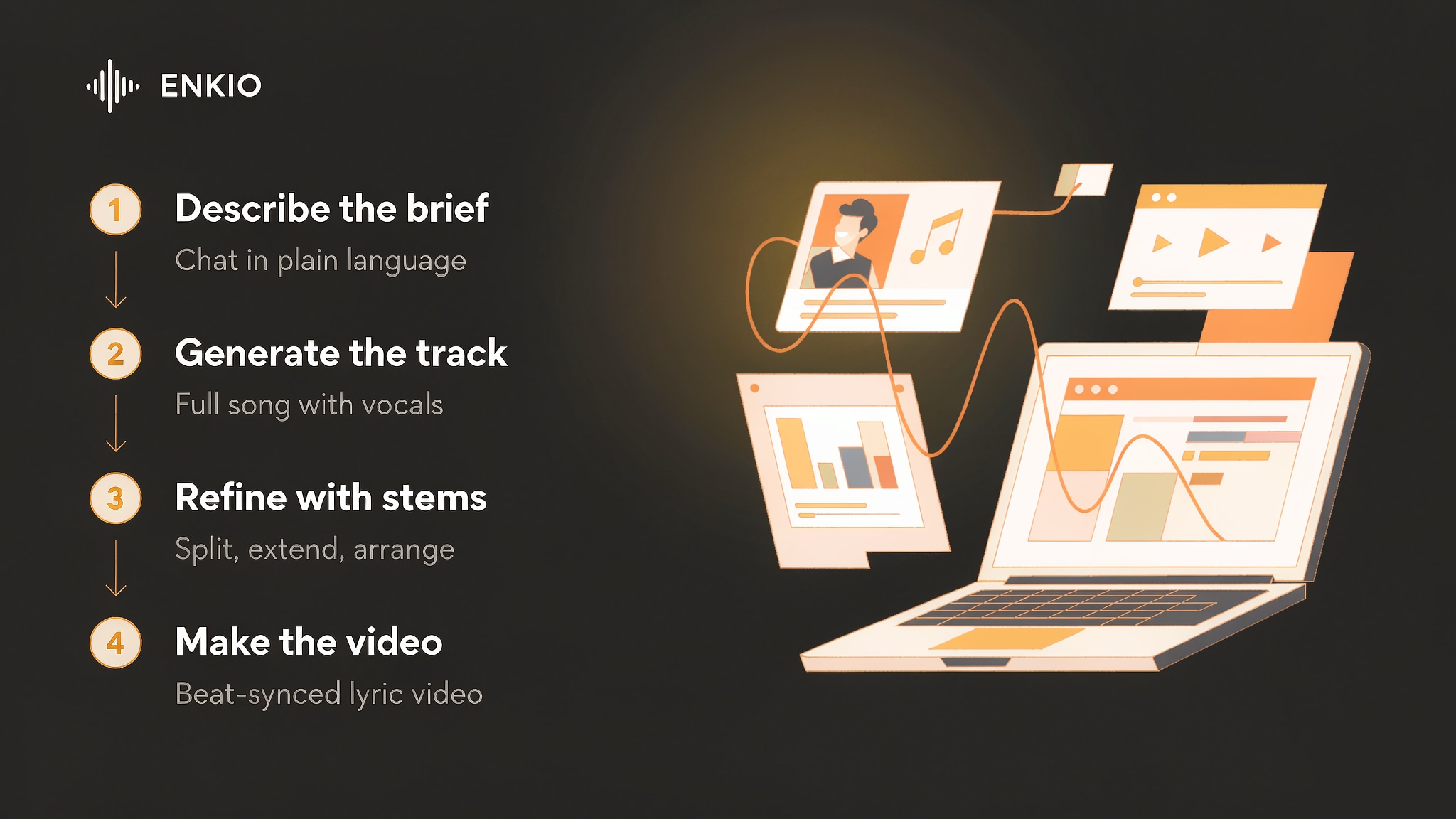
Move the track into the video step
The final step extends the song into a music video. The Soundverse AI music video generator, launched from the studio, builds beat-synced lyric videos, cover-art animations, and motion graphics from a finished track. The video tool outputs 9:16 vertical and 16:9 widescreen with lip-synced vocals, and it is tied to the Soundverse project rather than to an arbitrary audio file.
What the Soundverse AI Music Generator Gets Right
Four strengths held up against the official listings and independent write-ups we read.
The conversational agent lowers the production barrier
Soundverse assumes you want to talk a track into being instead of writing one perfect prompt. The follow-up questions and the stated context memory mean a vague first idea can converge over several turns, which is a gentler entry than tools that punish a thin brief. For a creator who thinks in mood and scene, that shape is the product's clearest advantage.
One connected studio spans music, voice, lyrics, and video
The official page lists a single workspace that covers text-to-music, an AI singing generator, a speech generator, stem tools, arrangement editing, and the video builder. Keeping those steps in one project means you can move from a sung draft to a lyric video without exporting to three separate apps. The Udio AI Music Generator Review shows what a narrower song-only tool looks like, which helps when you weigh how much the breadth actually matters to you.
The post-generation tool set is broad
Beyond the song, Soundverse lists stem separation, extension, inpainting, auto-complete, loop generation, and voice swap. That bundle is broader than most song-only generators, and it is the reason Soundverse reads as a studio rather than a generator. The breadth is real, though several of those actions draw from the same token pool.
The ethical framework and artist royalties are stated
Soundverse describes an Ethical AI Music Framework built on licensed training data, plus a Partner Program that tracks usage and pays royalties to contributing musicians. The Artist DNA marketplace lets musicians license their own sound or train a rights-cleared voice model. We report that as the vendor's stated position rather than as a verdict on the wider licensing debate.
Pricing and Credits
As of September 2026, the official English pricing page lists Free at $0, Creator at $12.49 per month, Pro at $31.24 per month, and Max at $72 per month, with annual billing shown about twenty percent lower. Third-party listings vary, so confirm the current figures on the official pricing page before you subscribe.
| Plan | Monthly price | Stated tokens | What the tier adds |
|---|---|---|---|
| Free | $0 | 1,000 trial tokens | 10 MP3 exports per month, text-to-music at 15s and 30s, free stem separation, studio with collaboration |
| Creator | $12.49 | 4,000 per month | Unlimited MP3, WAV, and STEM exports, all durations, royalty-free license, private prompts |
| Pro | $31.24 | 10,000 per month | Royalty-free plus sample license, priority renders, DSP distribution |
| Max | $72 | 25,000 per month | Ultra-priority renders, dedicated processing, advanced collaboration |
The detail that decides value is the per-unit math, not the headline. As of September 2026, Creator carries 4,000 tokens per month, and independent write-ups estimate that translates to roughly four or five full-length songs depending on duration and the tools used.
The vendor states that paid plans include a royalty-free license, and the free plan limits use to non-commercial exploration. Confirm the exact limits on the official pricing page, because token rates differ by tool and by length.
Compare what a plan includes.
Enkio plans include AI music and music video generation, with credit costs listed on the pricing page.
Real Limitations of Soundverse
The limits below are structural, and the first one is the reason most buying decisions turn on this platform rather than its sound.
The token economy is hard to forecast
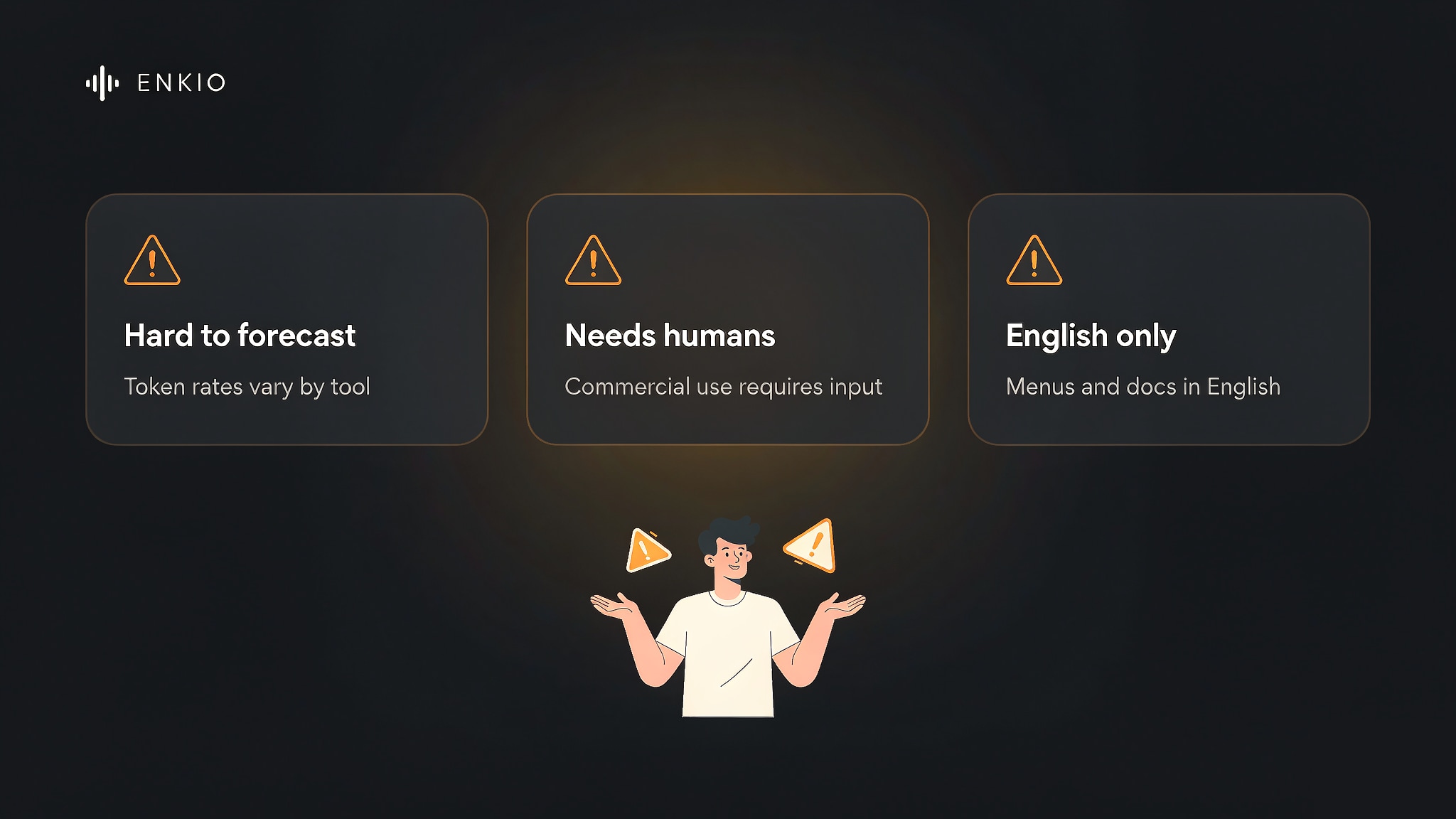
As of September 2026, different tools and durations consume tokens at different rates, and independent reviews describe the token economy as confusing to predict. A single long song, a stem export, and a video clip each draw from the same pool at unequal cost, so a token budget does not map cleanly to a number of finished pieces. The music and the video are billed on the same uncertain scale.
That gap matters most once you already hold a finished song and want the visual half on a predictable plan. If the piece you are missing is the video, Enkio's AI Music Video Generator takes a finished track plus a visual direction and returns 720p and 1080p output across five aspect ratios, on credit-based plans with the current credit costs on its pricing page.
Commercial use asks for human involvement
As of September 2026, the vendor's terms state that commercial use requires meaningful human involvement in the final track, so fully AI-only output is not cleared for monetization. We report that as the vendor's wording and have not verified the terms directly. For a creator whose plan is to ship a track unchanged, that condition is a real boundary rather than a footnote.
The interface is English-only
Independent reviews note that the Soundverse interface is English-only, which limits accessibility for non-English-speaking creators. The agent understands natural-language instructions, but the surrounding menus, docs, and support live in English. We flag this as a fit caveat for multilingual teams rather than as a defect claim.
Independent reviews report recurring stability issues
Separate review aggregators cite recurring platform stability issues that can interrupt sessions and waste tokens. We attribute those reports to those sources rather than to our own testing, and the point stands as a reliability dependency rather than a defect claim. A creator on a deadline should plan for the occasional retry.
The free tier is narrow
As of September 2026, the official pricing page lists the free plan at 1,000 trial tokens and 10 MP3 exports per month, with text-to-music capped at 15-second and 30-second clips. Free works do not unlock WAV or STEM exports, and the trial tokens do not roll into a production workflow. For anyone publishing, the free tier is a try-out rather than a path.
How It Compares With Suno and Enkio
Two reference points help here: Suno, the web-native song generator, and Enkio, which publishes this review. Read the last column as a statement of what ships today rather than as a verdict. The comparison below is a snapshot as of September 2026, and each vendor adjusts its plans, so verify specifics with the platform before you choose.
| Dimension | Soundverse | Suno | Enkio |
|---|---|---|---|
| Starting point | Conversation with Agent One plus magic tools | Prompt with optional lyrics | Upload a song and image, or pick an official track or generate music |
| Music side | Text-to-music, singing, speech, stems in one studio | Its own generation pipeline with vocals | Generates music with vocals and custom lyrics |
| Music video | Integrated AI music video generator for lyric and motion graphics from Soundverse Studio | Not a core feature | The same plan covers the video, in Solo MV Mode or Two-Person MV Mode |
| Output specs | MP3, WAV, STEMS; video at 9:16, 16:9, 1:1 | Levels set by its plan terms | 720p and 1080p across five aspect ratios (9:16, 16:9, 1:1, 3:4, 4:3) |
| Writing a prompt | Not required; the brief develops in chat | Usually required | Template library supplies the visual start; the audio and image still come from you |
| Billing unit | Monthly tokens; rates vary by tool and length | Pricing varies; check the vendor's site | $19.99 per month for 3,000 credits as of September 2026; failed generations are not deducted |
| Best fit | All-in-one studio with a conversational flow | Prompt-driven songwriting at a desk | One plan for the track and the video |
Soundverse suits the job where a song, a voice, and a lyric video grow inside one project, and Suno suits the desk-bound writing session. The How to Use Suno AI Music Generator guide shows that path, and the Best AI Music Generators list widens the field beyond these two.
The third case puts both halves of a release with one owner, so the song and the video stay inside a single plan. That column has limits too, since output tops out at 1080p and plan features differ by tier, so check the pricing page before treating any row as final.
Who the Soundverse AI Music Generator Is For Right Now
Our comparison splits by job, because that is where the token uncertainty and the commercial condition separate the fits from the misfits.
Soundverse suits creators who want to talk a song into being and then extend it into a lyric video, hobbyists who value a broad tool set in one place, and small studios that benefit from keeping music, voice, and video in a single project. The conversational loop and the bundled post tools make it a low-friction starting point for scene-led work.
It is a weaker fit for anyone who needs predictable per-unit cost across many finished pieces, because the token economy varies by tool and length. It is also a poor match for buyers who want fully AI-only output cleared for monetization without added human work, and for creators who need a non-English interface. If your priority is a predictable per-plan credit model for turning an existing song into a video, Enkio keeps the audio-to-video step in one plan with a stated monthly credit total.
From a Soundverse Track to Something You Can Publish
A generated track is usually the start of a piece of work rather than the end of one. A song written for a scene becomes a video, and a bed written for a channel becomes a release asset.
If you already hold a track and want the visual half, Enkio takes the finished audio plus a visual direction and returns a music video, with 720p and 1080p output across five aspect ratios including 9:16 and 16:9. Soundverse songs pair cleanly with a generated video, since the mood already matches the picture: shape the sound first, then give the finished audio a visual.
One reminder applies whichever route you take. Platform policies on AI-generated content differ, and several major platforms expect disclosure when music or video is machine-generated. Check the platform's current guidelines before publishing, particularly if monetisation is the goal.
Make more from your track.
Let Enkio create a complete AI music video from your song with optional prompts up to 2000 characters.
Frequently asked questions
These are the questions we see most often about the Soundverse AI music generator.
What is Soundverse AI?
Soundverse is an AI studio that turns text, lyrics, and reference audio into songs, voices, and music videos inside one workspace. The platform is built around a conversational agent called Agent One, which picks tools, remembers context, and chains steps together. The official page lists functions from text-to-music and stem separation to voice cloning and a lyric-video builder.
Is Soundverse free to use?
As of September 2026, there is a free plan at $0 with 1,000 trial tokens and 10 MP3 exports per month, and text-to-music capped at 15-second and 30-second clips. Free works do not unlock WAV or STEM exports, and the trial tokens do not roll into a production workflow. Check the official pricing page for the current free limits before relying on it.
How much does Soundverse cost?
As of September 2026, the official English page lists Creator at $12.49 per month, Pro at $31.24 per month, and Max at $72 per month, with annual billing shown about twenty percent lower. Third-party listings vary, so confirm the figures on the official pricing page. Creator carries 4,000 tokens per month, which independent write-ups estimate as roughly four or five full-length songs.
Does Soundverse generate music videos?
Yes. The Soundverse AI music video generator, launched from the studio, builds beat-synced lyric videos, cover-art animations, and motion graphics from a finished track. The official page states it outputs 9:16 vertical and 16:9 widescreen with lip-synced vocals. The video tool is tied to the Soundverse project rather than to an arbitrary audio file.
Can I use Soundverse music commercially?
The vendor states that paid plans include a royalty-free license, and the terms add that commercial use requires meaningful human involvement in the final track. We report that as the vendor's wording and have not verified the terms directly. Read the terms before any commercial step, because fully AI-only output is not cleared for monetization under the stated conditions.
What are the best Soundverse alternatives?
If your priority is a prompt-driven song tool, the Suno and Udio reviews cover the two best-known song generators, and our list of the best AI music generators widens the field. If your song is already finished and the missing piece is the visual, you do not have to adopt a full music platform. Enkio handles the audio-to-video step from the track you already have, without a separate token economy to learn.
How does Soundverse compare with Suno?
Soundverse and Suno both turn a brief into a sung track, but Soundverse starts from a conversation and adds voice, lyrics, and video in one studio, while Suno starts from a prompt and stays focused on the song. Soundverse's breadth is the trade-off against Suno's tighter songwriting loop. The right pick depends on whether you want one connected studio or a dedicated song engine.
Conclusion
Soundverse takes a distinctive position by turning music, voice, and video creation into one agent-led studio. The strengths are clear: a low-friction conversational loop, one workspace that spans song, voice, and video, a broad set of post tools, and a stated ethical framework with artist royalties. The trade-offs are equally clear: the token economy is hard to forecast, commercial use asks for human involvement in the final track, the interface is English-only, independent reviews report stability issues, and the free tier is narrow. If the track is finished and the visual is the next item on your list, Enkio takes that step from the audio you already have, without a separate token economy to learn.